

Qatar Relief Flights From Muscat Start March 5
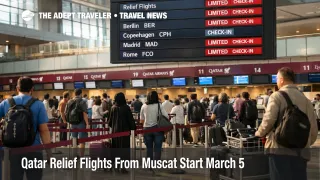
Qatar Airways says its scheduled operations remain suspended because Qatari airspace is still closed, but it is now running a limited set of relief flights starting March 5, 2026, to move stranded passengers out of the region. This matters because it turns a static "suspended" posture into a usable evacuation channel, but only through a tightly controlled list of flights and eligibility rules.
The airline's published relief network includes departures from Muscat, Oman, to London Heathrow Airport (LHR), Berlin Brandenburg Airport (BER), Copenhagen Airport (CPH), Adolfo Suárez Madrid Barajas Airport (MAD), Rome Fiumicino Leonardo da Vinci International Airport (FCO), and Amsterdam Airport Schiphol (AMS), plus a Riyadh, Saudi Arabia, to Frankfurt Airport (FRA) service.
Qatar Airways is also explicit about the gatekeeping: passengers are asked not to proceed to the airport unless they have received an official notification from Qatar Airways for these flights. In practice, that means Muscat is not an open "show up and buy a seat" solution for most travelers.
Who This Helps Most, and Who May Still Be Stuck
The best fit is travelers already holding disrupted Qatar Airways itineraries who can be matched to the relief flight list, and who can physically reach Muscat International Airport (MCT) in time while still meeting entry rules for Oman. If you are in a location where Qatar Airways or your government is already coordinating manifests, the relief flights are most useful when you stay reachable for notifications and do not self deploy to the terminal without confirmation.
Travelers on separate tickets, travelers who routed through Doha without Qatar Airways as the ticketing carrier, and travelers trying to "route shop" their way out may find the relief channel functionally closed unless Qatar specifically assigns them to one of the flights. This is the key tradeoff: getting to Oman can be the right move, but only when you can tie that repositioning to an actual confirmed seat, not just hope.
If you are trying to understand why Muscat keeps showing up as the practical exit hinge in this disruption, the earlier Adept coverage still holds as the baseline: Muscat Evacuation Flights Become Gulf Exit Hub.
What Travelers Should Do Now
First, treat Qatar's notification requirement as the decision gate. If you have not received an official message for a relief flight, do not build an entire overland transfer and hotel plan around a flight you are not yet assigned to. Instead, get your booking record accessible, keep your contact channels live, and monitor Qatar Airways' travel alerts for changes to the relief list.
Second, if you can reposition to Oman, build buffers like you are moving into a processing bottleneck. Muscat hotel inventory, road transfer times, and airport check in capacity can become the limiting factor, not the flying time to Europe. Plan for at least one overnight in Muscat if you are moving by ground or arriving late day, and avoid tight onward connections in Europe until you are back inside stable hub operations.
Third, keep one eye on the Doha reopening trigger, because it determines whether normal networks restart, and whether relief flights stay the only viable option. Qatar Airways has tied its broader restart to the Qatar Civil Aviation Authority reopening Qatari airspace, and it has signaled a next update timing in its alerts. Until that happens, assume DOH is not a reliable connection point. For background on the earlier suspension posture and why hub restarts lag airspace headlines, see: Qatar Airspace Closed, Qatar Airways Suspends Flights.
Why Muscat Becomes the Pinch Point, and What Breaks Next
This disruption is an airspace stop first, and a schedule problem second. When a hub like Doha loses usable airspace, the normal connection banks collapse instantly, aircraft and crews strand out of position, and reaccommodation demand spills into the nearest workable corridors. Relief flights are a pressure release valve, but they also concentrate demand into the few airports that can legally and operationally stage departures.
First order, the Muscat flights can uplift a subset of stranded passengers to major European hubs, which helps clear immediate backlogs. Second order, Muscat becomes the choke point: airport processing, hotel rooms, transport capacity, and border feasibility decide whether travelers can actually use the channel. Third order, European arrivals can see long rebooking queues, missed onward flights, and baggage mispositioning, because relief operations are designed to move people first, then reconcile the rest of the itinerary.
If you want the systems level explanation for why network disruptions cascade and why capacity constraints bite hardest at bottleneck nodes, this evergreen remains the cleanest reference point: U.S. Air Traffic Control Privatization: Reality Check.