

Muscat Relief Flights Become Qatar Airways Exit Route
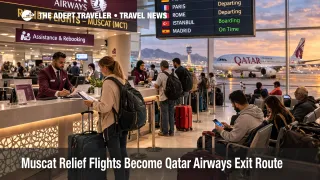
Qatar Airways says its regular schedule remains suspended because Qatari airspace is still closed, but March 5, 2026 is a real operational shift: the airline is now running a limited set of relief flights that depart from Muscat, Oman, rather than Doha, Qatar. That turns "wait for a restart" into a workable exit lane for some stranded passengers, but it also changes the traveler decision point, Muscat is where the process and capacity constraints now live, not Hamad International Airport (DOH).
The airline's published plan centers on Muscat departures to several European cities, plus a separate relief flight from Riyadh, Saudi Arabia, to Frankfurt. Qatar Airways is also explicit about gatekeeping, travelers should not go to the airport unless they have received an official notification from the airline for these specific flights. In practice, this is not an open, walk up option, it is a controlled uplift channel that depends on Qatar assigning you to a flight, and on your ability to reach Muscat legally and logistically.
For continuity with earlier coverage and related regional constraints, see Qatar Relief Flights From Muscat Start March 5 and Dubai Airport Limited Departures Resume March 5, 2026.
Who Can Actually Use The Muscat Exit Lane
This pathway is most likely to help travelers who were already ticketed on Qatar Airways, or who are being actively handled by Qatar Airways through disrupted bookings, manifests, and direct notifications. If you are in that cohort, the relief flights can function like a pressure release valve, you are not trying to rebuild a normal itinerary, you are trying to get to a stable node in Europe where rebooking becomes easier.
The fit drops sharply if you are trying to self deploy to Muscat without an assignment. The airline's "do not proceed to the airport without notification" language means the limiting factor is not only seat count, it is eligibility and communication. Travelers on separate tickets, travelers who intended to connect through Doha on a different carrier, and travelers hoping to buy their way out at the terminal may find the channel effectively closed unless Qatar explicitly matches them to one of the relief services.
There is also a second gate that travelers sometimes miss in crisis repositioning, Oman entry and transit feasibility. Even when the flight exists, the traveler still has to reach Muscat International Airport (MCT) with the right documents, enough time buffer, and enough cash flow for unplanned hotels and ground transport. That is why Muscat becomes the decision hinge, it is a workable departure point, but it concentrates every upstream constraint into one place.
What Travelers Should Do Now
Treat the Qatar notification requirement as the first hard threshold. If you have not received official confirmation for a relief flight, do not build an overland transfer and hotel plan around the hope that you will be accommodated at Muscat. Your first move is administrative and practical: make sure Qatar Airways has the right contact details tied to your booking, keep your phone reachable, and monitor Qatar's travel alerts for changes to the relief list and handling instructions.
If you have been assigned to a relief flight, plan Muscat like a bottleneck airport day, not like a normal connection. Build time for ground transfer variability, document checks, and queues at check in and customer service. Assume at least one overnight in Muscat unless you are already nearby and moving on a short, predictable transfer. Once you are uplifted to Europe, avoid tight onward connections until you are back inside stable, published schedules, because relief flights often arrive into a crowded rebooking environment where bags, seat changes, and misconnects are common.
Set a simple decision rule for whether to wait versus reposition. If your trip has a hard start within 24 to 48 hours, for example a cruise embarkation, a tour departure, a work obligation, or a medical appointment, the downside of waiting for Doha to reopen is usually larger than the cost of an imperfect reroute, especially if you can secure a confirmed seat via Muscat. If you have flexibility, and you are on a single protected ticket, waiting can still be rational, but only if you are seeing active communication from the airline about assignment to a specific flight, not open ended reassurances.
Why Oman Becomes The Pinch Point
When a hub loses usable airspace, the hub bank model collapses. Doha normally works because waves of arriving flights feed timed departure banks, and the system has enough slack to recover from routine delays. With airspace closed, that bank structure cannot operate, aircraft and crews strand out of position, and reaccommodation demand spills into nearby airports that still have legal routings and operational capacity. Relief flights are designed to move people out of the disruption zone, but they are not designed to restore the network's normal connection reliability.
First order, the Muscat flights can move a subset of stranded passengers to major European gateways, which helps clear backlogs for those who are assigned. Second order, Muscat's local constraints become the binding limit, airport processing capacity, hotel inventory, ground transport availability, and documentation friction decide who can actually execute the plan. Third order, the relief flights shift disruption into Europe in a different form, heavy rebooking queues, missed onward flights, and baggage mispositioning, because the uplift operation prioritizes getting people moving first, then reconciling the rest of the itinerary.
For a broader systems explanation of why bottlenecks, staffing, and capacity limits create outsized downstream effects in air travel, see U.S. Air Traffic Control Privatization: Reality Check.