

Middle East Airspace Closures Raise Asia Europe Fares
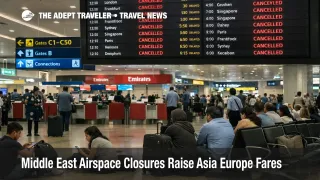
Airline ticket prices on Asia Europe routes are climbing because the U.S. Israel war on Iran has taken major Gulf hubs and key overflight corridors out of normal use, shrinking capacity and forcing detours. Reuters reported that bookings are tighter, some popular routings are sold out for days, and travelers are paying materially more to get seats via alternative hubs.
The most immediate capacity shock is at the Gulf connection machine. Dubai International Airport (DXB), a hub that normally handles more than 1,000 flights per day, remained closed or severely restricted for a fourth day as of Tuesday, March 3, 2026, according to Reuters. That matters because Gulf hubs are not just destinations, they are the bridge that makes one stop Australia Europe, South Asia Europe, and Southeast Asia Europe itineraries work at scale.
Which Travelers Are Most Exposed To Higher Prices and Broken Connections
The highest exposure is travelers whose itineraries depend on a Gulf hub connection bank, especially those routing Australia to Europe where Emirates and Qatar Airways typically carry large shares. When the hub cannot run, the seat inventory that normally flows through Dubai, Doha, and Abu Dhabi collapses, and the remaining options concentrate into a smaller set of routes through East Asia, Southeast Asia, or the United States.
Australians are a clear example of the demand shock. Reuters reported that Flight Centre Travel Group saw a 75% increase in calls as customers tried to rebook, often shifting to routings via China, Singapore, and the United States. In the same reporting, one stranded family paid 1,900 pounds per person for one way London to Sydney seats after their Dubai connection failed, and that fare jumped sharply from the prior night.
A second group at risk is anyone buying separate tickets. When your long haul and onward segment are on different tickets, a late arrival or a reissued routing can behave like a missed flight, not a protected connection. That is how a Middle East disruption turns into a much more expensive same day replacement fare, plus hotel nights, and potentially lost tour or cruise deposits.
A third group is travelers who are not touching the Gulf on purpose, but whose flights still need the airspace. Airlines operating nonstop Asia Europe flights can sometimes keep operating by routing around the closure area, but those detours still increase block time and cost.
What Travelers Should Do Now
Treat rebooking as a time sensitive inventory problem, not a customer service problem. If your itinerary depends on a Gulf hub in the next 72 hours, and you cannot tolerate an overnight or a forced reroute, move early onto an alternate hub routing while seats still exist. In practice, that means looking for Asia based hubs that can offer multiple onward options on the same day, rather than a single fragile connection that must work.
Use a simple decision threshold. Rebook now if your trip has a hard start, for example a cruise embarkation, a fixed tour departure, a wedding, or a work start, and your current routing relies on Dubai, Doha, or Abu Dhabi. Waiting can make sense if you are on one protected ticket, your carrier has published a waiver, and you can absorb a slip of at least one night without breaking the purpose of the trip.
Choose longer connection buffers than you would normally accept. Detours, flow restrictions, and corridor management can turn a routine 60 minute pad into a missed bank. The goal is not the shortest elapsed time, it is making the onward flight reliably.
Finally, monitor operational signals, not social posts. A useful traveler signal is whether published airspace expiry windows keep extending, and whether major safety bulletins are being renewed. Flightradar24 has been publishing rolling airspace status and NOTAM expiry times, and EASA extended its conflict zone bulletin for the Middle East and Persian Gulf through March 6, 2026. If your departure sits close to an expiry time, assume extension risk is high, and decide earlier than you think you need to.
For contingency routings that may require an unexpected landside entry, keep an entry rules reference handy, including for overland options. Jordan Entry Requirements For Tourists In 2026 is a practical baseline if your fallback involves Jordan.
Why Detours Raise Prices and Reduce Connectivity
The mechanism is straightforward. When Gulf hubs and central corridors are unavailable, airlines lose their most efficient bridge between Europe and Asia, and travelers lose the densest source of connection inventory. That forces demand onto fewer remaining corridors and hubs, which tightens seats and pushes fares higher.
Even for airlines that can keep operating, the workaround has a cost. Reuters reported that carriers are bypassing closed Middle Eastern airspace by routing north via the Caucasus and Afghanistan, or south via Egypt, Saudi Arabia, and Oman. Those longer routings add flight time and fuel burn, and they compress schedule slack across the network. When slack disappears, misconnect risk rises, baggage misroutes rise, crews time out, and later day cancellations show up far from the conflict zone.
This is why the tradeoff can feel unfair to travelers. Some nonstop flights still operate, but at higher operating cost and with less timetable resilience. Meanwhile, the travelers who used Gulf hubs for price and convenience face a double hit, fewer seats and higher replacement fares when things break. As Subhas Menon of the Association of Asia Pacific Airlines put it in Reuters reporting, the real cost is not only higher fares, it is reduced connectivity.
For the latest operational framing on how these reroutes are stretching long haul schedules, see Middle East Reroutes Stretch Europe Asia Flights and Middle East Airspace Reopens, Closures Stay Fluid.
Sources
- Airline ticket prices soar on Asia-Europe routes after Gulf airport closures (Reuters)
- Airline, travel industries scramble with fallout from Middle East conflict (Reuters)
- Airspace closures following Israeli and US strikes on Iran (Flightradar24)
- EASA extends duration of CZIB for Middle East and Persian Gulf (EASA)