

Air Canada Extends Dubai, Tel Aviv Suspensions
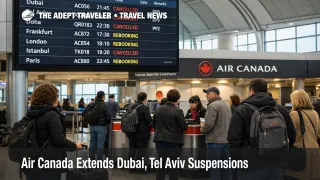
Air Canada Dubai Tel Aviv suspensions just turned from a short shock into a dated planning problem for Canadian travelers. Air Canada says flights to and from Dubai are canceled through March 28, 2026, inclusive, and Tel Aviv flights are canceled through May 2, 2026, inclusive, while telling affected passengers already in either region not to go to the airport. That matters because a published end date changes the decision window, even if it does not restore certainty. Travelers with March Dubai trips now need a replacement routing or a trip reset, while Tel Aviv travelers face a much longer spring disruption window.
The practical divide is simple. Dubai is a late March problem with some chance of improvement after the current window. Tel Aviv is now a deeper spring planning problem, which means more tours, family visits, cruise tie ins, and timed land segments are exposed to repeated rebooking pressure. For the wider network picture behind this shift, travelers should also read Middle East Airspace Closures Ground Gulf Hubs and Lufthansa Middle East Suspensions Stretch to April.
Air Canada Dubai Tel Aviv Suspensions, What Changed
What changed versus Air Canada's earlier advisory is the length and separation of the restart windows. On March 2, the carrier had said Dubai and Tel Aviv service were suspended and restarting on March 23, 2026. Its March 6 update replaced that single date with two different horizons, March 28, 2026, for Dubai and May 2, 2026, for Tel Aviv. That is the real traveler update here, because it turns one broad disruption into two different booking problems with different urgency levels.
Dubai and Tel Aviv should not be treated as the same case. Dubai service is tied to a Gulf aviation system that remains operationally fragile even where some flights have resumed, with Reuters reporting fresh drone incidents near Dubai International Airport (DXB) on March 11. Tel Aviv is different, because Air Canada has already pushed its suspension window much farther into spring than Dubai, which makes it harder to justify waiting for a quick normalization if your trip depends on fixed dates.
Which Canadian Itineraries Are Most Exposed
The highest exposure sits with travelers who were counting on Air Canada's nonstop Canada links rather than just a generic one stop itinerary. Air Canada continues to market Dubai service tied to Toronto Pearson International Airport (YYZ), and its Tel Aviv network pages show Canada demand centered on Toronto and Montréal Trudeau International Airport (YUL). In practice, that means the most exposed Canadian departure patterns are nonstop or one ticket itineraries built around Toronto for Dubai, and Toronto or Montréal for Tel Aviv, plus domestic feeders from Western Canada and Atlantic Canada that were meant to connect onto those long haul services.
The next group at risk is anyone trying to save the trip with separate tickets. A Europe or U.S. gateway can look workable on a search screen, but separate ticket protection is weak if the first leg slips, the second carrier changes its schedule, or baggage does not transfer cleanly. That is where a canceled Middle East flight turns into a hotel bill, a replacement fare bought at the worst possible moment, and maybe a lost cruise embarkation, tour start, or private transfer. The longer the disruption runs, the more those second order costs matter. Adept has already documented that risk in Middle East Airspace Closures Raise Asia Europe Fares.
What Travelers Should Do Now
For Dubai departures through March 28, 2026, the realistic choices are to take Air Canada's options if you are on eligible Air Canada ticket stock, or to rebuild the trip only if the rest of your itinerary still justifies the added cost and time. Air Canada's schedule change policy says customers on 014 ticket stock for canceled Dubai travel between March 1 and March 28 may move to an alternative airport in Europe or India on Air Canada operated flights without a change fee or additional collection. That is useful because it gives some travelers a controlled reroute path without forcing an immediate refund decision.
For Tel Aviv, the threshold is stricter. Because Air Canada's suspension now runs through May 2, 2026, travelers with March or April departures should stop treating this as a short hold unless they are waiting on a specific airline-led reaccommodation. Air Canada's policy for Tel Aviv allows eligible customers on 014 ticket stock for canceled travel between March 1 and April 30 to switch to an alternative airport in Europe on Air Canada operated flights without a change fee or additional collection. That can help if Israel is only part of a wider Europe trip, but it is a poor substitute if the actual goal is to be in Israel on fixed dates.
A bad money chase usually looks like this, buying separate replacement tickets through a crowded Europe hub, hoping to stitch the trip back together day by day, while still holding nonrefundable hotels, tours, or onward segments on the original timeline. A realistic self repair usually means one protected ticket, one overnight buffer if a hub connection is unavoidable, and a clear answer on whether the destination still works if you arrive a day late. If you cannot meet those conditions, the safer move is often to reset the trip, or narrow it to the part that is still operational.
Why the Disruption Still Spreads Beyond Air Canada
This is not just an Air Canada story. It is a network reliability story shaped by a wider Middle East operating environment that remains unstable. Reuters reported on March 11 that drone incidents near Dubai airport came on top of a broader aviation crisis that has already cut traffic, strained routing options, and pushed fares higher. Even when one carrier publishes a date, travelers are still competing for a smaller pool of workable seats through Europe and North America.
That is why Canada based travelers feel the disruption in layers. First order, the nonstop disappears. Second order, the replacement itinerary gets longer and more expensive. Third order, the rest of the trip becomes less protected if it depends on cruise departures, tours, timed land transfers, or separate tickets. Air Canada's dated suspension windows are helpful because they make the decision point clearer. They are harsh because they also tell travelers that waiting for a near term return is no longer the smart default, especially for Tel Aviv.