

Lufthansa Middle East Suspensions Stretch to April
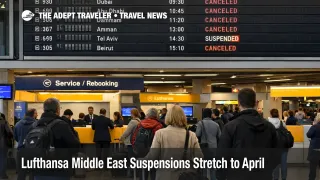
Lufthansa Group has turned a broad Middle East disruption into a dated recovery ladder, and that is the real update for travelers on March 6, 2026. Its current travel information page now shows suspensions through March 10 for Dubai, Abu Dhabi, and Dammam, through March 15 for Amman and Erbil, through March 22 for Tel Aviv, through March 28 for Beirut, and through April 30 for Tehran, while Larnaca is set to resume from March 7. That matters because travelers can finally stop treating the whole region as one undifferentiated shutdown and start making route specific decisions about what is still worth protecting. On a protected ticket, some itineraries are still worth holding for a few days. Others are now long enough disruptions that waiting mainly burns time, hotel money, and onward inventory.
The practical takeaway is simple. A dated suspension map is not a promise that service snaps back cleanly on those exact days, but it is a better decision tool than a generic warning banner. Lufthansa travelers should now sort their bookings into short hold, medium hold, and abandon for now buckets, then decide based on ticket protection, trip purpose, and how much onward exposure sits behind the canceled sector.
Lufthansa Middle East Suspensions: What Changed
What changed versus earlier coverage is precision. Lufthansa Group is no longer signaling a broad, open ended Middle East disruption, it is publishing a route by route ladder with different restart horizons. The shortest holds are Dubai, Abu Dhabi, and Dammam, all suspended through March 10. Amman and Erbil run through March 15. Tel Aviv stretches to March 22, Beirut to March 28, and Tehran to April 30. Larnaca is the outlier on the positive side, with service set to resume on March 7.
That is useful because these dates imply very different traveler decisions. A Dubai or Abu Dhabi passenger due to travel in the second half of March is dealing with a short horizon disruption and may still have a reason to preserve the booking if the rest of the itinerary remains intact. A Tehran passenger, by contrast, is no longer facing a temporary pause in any practical sense. That market is off the board for the rest of March and all of April under Lufthansa's current notice, so waiting for normal recovery is not a rational plan for near term travel.
Which Lufthansa Trips Are Still Worth Preserving
The best preserve candidates are travelers on a single protected Lufthansa Group ticket whose affected segment falls in the short hold bucket, Dubai, Abu Dhabi, Dammam, or possibly Larnaca if the resumed schedule actually operates as planned from March 7. If your long haul return, corporate travel policy, or complex onward ticketing would become more expensive to rebuild from scratch, holding for a few more days can still make sense, especially where the suspension window ends on March 10 and your trip starts after that point.
The weakest preserve candidates are Amman and Erbil trips scheduled in the next week, and most Tel Aviv, Beirut, and Tehran trips through the rest of March. Those markets now sit far enough out that the opportunity cost of waiting rises fast. Separate tickets, cruise embarkations, tours with hard start dates, weddings, conferences, and last flight of the day connections are the kinds of itineraries that break first when one suspended segment lingers too long. In those cases, the smarter move is usually to rebuild around another gateway or postpone the trip rather than keep defending the original plan.
There is also a middle category, travelers heading to Jordan, northern Iraq, Israel, or Lebanon later in March who are not traveling immediately but still need the trip. These passengers should not assume the posted restart date equals stable operations on day one. The date is a planning marker, not proof that banks, crews, aircraft positioning, and onward connectivity have normalized.
What Travelers Should Do Now
Start with ticket structure, not destination emotion. If you are on one Lufthansa Group ticket and your affected market is Dubai, Abu Dhabi, Dammam, or Larnaca, check whether the rebooked option keeps the same ticket protection and whether the new itinerary still lands before your real deadline. If yes, preserving the booking can be reasonable. If your destination is Tel Aviv, Beirut, or Tehran, or if your trip depends on a tight March 6 to March 20 window, treat rebooking or canceling now as the default rather than the exception.
Lufthansa also says affected passengers whose flights have already been canceled can request a full refund or a rebooking on a later Lufthansa Group operated flight. For tickets to Tel Aviv, Amman, Beirut, Erbil, Dammam, and Dubai issued on or before March 1, 2026, with original travel dates up to March 15, 2026, the carrier says travelers may rebook without charge onto Lufthansa Group operated flights from March 16 through March 31, 2026, or refund the ticket. That flexibility matters because it gives some travelers a clean off ramp instead of forcing them to sit inside an unstable schedule.
Over the next 24 to 72 hours, monitor two things. First, watch whether Larnaca's March 7 restart actually holds, because that is the nearest proof point for whether Lufthansa's recovery ladder is beginning to move. Second, watch broader corridor risk, not only airport status. EASA's active conflict zone bulletin for the Middle East and Persian Gulf was revised on March 6 and is valid until March 11, covering a wide affected airspace set and warning of high risk to civil aviation from spillover, interception, and misidentification hazards. That is why a route can be scheduled to return on paper while the wider network still behaves cautiously.
If you need parallel context while rebuilding a wider regional itinerary, Middle East Reroutes Stretch Europe Asia Flights explains why even operating flights are arriving late into connection banks, and Muscat Relief Flights Become Qatar Airways Exit Route shows how alternate exit nodes can help some stranded travelers while creating new bottlenecks of their own. If your fallback plan could push you through Jordan, Jordan Entry Requirements For Tourists In 2026 is the cleanest verified guide to check before accepting a reroute that may require landside entry.
Why The Recovery Dates Still Do Not Mean Normal Travel
The mechanism here is network recovery, not just destination reopening. Airlines do not restore a disrupted region in one move. They bring back specific stations as safety, aircraft positioning, crew legality, and usable airspace improve, and that produces an uneven map where one route restarts while another stays closed for weeks. Lufthansa's published ladder is a visible example of that process. Larnaca returns first, Gulf stations come next, then the more exposed conflict adjacent markets, while Tehran remains the longest shut.
That uneven ladder will reshape traveler behavior across the region. First order, passengers now shift away from waiting on the most delayed markets and start hunting substitute routings through places that still function. Second order, that drives fare pressure, hotel demand, and transfer churn through alternate nodes, while also consuming inventory for travelers whose original booking was not even on Lufthansa. The wider Middle East conflict zone bulletin helps explain why this happens, the airspace problem is regional, not isolated to one airport or one carrier.
The important traveler mindset is to stop asking whether Lufthansa has a date and start asking whether your itinerary still has resilience. A short suspension with one protected ticket and flexible timing is manageable. A long suspension tied to separate tickets, fixed events, or scarce onward seats is usually not. That is the real value of this longer disruption map, it lets travelers abandon weak plans sooner, and protect the few that still have a realistic path to completion.