

Shutdown Shields a Few U.S. Airports From TSA Delays
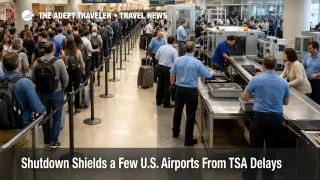
A partial Department of Homeland Security shutdown is not hitting every U.S. airport the same way. A small group of airports, including San Francisco International Airport (SFO), is better insulated from the worst checkpoint slowdowns because they use private screening contractors under Transportation Security Administration oversight instead of relying entirely on federal TSA officers. For travelers, that does not mean those airports are disruption proof. It means a few places have one less staffing pressure point while much of the rest of the system enters a spring break surge that is already producing multi hour security lines.
The practical takeaway is simple. Travelers should not assume every airport faces the same shutdown risk, and they should not assume a contract screening airport will automatically save a fragile itinerary. The bigger system is still under strain, and that matters because airlines expect a record 171 million passengers to fly from March 1, 2026 through April 30, 2026.
A small airport group is avoiding the worst shutdown TSA pressure
The immediate change is not a new federal rule. It is a structural difference that becomes more visible during funding lapses. The TSA's Screening Partnership Program lets commercial airports opt to use federally approved private contractors to staff checkpoints while TSA keeps control over standards, procedures, and oversight. The Associated Press reported this week that San Francisco International, Kansas City International Airport (MCI), Atlantic City International Airport (ACY), and Orlando Sanford International Airport (SFB) are among the participating airports now drawing attention because contractor pay continues through the shutdown under existing federal contracts.
That matters because most of the country's roughly 400 commercial airports still depend on federal TSA officers who are required to work during a shutdown even when pay is interrupted. As that pressure stretches on, absenteeism and attrition can rise, which reduces the number of open lanes and slows checkpoint throughput. The program helps a few airports avoid that exact failure mode, but it does not change the fact that the broader national network still runs on federal staffing.
Why shutdown TSA airport delays are spreading unevenly
The mechanism is straightforward. Airport security lines do not fail only when there are too few people in the building. They fail when staffing gaps, lane closures, and peak departure banks collide. That is why the shutdown is showing up as uneven checkpoint pain instead of a single nationwide collapse.
Reuters reported on March 8 that security waits reached as much as 3.5 hours at William P. Hobby Airport (HOU) in Houston, while Louis Armstrong New Orleans International Airport (MSY) warned passengers to arrive at least three hours early because of staffing shortages. Reuters also said TSA reported longer than average lines at George Bush Intercontinental Airport (IAH), Charlotte Douglas International Airport (CLT), and Hartsfield Jackson Atlanta International Airport (ATL). In plain language, the first order effect is slower screening at specific airports and specific times of day. The second order effect is more damaging for travelers, because a long checkpoint line can break domestic connections, cruise embarkation timing, airport hotel plans, and same day ground transfers even when the flight itself is still operating.
That is also why a few contract screening airports do not fix the broader travel problem. A traveler might clear security faster at one airport, then run into downstream disruption at a hub connection or on the return trip through a federally staffed checkpoint. Adept Traveler has already tracked that wider deterioration in U.S. Shutdown Hits TSA Lines at Spring Break Airports and the next staffing stress point in U.S. Shutdown Pushes TSA to a March 13 Pay Cliff.
Why more private screening is not a clean national fix
It is tempting to read this week's contrast as a case for broad privatization, but the evidence does not support that as a simple answer. TSA says the contract model can relieve staffing shortages during a shutdown, yet labor leaders and some security experts argue that a wider shift could weaken accountability if screening responsibility becomes more fragmented across private operators.
The more important point for travelers is operational, not ideological. The Screening Partnership Program is a narrow exception inside a much larger federally run system. Even if more airports wanted to join, that would not happen fast enough to solve a live spring break disruption. Airport security is also only one choke point in the shutdown chain. Customs staffing, customer service pressure, flight bank compression, and missed onward segments still affect travelers even where screening is moving better than expected. The March 11 restart of Global Entry helped on the international arrivals side, but it did not remove the checkpoint risk facing domestic departures, as explained in U.S. Global Entry Restarts as Shutdown Drags On.
What travelers should do before flying during the shutdown
For now, the safest move is to treat airport choice as one risk variable, not the whole solution. If you are booking or rebooking a trip during the shutdown window, it is reasonable to view airports in the Screening Partnership Program as somewhat more resilient on the departure side. That edge matters most for same day business travel, tight morning departure banks, and trips with no tolerance for a missed first segment. It matters less if your itinerary still depends on a congested hub later in the day.
Travelers flying in the next several weeks should build more buffer than usual, especially at large hubs that have already reported longer than average lines. The shutdown started on February 14, 2026, and the pressure point is intensifying into the heaviest March and April demand. Earlier arrival time is still the blunt but correct tool here. That is particularly true for families, cruise passengers, travelers checking bags, and anyone whose fare does not give them much reaccommodation flexibility.
The next decision threshold is whether the disruption remains isolated or broadens after the next missed pay cycle. Watch your departure airport, your connection hub, and your airline app together, not in isolation. If your trip depends on a fragile connection, a fixed event, or a cruise embarkation, paying more for a better timed flight or an earlier departure day may now be the cheaper decision in practical terms.
Sources
- What the latest government shutdown shows about privatizing TSA
- Screening Partnership Program - Airports - TSA.gov
- Security lines hit three hours at some US airports as TSA absences rise
- U.S. Airlines Prepare for Record Number of Passengers this Spring Amid Government Shutdown
- Homeland Security restarts Global Entry program after travelers faced long airport lines