

U.S. Shutdown Hits TSA Lines at Spring Break Airports
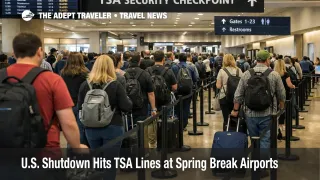
The U.S. shutdown airport story has shifted from warning to active checkpoint failure at some airports. Reuters reported on March 8 that security waits reached as much as 3.5 hours at William P. Hobby Airport in Houston, while TSA also said longer than average lines were reported at George Bush Intercontinental Airport, Charlotte Douglas International Airport, and Hartsfield Jackson Atlanta International Airport. That matters more now because the slowdown is hitting during a record spring travel push, with Airlines for America projecting 171 million passengers from March 1 through April 30, 2026. Travelers with domestic departures, short connections, or same day cruise and event plans should stop using normal airport arrival buffers and treat screening itself as a delay risk.
This is the material change since Adept Traveler's March 6 shutdown coverage. The earlier problem was staffing risk and line volatility. The March 8 and March 9 problem is that some of that strain is now visible at checkpoints, with Houston and New Orleans issuing concrete early arrival guidance after long lines formed.
Shutdown TSA Lines: What Changed at Airports
The worst confirmed pressure point so far is William P. Hobby Airport (HOU). Reuters said Hobby reported waits averaging 3.5 hours at one point on March 8, and Houston Airports says passengers at HOU should plan to arrive four hours before departure, with waits extending beyond two hours and TSA PreCheck lanes not always open because of limited staffing.
Houston's larger George Bush Intercontinental Airport (IAH) is under strain too, but in a different way. Reuters and TSA flagged it as a longer than average line location, while Houston Airports says travelers should allow extra time and that Terminal D screening is closed on March 8 and 9, pushing some passengers to Terminal E after bag drop. That does not mean IAH is failing as badly as Hobby, but it does mean the airport has less slack than usual, especially for international passengers and anyone unfamiliar with terminal changes.
New Orleans is also a real traveler problem now, even though it was not in the original Reuters airport list. AP reported that Louis Armstrong New Orleans International Airport (MSY) told passengers to arrive at least three hours early, warned waits could last up to two hours, and said similar delays could continue through the week because of a shortage of TSA agents.
Charlotte Douglas International Airport (CLT) and Hartsfield Jackson Atlanta International Airport (ATL) are important because they are major connection machines, not just local origin airports. Reuters reported longer than average lines there as well. Even when the raw wait is shorter than Hobby's peak, those hubs can punish travelers faster because a missed first flight often breaks the rest of the itinerary, and spring break loads leave fewer same day recovery seats.
Which Travelers Face the Most Missed Flight Risk
The most exposed travelers are not only the ones flying from the worst airports. They are the people whose trip depends on timing precision. That includes domestic passengers who usually show up 90 minutes before departure, families moving through busy terminals with checked bags, travelers relying on TSA PreCheck to save time, and anyone starting a connection chain through Atlanta, Charlotte, or another hub where one miss can kill the whole day.
Houston origin passengers face the clearest immediate risk because the airport system itself is now telling Hobby travelers to add four hours and warning that operations can change from shift to shift. New Orleans origin passengers should also assume the next few days stay unstable unless airport messaging improves, because MSY has already warned that delays could persist through the week.
Connection passengers face a different problem. They may clear security fine at their first airport, then get trapped later when a delayed inbound, weather, or crew issue intersects with already packed spring schedules. Reuters reported that airlines are already seeing passengers miss flights because of the security lines. In practice, that means a checkpoint delay can become a hotel bill, a rebooking fight, or a lost vacation day much faster than travelers expect.
What Travelers Should Do Now
For departures from Houston Hobby, the correct move is simple, use the airport's four hour recommendation unless conditions clearly improve before you leave for the airport. For New Orleans, use at least three hours. For IAH, Atlanta, Charlotte, and other busy spring break hubs, add more screening buffer than normal even if your airport has not yet issued a dramatic warning, because Reuters reported longer than average lines at multiple airports and TSA said absenteeism is running above normal.
Rebook rather than wait if your plan includes a short domestic connection, a nonrefundable event, a cruise embarkation, or the last practical flight of the day. Waiting may still work for a flexible nonstop, but it is the wrong bet when a checkpoint miss would force an overnight stay and there are few backup seats left. The tradeoff is straightforward, leaving too early costs time, but leaving too late can now collapse the itinerary before you even reach the gate.
Over the next 24 to 72 hours, watch airport specific advisories more than national political theater. Houston and New Orleans have already shown that local checkpoint conditions can diverge sharply from airport to airport. Also watch for any expansion of airport issued arrival guidance, more checkpoint closures, or signs that TSA PreCheck availability is becoming inconsistent. Until the shutdown ends or staffing stabilizes, shutdown TSA lines should be treated as an operational risk in their own right, not just a background policy story.
Why the Disruption Spreads Faster During Spring Break
The mechanism is not complicated, but the consequences stack quickly. TSA officers are continuing to work without pay during the partial Department of Homeland Security shutdown, and Reuters reported higher than normal absences as the travel surge builds. When even a few screening lanes run short staffed, throughput falls, lines lengthen, and airports lose their ability to absorb the normal spikes that come with morning departures, family travel, checked bags, and uneven passenger arrival patterns.
Spring break makes that weakness more dangerous because the system is already running near a busy period baseline. Airlines for America projects 171 million passengers between March 1 and April 30, 2026, about 2.8 million per day, with roughly 26,000 daily passenger flights. In that environment, a checkpoint delay is not isolated. It spills into later departures, missed first legs, overcrowded service desks, and thinner same day recovery options once flights start filling up.
There is also a second order effect that matters for travelers who think they can just improvise later. Houston Airports said shutdown impacts can vary day to day and shift to shift, which means line performance is less predictable than a normal peak week. That unpredictability is why ordinary habits, like trusting PreCheck, using a standard 90 minute buffer, or assuming a later same day rebooking will be easy, are weaker strategies right now. The main lesson from the first wave of shutdown TSA lines is that airport security has become the first failure point, but not the last.
Sources
- Security lines hit three hours at some US airports as TSA absences rise, Reuters
- Travelers endure long wait times at Houston, New Orleans airports, AP News
- Government shutdown impacting TSA, Houston Airports
- U.S. Airlines Prepare for Record Number of Passengers This Spring Amid Government Shutdown, Airlines for America
- U.S. Shutdown Risk Raises Spring Break Airport Strain, Adept Traveler
- Global Entry Pause, TSA Pay Fight Hit U.S. Travel, Adept Traveler