

U.S. Shutdown Pushes TSA to a March 13 Pay Cliff
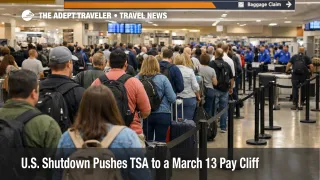
The U.S. shutdown airport story has moved again, and the new risk is sharper than the long lines already seen over the weekend. Reuters reported on March 9 that spring break demand is about to intensify just as TSA officers are set to miss their first full paycheck on Friday, March 13, after the Department of Homeland Security funding lapse that began on February 13. For travelers, that shifts the main concern from isolated checkpoint backups into staffing durability at the exact moment March volumes are rising.
That matters because the first visible strain is already real. Reuters reported average standard checkpoint waits of three hours at William P. Hobby Airport (HOU) on March 9, after Hobby had reported waits as high as 3.5 hours on March 8. Louis Armstrong New Orleans International Airport (MSY) told passengers to arrive at least three hours early, while Reuters also cited longer than average lines at George Bush Intercontinental Airport (IAH), Charlotte Douglas International Airport (CLT), and Hartsfield Jackson Atlanta International Airport (ATL). Travelers with domestic departures, tight connections, cruise embarkations, or event tickets should stop treating screening as a routine step and start treating it as a possible trip breaker.
The change since prior Adept Traveler coverage is straightforward. Yesterday's problem was that some airports were already publishing aggressive arrival guidance after passengers missed flights. Today's problem is that the shutdown is nearing a labor cliff, because missing a full paycheck can push more officers to call out, seek second jobs, or leave entirely, which is exactly the failure mode travel groups and Reuters have been warning about since March 5. Readers who need the earlier checkpoint picture can see U.S. Shutdown Hits TSA Lines at Spring Break Airports, and the earlier pay fight angle in Global Entry Pause, TSA Pay Fight Hit U.S. Travel.
TSA Paycheck Cliff: What Changed
What changed is not just that lines are long. Reuters reported that Airlines for America now sees Friday, March 13, as the point when spring break demand collides with the first full missed paycheck for TSA workers. That is a different operational risk than a bad morning at one airport, because a missed full paycheck can worsen absenteeism across multiple shifts and airports at once.
The system is already giving off warning signals. Reuters said about 50,000 TSA airport security screeners are working without pay. Reuters also reported that around 1,110 transportation security officers left TSA in October and November 2025 after the prior 43 day shutdown, which was more than 25 percent above the same period in 2024. That history does not prove the same departure spike will happen again this week, but it does show why the March 13 paycheck cliff matters more than a normal political deadline.
Which Spring Break Trips Are Most Exposed
The most exposed travelers are not simply the ones departing from the worst airport today. They are the people whose itinerary fails if one link slips. That includes families checking bags, travelers booked on the last practical flight of the day, passengers trying to make cruise embarkations or fixed events, and anyone connecting through ATL or CLT, where a missed first leg can wipe out the rest of the trip in a high load factor environment.
Houston remains the clearest live pressure point, but even there the picture is mixed. Houston Airports said on March 10 that National Deployment Officers had arrived at Hobby and were having a positive impact, yet it also warned that longer than normal TSA waits may continue until the shutdown ends. Houston Airports now recommends arriving three hours early for domestic flights and four hours early for international flights, and says IAH Terminal D screening remains closed because of federal staffing challenges, pushing affected passengers to Terminal E after bag drop.
That matters outside Houston because spring break volumes are not light. Airlines for America forecasts 171 million passengers from March 1 through April 30, with about 2.8 million travelers a day, roughly 26,000 daily passenger flights, and 3.5 million daily seats. In a system already running that full, even modest checkpoint degradation can spill into later departures, missed connections, crowded airline service desks, and thinner same day rebooking options.
What Travelers Should Do Before March 13
Travelers departing before the end of this week should change their timing assumptions now, not after airport conditions worsen. For Houston, follow the current airport guidance, three hours for domestic flights and four hours for international flights. For New Orleans, use at least three hours until the airport says conditions are stable again. At other large hubs, especially ATL, CLT, and IAH, add more screening buffer than normal even if your airport has not yet posted dramatic warnings, because Reuters has already documented strain across multiple hubs.
The better rebooking threshold is also getting clearer. Rebook earlier if your trip depends on a short domestic connection, a same day cruise boarding, a major event, or the last flight that can still save the day. Waiting can still make sense for a flexible nonstop or a trip with overnight slack, but it is the wrong gamble when one checkpoint miss would force a hotel stay or a lost vacation day. The tradeoff is simple, showing up too early costs time, but showing up too late in this environment can collapse the itinerary before you reach the gate.
Over the next 24 to 72 hours, watch airport specific guidance more than Washington rhetoric. Houston has already shown that conditions can change shift by shift, and MSY has warned delays could continue through the week. Check your airport alert page before leaving, monitor whether checkpoint closures spread, and assume weekend spring break banks will be less forgiving than weekday shoulder periods.
Why the Shutdown Threatens More Than Lines
The mechanism is straightforward. When TSA staffing drops, even by a modest amount, fewer screening lanes stay open, throughput falls, and wait times become more variable. Houston Airports explicitly says available screening lanes can vary by airport and by shift depending on how many officers report to work. That variability matters because travelers plan around expected averages, but irregular operations punish unpredictability more than they punish a steady, known delay.
The second order effects are where this becomes a broader travel story. A long checkpoint line does not just threaten one departure. It can push travelers to leave hotels earlier, miss rental car return windows, lose domestic connections, crowd later flight banks, and create more last minute demand for driving or rail on short haul trips when flying starts to feel too fragile. That is also why this story is no longer only about lines in Houston, New Orleans, and Atlanta. It is about whether the airport screening layer can stay reliable once the March 13 paycheck cliff hits at the front edge of the busiest spring break period. For broader background on why U.S. aviation recovery can stay fragile when one staffing layer breaks, U.S. Air Traffic Control Privatization: Reality Check is useful context.
Sources
- US airport security lines worsen as missed paycheck looms for screeners, Reuters
- Security lines hit three hours at some US airports as TSA absences rise, Reuters
- Airline and travel groups warn of risks to air traffic as partial shutdown persists, Reuters
- U.S. Airlines Prepare for Record Number of Passengers this Spring Amid Government Shutdown, Airlines for America
- Government shutdown impacts TSA, Houston Airports
- Airport Info, William P. Hobby Airport