

TUI Extends UAE and Qatar Decision Window to March 31
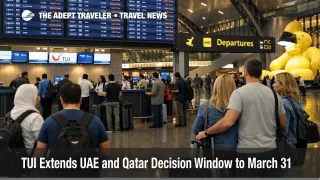
TUI has extended its customer handling window for UAE and Qatar trips through March 31, 2026, and that is a meaningful shift for UK travelers because it turns a live Gulf disruption into a longer operator managed decision period, not just a same week airport problem. The company says flights to and from the UK linked to the UAE or Qatar, including transits, have been affected by regional airspace restrictions, and that customers due to travel on or before March 31 will be contacted in departure date order to discuss options. At the same time, TUI says customers currently in the UAE or Qatar should remain indoors and shelter in place as a precaution.
The TUI UAE Qatar travel alert now matters because the traveler decision is no longer only whether a specific airport is open. It is whether a package holiday, flight inclusive booking, or Gulf transit itinerary can still be delivered reliably enough before March ends to avoid extra hotel nights, broken transfers, and a costly scramble for replacement seats.
TUI UAE Qatar Travel Alert: What Changed
The new fact is the end date. TUI reviewed its Middle East conflict alert on March 13 and said anyone due to travel to, or transit through, the UAE or Qatar on or before March 31 will be handled through its pre travel team in departure date order. That extends the live decision window well beyond the first shutdown phase and makes clear that the company does not see this as a one or two day operational wobble. It is a managed disruption period that can still affect late March departures even if some flights continue to operate.
TUI also draws a useful line between future and current customers. For customers already in the UAE or Qatar, the message is precautionary and immediate, remain indoors, follow local guidance, stay in your accommodation, and avoid non essential travel. For customers who have not yet departed, the company is working through bookings in order of travel date and discussing options case by case. That difference matters because in resort assistance is about safety and continuity, while pre departure handling is about whether to travel, defer, reroute, or unwind the booking.
Which Travelers Are Most Exposed Through March 31
The most exposed group is not every TUI customer in the Gulf. It is travelers whose booking either depends on the UAE or Qatar as the destination, or uses those hubs as the middle of a longer chain. TUI's alert explicitly includes transits, which means passengers heading beyond Dubai, Abu Dhabi, or Doha can still be caught even if the Gulf is not the final stop. That is the same structural weakness Adept identified in Middle East Airspace Closures Ground Gulf Hubs, where the problem was not only local airport status, but the fragility of itineraries built around Gulf connection banks.
Package travelers face a different problem from do it yourself passengers. A self booked flier can start rebuilding immediately, but a TUI customer is often waiting for operator contact, because the company is sequencing assistance by departure date. That can be helpful if TUI can rework the trip inside its own system, but it also compresses decisions into a narrower channel as more customers approach departure at once. The second order effect is easy to miss, hotel extensions become harder to price, airport transfer timing gets less predictable, and travelers trying to protect timed cruise embarkations, tours, or event dates may lose useful rebooking time while the queue moves toward them.
Travelers already in the UAE also face a harsher operating environment than they did earlier in the month. Adept's UAE Airport Access Tightens for Stranded Travelers showed that some airport access is restricted to confirmed travelers only, which means last minute airport improvisation is less workable. That raises the value of getting clear operator instructions before moving.
What Travelers Should Do Now
Travelers already in resort should treat TUI's shelter guidance as the active operating rule, not a soft suggestion. Stay in your accommodation, keep phones charged, preserve booking records, and avoid unnecessary airport or city movement unless TUI, your airline, or local authorities tell you to move. In the UAE and Qatar, both the FCDO pages updated on March 14 still warn of regional escalation and advise following local authority instructions if told to shelter.
Travelers who have not yet departed need a threshold based approach. Wait for TUI contact if your trip is flexible, largely operator controlled, and not tied to a hard start date. Push for a faster decision if your departure is close, your itinerary includes a Gulf transit on separate tickets, or the trip breaks if one late segment fails, such as a cruise embarkation, wedding, guided tour, or nonrefundable event. TUI says customers may call sooner, but it also warns of high call volume, so the practical decision is whether preserving schedule certainty matters more than waiting for operator sequencing.
Insurance and documentation now matter more than many travelers expect. The FCDO says travel insurance can be invalidated if you travel against its advice for both the UAE and Qatar, which means late departures should be checked against policy terms before committing. Anyone considering an overland fallback from the UAE should also remember that border congestion and visa requirements remain live constraints, as Adept detailed in UAE Border Congestion Complicates Overland Exits.
Why the March 31 Window Matters
The March 31 date matters because it changes the story from disruption at the airport to disruption in the decision chain. A short closure can be handled with a waiver and a later departure. A longer operator handling window creates a rolling bottleneck where departures, rebookings, hotel stays, and available seats all compete across more days. The first order effect is uncertainty around whether a TUI managed itinerary will operate as booked. The second order effect is that customers bunch into the same limited recovery space, especially on flights that avoid the worst regional constraints or operate with tighter screening and airport access controls.
There is also a mismatch between operator messaging and the wider official environment. TUI says there is currently no FCDO advice against travel to the destinations where it is operating and that some holidays are continuing as planned, but the live FCDO country pages for both Qatar and the United Arab Emirates currently state that the FCDO advises against all but essential travel. Travelers should read that gap carefully. It does not automatically mean every booking will be canceled, but it does mean the TUI UAE Qatar travel alert sits inside a broader official risk posture that is still materially restrictive on March 14, 2026.
As March 31 approaches, the main signal to watch is not a headline about "reopening." It is whether TUI narrows, extends, or withdraws the TUI UAE Qatar travel alert window, and whether official advice softens at the same time. Until both move in the same direction, travelers should assume Gulf itineraries linked to TUI, especially those involving transit, remain a managed risk rather than a normal late March booking.