

Dubai Airport Shutdown Exposes DXB Hub Failure
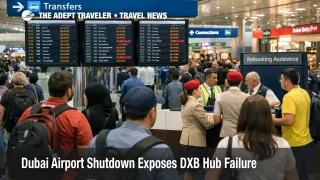
A Dubai airport shutdown on Monday, March 16, 2026 turned a broad Gulf disruption story into a single hub failure at Dubai International Airport (DXB). After a fire near the airport triggered a temporary suspension, Dubai Airports said flights were gradually resuming to selected destinations, and Emirates said it was operating a reduced schedule with some cancellations. That matters because DXB is not just another airport, it is one of the world's biggest connection machines, so even a same day restart on limited operations can still break onward banks to Europe, India, Africa, and long haul destinations. Travelers should not treat "resumed" as "normal." They should verify that their exact flight is operating before leaving for the airport, and they should expect knock on disruption even if their own departure is still listed as on time.
The practical change from earlier Gulf coverage is the concentration of risk. For much of this regional crisis, travelers were dealing with rolling airspace closures, longer reroutes, and suspended city pairs. On March 16, the main traveler problem became more concrete, one major global hub stopped, then restarted with less capacity than planned. That narrows the immediate decision. If your trip depends on DXB today or tonight, the core question is no longer only whether the wider region is stable enough for flying. It is whether your specific aircraft, crew, gate, and onward connection can still be recovered inside Dubai's reduced operating window.
Dubai Airport Shutdown: What Changed
What changed on March 16 was not just another round of regional caution. Reuters reported that a drone attack ignited a fuel tank fire near the airport, forcing a temporary halt to operations before flights began resuming gradually. Dubai Airports then said services were returning only to selected destinations, which is a materially different condition from a full reopening. Emirates followed with a live advisory saying the temporary suspension at Dubai Airport caused some cancellations, that operations had resumed, and that customers should check flight status before heading to the airport.
That sequence matters because the shutdown hit the airport during the part of the day when long haul recovery becomes hard. Once an airport like DXB pauses, inbound aircraft divert, outbound aircraft miss slots, and connecting passengers lose the timed structure that makes a hub work. A later partial restart helps, but it does not instantly rebuild the bank. Flights may still depart, yet baggage, crews, and transfer passengers can remain out of position for hours after the runway system is technically usable again. FlightAware's airport status page was still showing delays and cancellations after the restart, which supports treating this as an ongoing recovery event rather than a finished incident.
Which Travelers Face the Most DXB Risk
The most exposed travelers are not only those starting in Dubai. They are passengers connecting through DXB on tight onward itineraries, especially trips that bridge Europe to India, Europe to Southeast Asia, Africa to Asia, or regional Gulf sectors into Emirates' long haul departures. A nonstop passenger may only need one flight to recover. A connecting passenger needs two working flights, a usable transfer window, baggage that keeps up, and enough slack at the destination for hotel check in, cruise embarkation, or onward ground transport.
The second high risk group is travelers whose airline depends heavily on Dubai rather than merely serving it. Emirates is the obvious case because the carrier itself said it was operating a reduced schedule after the suspension, but the spillover does not stop there. Reuters reported disruptions at Emirates, flydubai, Air India, and Air India Express, with some flights diverted to Al Maktoum International Airport and Al Ain. That means travelers booked on other carriers can still be caught by crew knock on effects, aircraft rotation gaps, or late arriving inbound aircraft from a disrupted Dubai turn.
What Travelers Should Do Now
The right immediate move is to hold until your airline confirms your flight is operating, then move only when that confirmation is current. Emirates' own advisory says passengers should check flight status before heading to the airport, and Dubai Airports has told travelers to check with their airline for the latest updates. For anyone not yet checked in, that means app alerts, airline SMS, and a fresh status check matter more than a static booking confirmation or yesterday's schedule.
Rebooking now makes more sense than waiting if your itinerary depends on a same day connection at DXB, an overnight long haul bank, or a time sensitive arrival such as a cruise, event, or onward rail segment. Waiting can still work for travelers ending in Dubai, or for those with a flexible ticket and at least a day of slack. The tradeoff is simple. Waiting may preserve fare value, but early rebooking may preserve the trip. Travelers who need a wider regional fallback should also look at Middle East Reroutes Stretch Europe Asia Flights and British Airways Asia Reroutes Reshape Gulf Exits, because the best alternative may no longer run through the Gulf at all.
Over the next 24 to 72 hours, the useful recovery signals are narrow and operational. Watch whether Emirates expands beyond a reduced schedule, whether more airlines restore normal Dubai service rather than selected flying, whether diversion airports such as Al Maktoum remain in heavy use, and whether cancellation totals keep climbing into the next bank cycle. If those signals improve, the event starts to look like a sharp single day shock. If they do not, DXB remains a degraded hub even with flights technically operating.
How the Disruption Spreads Through Travel
The mechanism here is what makes this more serious than a brief airport pause. DXB is a hub built on synchronized waves of arrivals and departures. When one of those waves breaks, the first order effect is obvious, delayed, canceled, or diverted flights. The second order effect is harder, and more expensive. Crews time out, aircraft end up at the wrong airport, bags separate from passengers, hotel demand rises for forced overnight stays, and the next wave inherits a smaller pool of usable aircraft and staff. That is why a limited restart still leaves real traveler risk.
This also explains why nearby airports do not fully solve the problem. Diversions to Al Maktoum International Airport (DWC) or Al Ain can protect aircraft and passengers in the moment, but they also create a ground logistics problem. Travelers may land in the UAE without arriving where their trip was supposed to reconnect. Bags, visas, onward transport, and hotel plans then have to be reworked on the fly. In a normal operation, a mega hub absorbs friction because everything is built around one coordinated system. In a disrupted operation, that same concentration becomes the weakness. DXB's scale is why Dubai is powerful on a good day, and why a single day shutdown hits so many unrelated itineraries at once.