

British Airways Asia Reroutes Reshape Gulf Exits
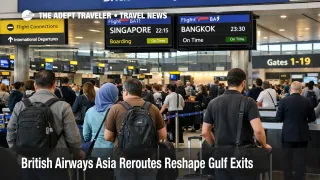
British Airways is turning part of the Middle East recovery into an Asia rerouting story, not just a Gulf rescue story. On March 13, 2026, the airline said it added extra flights between London and both Singapore and Bangkok "next week" to support disrupted customers, while confirming that its Muscat, Oman relief flights have paused and that its regional schedule remains under review. For stranded passengers, that creates a new decision path. The fastest way out may no longer be waiting for Gulf flying to normalize, but rebuilding the trip through Southeast Asia instead.
The change matters because it shifts scarce recovery capacity onto long haul Asia banks rather than keeping the focus on point to point evacuation flying from Oman. That gives some passengers new options, but it also lengthens many trips, raises overnight transit risk, and can push onward fares higher when travelers need a second ticket beyond Singapore or Bangkok. Travelers with urgent returns or fragile onward connections should treat this as a routing change with real cost and timing consequences, not just a helpful extra seat release.
This is the material update from earlier British Airways recovery coverage. The first phase was Muscat relief flying for customers already displaced into Oman or the United Arab Emirates. The March 13 update shows the airline now using Asia gateways as part of its recovery channel, while keeping the option to resume Muscat operations only if conditions or demand justify it.
British Airways Asia Reroutes: What Changed
British Airways' March 13 update is short, but the operational meaning is bigger than the wording. The airline said it added additional London flights to Singapore and Bangkok for the following week, and that disrupted customers can book those flights on ba.com or through the airline they were originally booked with. At the same time, BA said its Muscat relief flights have paused, though they remain under continuous review.
That is a real pivot. Earlier in March, Muscat acted as a controlled exit point for some stranded BA customers after Gulf disruptions broke direct recovery paths. Now the airline is clearly leaning on large Southeast Asia gateways to absorb displaced demand instead. BA has not published the exact dates or flight numbers for the added Singapore and Bangkok sectors in its public update, which means travelers still need to verify whether those seats are actually usable for their own ticket, date, and onward plan before moving.
The other important context is that BA's broader Middle East schedule is still not normal. As of its March 10 and March 12 updates, the carrier had reduced regional flying and said services to Amman, Bahrain, Doha, Dubai, and Tel Aviv were canceled until later in March, while Abu Dhabi was suspended longer. The March 13 change does not reverse that. It simply creates more escape capacity through Asia while the core Middle East operation stays unstable.
Which Travelers Gain the Most, And Who Still Faces Friction
The travelers most likely to benefit are passengers who already need to get back to London or another long haul destination and can tolerate a longer route. That includes people stranded in or near the Gulf whose original itinerary has failed, passengers on BA tickets who can be reprotected onto the new Asia capacity, and some customers booked through other airlines that can access the seats via reissue or reaccommodation.
But the fit is not universal. A reroute through Singapore, Singapore, or Bangkok, Thailand may solve the long haul problem while creating a new final leg problem. Someone trying to reach continental Europe or North America may still need another flight after London, or may need a separate ticket from Asia if the original itinerary cannot be rebuilt cleanly. That is where the second order cost starts to bite. A longer itinerary means more hotel exposure, more baggage transfer risk, more missed connection points, and less protection if the trip has already split across multiple tickets.
Travelers on separate tickets are in the weakest position. An added BA flight to Singapore or Bangkok is useful only if the rest of the trip can be stitched together without blowing up the fare, the baggage plan, or the connection time. The broader pricing problem is already visible in Adept's earlier Middle East Airspace Closures Raise Asia Europe Fares reporting. More displaced passengers flowing into Asia banks can keep pressure on exactly those routes that look like the obvious workaround.
There is also a ground side constraint. Even when recovery seats exist, travelers in the United Arab Emirates still face tighter terminal access rules, as covered in UAE Airport Access Tightens Into No Ticket Rule. In plain language, an Asia reroute is only helpful if the passenger actually has a confirmed, documented departure plan. Showing up early and hoping to negotiate the rest in person is a weaker bet than it used to be.
What Travelers Should Do Now
The immediate move is to separate "available in theory" from "ticketed for me." If you are a disrupted BA customer, check whether the added Singapore or Bangkok capacity appears in your actual booking options through ba.com or through the airline that issued your ticket. Do not assume that a public announcement means your fare class, alliance partner, or disrupted routing will automatically qualify for the same solution.
The main decision threshold is trip fragility. Rebook early if you have a time sensitive return, a cruise or tour start, a visa limit, or a costly onward connection that cannot absorb another day or two of uncertainty. Wait only if your itinerary is flexible, you are protected on one ticket, and you can tolerate further schedule revision while BA keeps its Middle East operation under review.
Over the next 24 to 72 hours, watch three things. First, whether BA publishes more detail on the added Asia flying, including dates or broader reaccommodation guidance. Second, whether Muscat relief flying resumes, which would matter most for customers already positioned in Oman or the UAE. Third, whether other carriers add or cut parallel recovery capacity, because that will shape both seat availability and final leg pricing beyond London, Singapore, and Bangkok.
Why Asia Gateways Matter More Than Muscat Right Now
The mechanism is straightforward. Muscat relief flights were a targeted rescue tool. They worked for a narrower group of customers already moved into Oman or able to reach it safely. Extra London flights to Singapore and Bangkok are different. They use large, globally connected hubs to absorb disrupted demand at scale, even if the trips themselves become longer and more expensive.
The first order effect is more long haul exit capacity for stranded passengers. The second order effect is pressure on Asia connection banks that were already attractive substitutes once Gulf hubs became less reliable. As more disrupted travelers chase the same Southeast Asia pathways, overnight transits, interline handling, premium cabin inventory, and last minute onward pricing all tighten.
That is why this matters beyond British Airways. A carrier decision to push recovery through Asia changes the shape of the whole traveler problem. The question is no longer only when Gulf service returns. It is whether rerouting through Southeast Asia still saves the trip once time, ticket protection, airport access, and final leg cost are all counted together.