

U.S. Visa Bond Rule Adds 12 Countries April 2
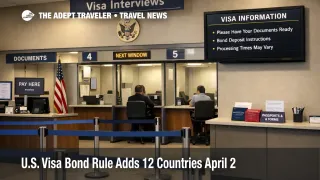
The United States is widening its visitor visa bond program again, and this round matters because it adds a real cash barrier to U.S. bound tourism and business travel from 12 more passport countries starting April 2, 2026. What changed since Adept's January coverage is not abstract immigration rhetoric, it is a new implementation date and a larger country list, now reaching 50 countries in total. For affected travelers and advisors, the practical move is to treat visa timing, refundable trip components, and proof of onward compliance as part of the trip budget from the start, not as paperwork to handle after flights are booked.
The U.S. visa bond rule matters because it can turn a normal B1 or B2 application into a cash intensive, timing sensitive trip decision. Reuters reported that the 12 newly added countries will face a $15,000 bond, but the State Department's live program page still says covered applicants may be assigned a bond of $5,000, $10,000, or $15,000 at the visa interview, which means travelers should plan for the highest number while recognizing the public guidance is not perfectly aligned.
U.S. Visa Bond Rule: What Changed on April 2
The State Department updated its visa bond country list on March 18, 2026, adding Cambodia, Ethiopia, Georgia, Grenada, Lesotho, Mauritius, Mongolia, Mozambique, Nicaragua, Papua New Guinea, Seychelles, and Tunisia with an implementation date of April 2, 2026. That takes the total number of covered countries to 50. The Department says these bonds apply to otherwise eligible B1 and B2 applicants and are tied to overstay, vetting, and related risk criteria under the pilot program.
There is another operational change that matters for itinerary design. Earlier Adept coverage focused on a narrow airport list, but the State Department's current page now says visa bond holders may use all commercial air ports of entry, including preclearance locations, while still excluding charter air, general aviation, land, and sea entry. That eases some routing pressure versus January, but it does not remove the core problem, which is that a covered traveler may still have to lock up thousands of dollars before the visa can be issued. US Visa Bond Expansion Starts Jan 21, New Countries Listed remains useful background on how the earlier expansion hit trip planning.
Which Travelers Now Face the Highest Friction
This rule applies to B1 and B2 applicants traveling on passports from the newly added countries, but the exposure is wider than the individual applicant. Family visits, conference trips, group tours, small business travel, and diaspora travel are the most fragile use cases because they often combine tight dates with limited liquidity. A refundable bond may sound temporary on paper, but in practice it can crowd out airfare purchases, hotel deposits, and tour balances during the exact window when international trips usually become more expensive to book.
The first order effect is visa affordability and timing risk. The second order effect is itinerary fragility. When a traveler cannot be sure whether a bond will be imposed, or what amount will be set at interview, advisors cannot confidently lock in nonrefundable air, cruise, or land arrangements. That is especially true for spring and summer trips with event dates, family gatherings, or fixed tour departures. It also means U.S. inbound demand from some affected markets may soften at the margin, which can ripple into hotel, airline, and tour volume on routes that depend on those travelers. International US Travel Decline Hits Disney Parks gives useful context on how broader inbound softness is already showing up in U.S. travel demand.
What Travelers Should Do Before Booking
Affected travelers should reverse the normal booking order. Start with passport country exposure, consular appointment timing, and total cash tolerance, then price the trip. Do not assume a visa interview is the last gate before travel. Under the pilot, the officer can deny issuance under INA 221(g) pending bond posting, and the bond generally must be posted within 30 days if the applicant wants to overcome that refusal and continue toward issuance.
The hard planning threshold is simple. If losing access to $15,000 would break the trip budget, or even if a lower bond would force the traveler to rely on nonrefundable bookings, the trip should stay in a flexible holding pattern until after the interview outcome is known. That means refundable hotels, fares with change options, and no prepaid tours that cannot survive a consular delay. Travelers dealing with other U.S. entry friction should also review Canada Advisory: US Entry Limits, 30 Day Rule, because the larger pattern in 2026 is that document and border rules are creating more same day failure points before departure.
Once a bond is posted and a visa is issued, compliance matters. The Department says the bond can be canceled automatically with a full refund if DHS records a timely departure, if the traveler never uses the visa before it expires, or if CBP denies admission at the port of entry. But the same rule set says the bond can become payable if the traveler violates status, overstays, files an unexcused late extension or status change request, or fails to leave within 10 days after a timely filed request is denied.
Why the Rule Is Expanding, and How It Changes Trip Timing
The State Department's temporary final rule set this up as a 12 month pilot to test both feasibility and deterrence, using countries with high B1 and B2 overstay rates, deficient vetting information, or citizenship by investment concerns. In plain language, the government is using a refundable cash bond as leverage. That changes travel timing because the trip is no longer just a visa adjudication question. It becomes a liquidity question, a compliance question, and a documentation question all at once.
That mechanism is why this is more than a border headline. A standard visitor visa process usually asks whether the applicant qualifies. The U.S. visa bond rule adds another layer, whether the applicant, or someone supporting the trip, can front the bond, post it correctly through Pay.gov with Form I-352 after consular instruction, and then preserve enough documentation to prove compliance later. As a result, the new April 2 expansion will hit not just consular windows, but also booking behavior, trip lead times, and the willingness of travelers and advisors to commit cash early.
Sources
- Countries Subject to Visa Bonds, U.S. Department of State
- Visas: Visa Bond Pilot Program, Federal Register
- US to require $15,000 bond to visa recipients from 12 more countries, Reuters
- US Visa Bond Expansion Starts Jan 21, New Countries Listed, Adept Traveler
- Canada Advisory: US Entry Limits, 30 Day Rule, Adept Traveler
- International US Travel Decline Hits Disney Parks, Adept Traveler