

Jordan Shelter Alert Hits Amman Airport Planning
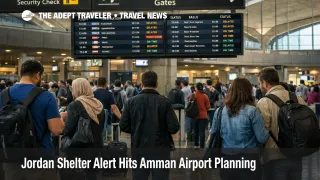
Travelers in Jordan now face a more immediate decision problem than they did on March 19. The U.S. Embassy in Amman said on March 20, 2026 that reports indicate missiles, drones, or rockets are in Jordanian airspace, urged people to seek overhead cover and shelter in place if needed, and said routine consular services remain suspended. Commercial flights are still operating from Queen Alia International Airport (AMM), Amman, Jordan, but the practical problem has shifted from protest-era road friction into a live shelter, transfer timing, and backup planning question. For most travelers, the safest operating posture is to treat airport runs, day tours, and border moves as conditional on the next alert, not as routine transport.
In an earlier Adept Traveler article, Jordan Embassy Alert Raises Amman Protest Risk, the main issue was road closures, checkpoints, and protest timing in Amman. The March 20 shift is more serious because the embassy is now pairing continued departure options with explicit shelter guidance tied to airspace threats, while the State Department's Jordan advisory still reflects the ordered departure of non-emergency U.S. personnel and family members due to the threat of armed conflict.
Jordan Shelter Alert, What Changed
What changed is not that Jordan fully closed or that Queen Alia stopped working. What changed is the operating logic around movement. The embassy alert says travelers should remain indoors and avoid exposure to falling debris when alarms or incidents occur, and an earlier embassy alert, republished by OSAC, explained that Jordan's civil defense alarm system may signal imminent danger and an all-clear. That turns a normal airport transfer into a conditional trip that only works if the road network, the security environment, and the alert posture all hold at the same time.
Routine consular services also remain suspended. That matters operationally because travelers who run into document trouble, detention, injury, or same-day itinerary failure should assume thinner normal support than in a standard tourism environment. The travel advisory page for Jordan says the country remains under a Reconsider Travel warning due to terrorism and armed conflict, and the March 16 embassy update said the ordered departure began on March 3.
Which Travelers Face the Most Disruption
The most exposed group is anyone trying to reach Queen Alia from central Amman on a tight schedule. The airport remains live, the airport website still shows active departures and real-time passenger process information, and Royal Jordanian says flights will operate as long as Jordanian airspace remains open. But the failure point is no longer just whether a driver gets caught behind a protest checkpoint. It is whether a road movement coincides with an airspace alert, a shelter order, or a sudden tightening in local security posture.
A second exposed group is travelers building fallback exits through land borders or Aqaba ferry links. The March 16 embassy update said several land crossings are operating, but also warned that hours can shorten on Fridays and Saturdays and can change at any time based on security conditions and nationality. That means a cross-border backup plan is still better than no backup plan, but it is not a clean substitute for a confirmed flight.
The third exposed group is travelers already inside a timed itinerary, especially those combining Amman hotel stays with Petra, Dead Sea, or border-corridor moves. A flight may still leave, but the sequence around it is weaker. One shelter episode, one police hold, or one airline schedule adjustment can push a same-day plan past the point where it is recoverable without an extra hotel night. Reuters and other coverage of the wider regional crisis also show that commercial aviation across the Gulf and Levant remains under pressure from route suspensions, airspace avoidance, and rapid carrier changes, which reduces the margin for easy rebooking once a plan breaks.
What Travelers Should Do Now
For departures from Amman over the next 24 to 72 hours, the first decision threshold is simple. Do not run a mission-critical flight on a normal city-to-airport timing assumption. Add heavy buffer, keep your phone charged, keep passports and medications immediately accessible, and use a licensed driver or official transport option that will reroute early. If your flight is expensive, long haul, or difficult to replace, an airport-area overnight stay is usually the cleaner tradeoff than gambling on a same-day transfer from the city.
The second threshold is whether you have a confirmed seat on an operating flight. Royal Jordanian's current travel update offers flexible options on affected tickets and says transit passengers via Amman may be involuntarily rerouted on other carriers when available, but that is not the same as broad network stability. Travelers should keep checking airline status pages directly, and they should not treat a still-open airport as proof that their own itinerary will run unchanged.
The third threshold is shelter readiness. If you stay in Jordan rather than depart, the embassy's earlier OSAC-posted guidance is the clearest operating rule: know your secure indoor location, be ready to shelter in place, stay away from debris, and monitor official alerts rather than social media noise. In an earlier Adept Traveler article, Amman Protests And Airport Transfers Risk Guide, the advice was to protect time against road disruption. That still applies, but the Jordan shelter alert means travelers now also need to protect for pauses in movement itself.
Why This Is Happening, and What Comes Next
Jordan sits inside a stressed air and land corridor, not outside it. The wider regional conflict has already produced route cancellations, airspace avoidance, and partial closures across neighboring systems, while the U.S. Embassy's Jordan messaging has gradually shifted from caution, to departure logic, to explicit shelter guidance. First order, that creates uncertainty around flights, consular access, and same-day airport moves. Second order, it raises hotel overnights, misconnect risk, and the odds that travelers will have to choose between leaving early at higher cost or waiting in a thinner support environment.
What happens next depends on whether alerts stay procedural or start adding harder movement controls. The most important signals to monitor are fresh U.S. Embassy Jordan alerts, Queen Alia departure status, and airline-specific notices, especially from Royal Jordanian and foreign carriers still limiting Middle East service. As of March 20, the Jordan shelter alert does not mean Amman is shut, but it does mean travelers should stop planning as if movement is normal. The safer posture is flexible lodging, wider airport buffers, a backup exit idea, and a readiness to shelter before moving again.
Sources
- Security Alert, U.S. Embassy Amman, Jordan, March 20, 2026
- Travel Advisory: Jordan, March 2026, U.S. Embassy in Jordan
- Security Alert: Jordan, Update 1, March 16, 2026, OSAC
- Security Alert, Jordanian Civil Defense Alarm System and Flight Departures Resource, March 2, 2026, OSAC
- Travel Update, Royal Jordanian
- Queen Alia International Airport
- European Airlines Extend Middle East Flight Suspensions, The Wall Street Journal
- Dubai airport hub rattled after drone strike spotlights Iran war risks, Reuters