

Jordan Embassy Alert Raises Amman Protest Risk
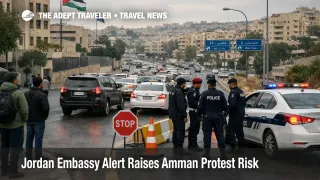
A fresh U.S. Embassy alert on March 19, 2026, does not say Jordan is shutting down or that flights are stopping. It tells people in Jordan to avoid protests and demonstrations, keep a low profile, and stay alert, while also saying there is no change to departure options or U.S. mission operations. For travelers, that shifts the practical problem back to ground movement in and around Amman, Jordan, not to whether Queen Alia International Airport (AMM) is open. The immediate fix is to treat Thursday night and Friday in the capital as a higher friction window, avoid known protest corridors, and build more slack into any airport run or day tour departure.
The update matters because it refreshes operational caution during a period when protest activity in Jordan often clusters around end of week gathering times. Canadian and Australian government travel advice both warn that demonstrations in Jordan are regular, that they often occur on Friday afternoons or after Friday noon prayers, and that they can lead to road closures, checkpoints, roadblocks, and public transport disruption. In other words, the main risk is not a headline airport closure. It is that a normal looking transfer becomes unreliable once police start channeling traffic away from protest nodes.
Amman Protest Travel Risk, What Changed
What changed on March 19 is the embassy's fresh warning, not Jordan's transport baseline. The alert repeats the personal security advice travelers have been hearing in recent days, but the new value is that it confirms the U.S. mission is still operating and that departure options remain available. That keeps the traveler decision centered on timing, routing, and buffer, not on emergency exit planning.
For anyone staying in Amman, the highest friction is likely to remain near known gathering areas and the roads that feed them. Canada's advisory points to the Al Kalouti mosque near the Israeli Embassy in Rabieh, the Prime Ministry area at Fourth Circle on Zahran Street, Al Husseini mosque downtown, and Parliament in Abdali as recurring demonstration points. Australia's advice adds that protests are likely near large mosques, diplomatic missions, major intersections, and downtown areas, especially after Friday prayers. Those are exactly the kinds of places where a short diversion can become a long delay because Amman traffic already has little spare capacity.
Which Travelers Face The Most Disruption
Airport transfers are the obvious exposure. If your route to Queen Alia touches central Amman, embassy districts, or major intersections during a protest window, the problem is not usually the airport itself. It is the risk of rolling closures, visible security checks, and driver reroutes that turn a routine run into a missed check in. The United Kingdom's advice also notes that police carry out random security checks in Jordan, which is another reason to keep ID on hand and avoid tight margins.
The second exposed group is travelers using Amman as the launch point for Dead Sea, Petra, or border corridor moves. A road trip south or west can still be workable, but the hidden failure point is often the first leg out of the capital, not the scenic part later in the day. This is why Adept's earlier Jordan Travel Advice Hardens Around Amman Exit Runs, Jordan Border Hours Tighten Exit Plans March 14, and Amman Protests And Airport Transfers Risk Guide remain relevant companions to today's alert. They are useful because the structural risk in Jordan is often surface access, not the flight itself.
What Travelers Should Do Now
For Thursday night and Friday movements, the practical threshold is simple. Add at least 60 to 90 minutes of extra buffer for any outbound airport transfer that starts in Amman, and avoid same day cross city plans if your flight is expensive, long haul, or hard to replace. If your departure is mission critical, an airport area overnight is usually the cleaner tradeoff than gambling on a normal city to airport timing window during an active protest alert. That is not because the airport is closed. It is because one checkpoint, one diversion, or one police hold can erase the margin you thought you had.
For hotel pickups and day tours, ask operators to confirm routing on the day, not just the night before. In Jordan, protest conditions can stay localized and still break a schedule if your pickup point sits near an affected circle, mosque, or embassy district. Travelers should avoid demonstration areas rather than trying to pass through them, carry ID, monitor local media and hotel advice, and use licensed drivers who will reroute early instead of waiting to get trapped in a closure.
Over the next 24 to 72 hours, the key thing to watch is not whether Jordan is "open." It is whether alerts stay procedural, or start adding concrete movement restrictions, route closures, or mission posture changes. As of March 19, the embassy says there is no change to departure options or operations. If that line changes in a later alert, the traveler decision changes with it.
Why This Pattern Tightens Movement In Amman
The mechanism is straightforward. Demonstrations in Jordan tend to gather near symbolic or high visibility sites, especially after Friday prayers, and authorities respond with extra security forces, roadblocks, and crowd control. Even when protests remain peaceful, those controls can narrow road capacity, shift traffic onto parallel routes, and create checkpoint friction that spreads beyond the protest footprint itself. First order, travelers lose predictability on roads near the gathering area. Second order, airport transfers, day tours, border runs, and hotel pickup windows all become more fragile because they depend on on time movement through the same road network.
That is why the right response to the current Amman protest travel risk is not panic and not complacency. Jordan still has operating flights, functioning hotels, and usable tourist corridors. But Thursdays and Fridays often bring demonstrations, rolling roadblocks, and checkpoints in Amman, with spillover risk for routes toward the Dead Sea and border areas, so travelers should treat timing as the real asset they are protecting. Leave earlier, route wider, and avoid building a same day plan that only works if the city behaves normally.