

Newark Near Miss Puts Runway Safety Back in Focus
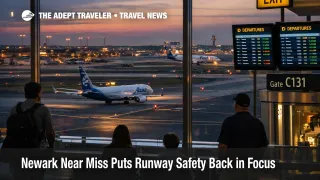
A Newark near miss is now under formal federal investigation after Alaska Airlines Flight 294 was ordered to go around at Newark Liberty International Airport (EWR) on Tuesday, March 17, 2026, while FedEx Flight 721 was cleared toward an intersecting runway. The Alaska jet came over the FedEx aircraft during the maneuver, and both the Federal Aviation Administration, or FAA, and the National Transportation Safety Board, or NTSB, are investigating. For travelers, this is not an immediate airport shutdown story, but it is a serious reminder that Newark remains a tight operating environment where small sequencing errors can turn into major safety events.
Newark Near Miss: What Changed
What changed is that a routine Newark arrival bank turned into a close call involving two large aircraft on intersecting runways. According to the FAA, air traffic control instructed Alaska Airlines Flight 294 to perform a go around because FedEx Flight 721 had been cleared for final approach to an intersecting runway. Reuters and other reporting, citing flight tracking data, said the Alaska aircraft was about 300 feet above ground level and climbed over the FedEx jet, clearing it by roughly 300 to 325 feet. Alaska said its pilots followed the go around instruction, and FedEx said its crew followed air traffic control instructions and landed safely.
That makes this more than a dramatic anecdote. A go around is a normal safety procedure, but one issued that late in the landing phase points to a very small margin at the point the conflict was recognized. The immediate traveler consequence is usually limited to that flight, nearby arrivals, and short term sequencing adjustments. The larger consequence is that another high profile runway conflict will likely intensify scrutiny on tower procedures, runway crossing operations, and broader FAA safety management at major hubs. That comes just after the FAA expanded helicopter separation rules at major U.S. airports in a separate safety move on March 18, 2026. In an earlier Adept Traveler article, FAA Helicopter Safety Rule Expands At U.S. Airports explained how regulators were already tightening mixed traffic procedures before this Newark event.
Which Travelers Face the Most Exposure at Newark
The most exposed travelers are people flying into or out of Newark during busy evening arrival banks, travelers on short domestic to international connections, and anyone already juggling ground side friction at the airport. Newark is not facing a published closure tied to this incident, but when a serious close call hits a constrained hub, the operational effect can spread through caution. Airlines and controllers may build a bit more spacing, recovery can take longer after small disruptions, and passengers with thin connection windows are the first group to feel it.
This matters more at Newark because the airport already has live transfer friction elsewhere in the system. On most weekdays through late May, AirTrain service at Newark Airport Station is being replaced by shuttle buses from 500 a.m. to 300 p.m., which slows the rail to terminal handoff even when flights operate normally. In an earlier Adept Traveler article, Newark Airport AirTrain Delays Hit Weekday Rail Links laid out that daytime rail to terminal bottleneck. Add a safety investigation and any extra arrival caution, and the airport becomes less forgiving for tight schedules from curb to gate and from gate to curb.
Travelers should also separate what is confirmed from what is not. It is confirmed that the aircraft were on approach to intersecting runways, that a late go around was ordered, and that both FAA and NTSB are investigating. It is not yet confirmed what specific decision chain, staffing factor, spacing judgment, or procedural breakdown caused the conflict to get that close. Until investigators publish more, assigning a single cause would be speculation.
What Travelers Should Do Now
For most passengers, the right response is not to cancel a Newark trip because of this event alone. The better move is to build more margin into any itinerary that depends on Newark working smoothly. If you are flying through EWR over the next several days, treat short layovers as the weakest link, especially on the final departure of the day or on itineraries that connect to long haul flights you cannot easily replace.
If you have a choice between a slightly longer connection and a tighter one at Newark, the longer connection is the safer buy right now. If you are arriving by NJ TRANSIT on a weekday morning or early afternoon, budget extra time for the AirTrain shuttle substitution before you even reach the terminal. If you are meeting a cruise departure, a tour start, or a fixed appointment after landing, plan around the possibility that a small airside slowdown and a slow landside transfer could stack into one missed commitment.
The next decision point is not whether Newark is safe to use, but whether federal investigators or the FAA signal any immediate procedural changes that could alter throughput. Watch for FAA statements, NTSB updates, and any airline schedule messaging if your trip depends on Newark in the next 24 to 72 hours. Travelers who do not need to connect tightly can usually stay with existing plans. Travelers with zero buffer should consider shifting to earlier departures, longer layovers, or a different New York area airport where practical.
Why This Happened, and What Comes Next
The mechanism here is straightforward even if the root cause is still under investigation. Newark uses intersecting runways, which can support efficient traffic flow but leave less room for sequencing mistakes when two arrivals do not separate the way controllers expect. Reporting based on air traffic control audio and tracking data indicates the plan was for the FedEx jet to land ahead of the Alaska flight, but the Alaska aircraft did not end up safely behind it, forcing the late go around. That does not tell us why the spacing failed, but it does explain how the conflict developed.
What happens next is likely a familiar sequence. The NTSB will gather flight data, radar tracks, controller communications, and crew statements. The FAA will examine the operational handling of the arrival sequence. The practical near term risk for travelers is not a repeat of this exact event, but a network that gets a bit more conservative after another headline safety scare. That can mean slightly slower sequencing at peak times, more sensitivity to weather or staffing pressure, and less tolerance for already thin schedules.
This also lands inside a broader aviation safety debate that travelers have been watching for months. The FAA has already been under pressure to harden separation rules after other recent close calls and a fatal 2025 midair collision that drove new safety recommendations. In an earlier Adept Traveler article, U.S. Airport Shutdown Delays Hit Travel Advisories we noted how federal aviation strain is already reaching travelers through longer lines and thinner operating margins. For readers who want the structural backdrop, U.S. Air Traffic Control Privatization: Reality Check gives the bigger system view. For now, the Newark near miss should be read as a serious warning, not a reason to panic, and as another signal that Newark travelers should keep more buffer in the plan than the booking engine suggests.
Sources
- US NTSB probes close call in Newark between FedEx, Alaska Airlines jets
- Authorities investigating close call between Alaska Airlines and FedEx planes landing at Newark
- Alaska Airlines flight, FedEx cargo plane nearly collide at Newark
- NTSB is investigating a "close call" between an Alaska Airlines 737 and FedEx 777 at Newark