

U.S. Airport Shutdown Delays Hit Travel Advisories
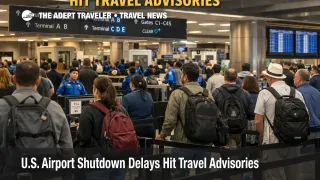
What changed on March 19 is not just that U.S. airport screening remains under strain, it is that foreign governments are now warning their citizens about it as a practical travel problem. The United Kingdom now tells travelers there "could be longer than usual queues at some US airports" because of the partial U.S. government shutdown, and Australia has added that the shutdown "has affected some federal government services, including at airports," with possible flight delays, longer lines, and slower connections. That shifts the story from a Washington funding fight into a broader traveler advisory issue. For anyone flying in, out of, or through the United States over the next several days, the sensible move is to add buffer time, avoid fragile same day connections where possible, and check your departure airport directly instead of relying on a single national app or headline.
The U.S. airport shutdown delays risk is now being described the same way travelers would describe any other operational disruption, as a time and throughput problem that can break an itinerary even when flights are still operating.
U.S. Airport Shutdown Delays: What Changed
The new layer is advisory language from outside the United States. The UK Foreign, Commonwealth and Development Office now warns of "longer than usual queues at some US airports" because of the shutdown, while Australia's Smartraveller says the shutdown has affected airport services and may produce flight delays, longer airport lines, and slower connections. That matters because it tells inbound international travelers, tour operators, and travel advisors that this is no longer just a domestic politics story to monitor in the background. It is now a live planning issue tied to airport throughput.
That advisory shift lands as airline leaders keep pressing Congress publicly. In a March 15 open letter, airline CEOs said Americans are already dealing with long airport lines, travel delays, and cancellations caused by repeated shutdowns, while Airlines for America separately highlighted zero dollar paychecks for TSA employees. Reuters reported on March 18 that TSA officer absences were still running at 9.9 percent nationally, with some airports including New York JFK, Pittsburgh, and Houston seeing much higher rates. Reuters also reported that 366 TSA officers had quit during the shutdown.
This is also a clear update from Adept's earlier shutdown coverage. The prior emphasis was on staffing strain, possible checkpoint closures, and small airport closure risk. The fresh development is that outside governments are now translating that strain into direct traveler guidance, which raises the practical stakes for inbound visitors and reinforces that U.S. Shutdown Pressure Grows on TSA as Airlines Warn has evolved into a broader planning story. The risk at the edges has not gone away either, as U.S. Shutdown Airport Closure Risk Hits Small Fields already showed.
Which Travelers Face the Most Delay Risk
The most exposed travelers are not all flying the same kind of trip. Inbound international visitors are one obvious group, because they are more likely to be building unfamiliar U.S. airport transfers, domestic onward flights, cruise embarkations, or long ground transfers off a single arrival day. If screening throughput slips on the departure side of a later domestic leg, the missed connection risk compounds fast. That is especially true for itineraries that stack air, rail, and cruise on the same day.
Domestic travelers are also exposed, particularly at large hubs that are already showing strain signals. Houston Airports says the shutdown is affecting TSA staffing at both George Bush Intercontinental Airport (IAH) and William P. Hobby Airport (HOU), and it is now recommending passengers arrive three hours early for domestic flights and four hours early for international flights. Reuters has also highlighted elevated absentee pressure at hubs including JFK and Houston. Atlanta remains important because it is one of the country's biggest connection machines, and its own passenger guidance notes that the busiest checkpoint hours are typically 500 a.m. through 900 a.m., when thin staffing hurts the most.
Connection heavy itineraries deserve the most caution. When one airport asks travelers to arrive earlier and another hub is already carrying a higher absence rate, the first order effect is a longer security wait. The second order effect is that a missed connection can turn into a missed cruise embarkation, a broken rail booking, a lost prepaid hotel night, or a same day business trip that no longer works. TSA checkpoint volume remains high, with more than 2.7 million people screened on March 15 alone, so the system does not need a total failure to produce real traveler pain.
What Travelers Should Do Now
For most domestic U.S. departures, a two hour airport buffer now looks too thin at stressed hubs unless you have strong local visibility on current lines. Three hours is the more defensible baseline at airports already warning of staffing pressure. For international departures from major U.S. hubs, four hours is no longer overkill in places that have issued official early arrival guidance. Travelers with checked bags, rental car returns, family groups, or spring break volume should lean toward the longer end of that window.
For connection heavy itineraries, the key threshold is not just departure time, it is how much slack exists after something goes wrong. If you are connecting from a U.S. domestic leg to a long haul international flight, heading to a cruise embarkation city, or trying to catch same day rail after landing, this is a bad period to gamble on tight turns. Rebook to a longer connection if the trip purpose is high stakes, especially where one misstep forces an overnight stay. If the fare difference is modest, buying time is probably cheaper than replacing a cruise, a tour, or a missed event.
Over the next 24 to 72 hours, monitor airport specific alerts, your airline's app, and live airport wait time pages rather than assuming national averages tell the whole story. Houston is explicitly warning of fluctuating open lanes, JFK publishes live terminal wait times, and Atlanta continues to flag early morning peaks. AP also noted that MyTSA data may not be reliable enough during the shutdown to serve as your only planning tool. That means the right workflow is local airport alert first, airline status second, and then a fallback plan for a later flight or an overnight near the airport if your itinerary cannot absorb a screening delay.
Why Foreign Advisories Matter, and How the Strain Spreads
Foreign travel advisories do not create the disruption, but they do change how the disruption is understood. Once governments start telling their citizens that U.S. airport operations may be slower because of a shutdown, the issue becomes legible as a traveler risk in its own right. That can affect not just individual planning, but also how travel advisors, corporate travel desks, and inbound tour operators build buffers and connection rules into bookings.
The mechanism is straightforward. TSA officers are essential workers, so checkpoints stay open, but unpaid work erodes attendance and retention over time. Fewer officers means fewer open lanes, less redundancy when peaks hit, and a thinner ability to recover when lines spike at one terminal or bank of departures. Airports then start pushing passengers to arrive earlier, and airlines face more late to gate travelers even if the aircraft itself is ready. In that environment, the disruption spreads from the checkpoint to the whole trip. A line problem becomes a connection problem, then a hotel problem, then sometimes a cruise or ground transport problem.
The main reality check is that this is still uneven. Not every airport is melting down, and not every day is equally bad. JFK's live wait times on March 19 still showed some relatively manageable numbers by terminal, while Houston continued warning that lane availability can change shift by shift. That unevenness is exactly why broad reassurance is not useful. Travelers should think in terms of exposure, which airport, which hour, which terminal, and how expensive a miss would be, rather than asking whether U.S. airports are "fine" or "not fine" in the abstract.
Sources
- USA travel advice, GOV.UK
- United States of America, Smartraveller
- An Open Letter to Congress from US Airline CEOs, Airlines for America
- A4A Statement on TSA's $0 Paychecks, Airlines for America
- Government shutdown impacts TSA, passengers, Houston Airports
- Airport Alerts, George Bush Intercontinental Airport (IAH)
- Airport Info, William P. Hobby Airport (HOU)
- Passenger Security, Hartsfield-Jackson Atlanta International Airport (ATL)
- John F. Kennedy International Airport live wait times
- TSA checkpoint travel numbers, Transportation Security Administration
- Oversight Hearing, Potential DHS Shutdown Impacts, TSA
- US airport security absences decline slightly as shutdown continues, Reuters
- How to monitor airport security lines at US airports while TSA officers go without pay, AP News