

British Airways Middle East Cuts Stretch Into Spring
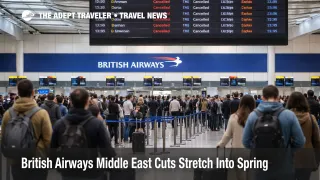
British Airways Middle East cuts became a late spring planning problem on March 16, 2026, when the airline extended cancellations well beyond the late March horizon many travelers had been watching. BA now has Amman, Bahrain, Dubai, and Tel Aviv canceled through May 31, 2026, Doha canceled through April 30, 2026, and Abu Dhabi still suspended until later in 2026 with no restart date published in the material reviewed. For travelers booked into Easter, late April, or May trips, this is no longer a short disruption to wait out. It is a rerouting and rebooking decision.
British Airways Middle East Cuts: What Changed
The practical change is duration. Earlier BA guidance had framed the disruption as a nearer term interruption, but the current date ladder is materially longer and forces a different traveler response. British Airways told Reuters it extended temporary reductions across the Middle East because of continued regional instability and airspace disruption, while also adding flights to Singapore and Bangkok to absorb some displaced demand and review options for bringing disrupted customers home.
That substitute capacity helps only at the margin. Extra seats to Singapore and Bangkok may give some Asia bound travelers another way to cross the network, but they do not replace nonstop service to Gulf cities or restore the original connection logic many itineraries depended on. A London passenger headed to the Gulf, Jordan, or Israel is not simply moving onto a similar flight at a different hour. In many cases, the trip now requires a different carrier, a different hub, a different city pair, or a different travel date.
Which Travelers Face the Most Disruption
The most exposed group is travelers who built trips around British Airways nonstops from London Heathrow Airport (LHR) into Amman, Bahrain, Doha, Dubai, Tel Aviv, or Abu Dhabi, especially where those flights anchored hotel bookings, meetings, cruises, or onward regional sectors. The risk is even higher for passengers using Gulf hubs as transfer points between Europe and Asia, because the loss of a single BA segment can break the entire chain rather than just delay one leg. In an earlier Adept Traveler article, Middle East Reroutes Stretch Europe Asia Flights explained how longer detours and hub instability were already weakening Europe Asia connection reliability.
The second pressure point is inventory. When one large carrier removes service for weeks or months, remaining seats in the market tend to become more expensive, harder to redeem with points, and less useful for tight connection planning. Reuters separately reported earlier this month that Asia Europe fares were already rising after Gulf airport closures and airspace restrictions disrupted one of the world's main east west corridors. That means BA's cuts do not land in a stable market. They land in one where backup options are already under strain.
What Travelers Should Do Now
Travelers with BA bookings into the affected cities should stop treating this as a near term waiver story and start checking whether the current itinerary still works as ticketed. If the trip depends on a nonstop BA flight to one of the suspended markets, or on a same day onward connection that now disappears with the cancellation, early replanning is usually safer than waiting for the original routing to recover. The tradeoff is straightforward, waiting may preserve flexibility, but rebooking earlier usually preserves the trip.
For Europe Asia itineraries, the main decision threshold is whether the trip still relies on a fragile Gulf connection bank. If it does, travelers should compare routings via more stable hubs and leave wider buffers for onward flights, rail, and hotel check in. In an earlier Adept Traveler article, UAE Airspace Shutdown Deepens Gulf Hub Risk showed why even resumed operations in the Gulf can remain operationally weak when repeat airspace alerts and reduced schedules continue.
The next monitoring window is not only the affected BA route list. Travelers should also watch for whether other carriers extend their own suspension dates deeper into April and May, because that would further tighten replacement options and push fares higher. Reuters' March 16 carrier roundup already showed several airlines extending pauses across Dubai, Doha, Tel Aviv, Abu Dhabi, Riyadh, and other regional markets, which is a sign that the network problem is broader than one airline's caution.
Why the Disruption Now Reaches Beyond BA
What is happening is bigger than a normal route suspension. British Airways is responding to a wider operating environment shaped by regional conflict, airspace instability, repeated airport interruptions, and longer reroutings around closed or constrained corridors. The first order effect is obvious, specific BA flights disappear from sale and from booked itineraries. The second order effect is what travelers feel next, thinner seat supply, weaker reaccommodation, more fragile connection chains, and extra hotel and transfer costs when a replacement itinerary no longer lines up cleanly.
What happens next depends on whether Middle East airspace and airport operations stabilize enough for carriers to trust a firmer recovery timetable. Reuters reported that BA is not currently planning fare hikes because it has hedged much of its fuel in the short to medium term, but that does not solve the schedule problem. The main uncertainty is operational confidence, not only fuel cost. Until airlines publish shorter suspension windows or firm restart dates, British Airways Middle East cuts remain a late spring network imbalance, not just a March disruption.