

UAE Airspace Shutdown Deepens Gulf Hub Risk
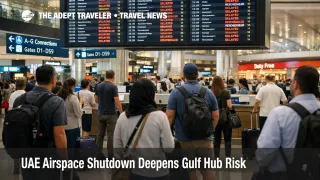
The UAE airspace shutdown on Tuesday, March 17, 2026 matters more than a normal short closure because it followed the March 16 Dubai disruption and turned Gulf transit risk into a repeat sovereign airspace problem, not just a single airport recovery issue. Reuters reported that the United Arab Emirates briefly closed its airspace in response to incoming missile and drone threats, and the UAE's aviation authority later said operations had returned to normal. Travelers moving through Dubai International Airport (DXB), Zayed International Airport (AUH), or nearby Gulf hubs should treat "reopened" as a throughput reset, not a reliability guarantee, especially for same day onward connections on separate tickets.
What changed versus Dubai Airport Shutdown Exposes DXB Hub Failure is the layer of disruption. Monday's problem was a Dubai airport side failure after a nearby fuel tank fire. Tuesday's problem was broader, because public reporting described a near two hour national airspace interruption, which means risk now sits above the airport level and can hit multiple UAE gateways at once. The practical result is that travelers should avoid assuming that a restored departure board means the system behind it is stable again.
UAE Airspace Shutdown, What Changed for Travelers
The latest closure window appears to have been brief but still operationally serious. Reuters confirmed the temporary shutdown and later reopening on March 17, while other current reporting described the interruption as lasting nearly two hours. The official UAE line is that flights returned to normal, but the public statement did not publish a minute by minute closure timeline in the material reviewed for this article. For travelers, that missing precision matters less than the repeat pattern, because a second straight day of interruption means aircraft rotations, crew legal duty clocks, gate plans, and transfer banks were hit again before the system had fully absorbed Monday's disruption.
The carriers most exposed are the airlines that depend on UAE hubs as long haul connection engines. Emirates said on March 17 that it was still operating a reduced flight schedule following the partial reopening of regional airspace. flydubai's live operational page continues to describe reduced operations and tells customers not to go to the airport unless they have confirmation that the flight is operating, has been rebooked, or has a revised check in time. Etihad has a published limited recovery schedule through March 19 and continues to frame operations as conditional and fluid. Air Arabia is also exposed because Sharjah sits inside the same sovereign airspace system, even though the airline's public traveler update was less clearly surfaced in current search results than those from Emirates, flydubai, and Etihad.
Non UAE carriers are exposed in a different way. Reuters reported that Gulf carriers including Emirates, Qatar Airways, Etihad Airways, and flydubai remain below prewar flying levels, while British Airways has extended cancellations to Dubai, Bahrain, and Tel Aviv until June and is adding capacity to alternate leisure markets. That is a useful signal for travelers because it shows some foreign airlines are already planning around prolonged Gulf instability, not just waiting for the next daily update.
Which Itineraries Are Most at Risk
The highest risk group is travelers trying to self connect through Dubai, Abu Dhabi, or Doha on the same calendar day, especially when the onward segment sits on a separate ticket. Repeat short closures are toxic for that structure because even if the first flight lands, a rolling ground hold, gate shortage, baggage delay, or late inbound aircraft can wipe out the transfer margin without any obligation for the second carrier to protect the rest of the trip. The main danger is not just cancellation. It is a seemingly operating itinerary that becomes unrecoverable mid chain.
Travelers already inside airline managed recovery channels are in a better position. Emirates is still running a reduced schedule, and Etihad has a dated limited map through March 19. Qatar Airways has separately published a limited March 18 to 28 recovery window, but Adept's own earlier reporting makes clear that Hamad is still fragile as a transfer machine even when more flights reappear. That means a protected single ticket on one carrier group is still meaningfully safer than improvising a same day Gulf hub connection across multiple carriers. Qatar Expands Doha Limited Schedule Through March 28 is relevant here because it shows that a published schedule window is not the same thing as a restored hub bank.
The next most exposed group is travelers treating a UAE overland fallback as an easy backup. UAE Border Congestion Complicates Overland Exits already showed why that assumption is weak. Border crossings can still help, but they require visas, documents, transport, and a real onward seat, which means they are a planned repositioning move, not a last minute replacement for a failed same day hub transfer.
What Travelers Should Do Now
The cleanest decision threshold is this, avoid same day self connects through the Gulf if missing the trip would be expensive, hard to replace, or tied to a cruise embarkation, safari, tour departure, wedding, or long haul final leg with limited backup service. In the current environment, a Gulf hub connection should only stay in play when the whole chain is on one protected ticket, the carrier is actively publishing reduced but real schedules, and you have enough slack for a forced overnight without wrecking the rest of the itinerary.
For travelers already booked in the next 24 to 72 hours, the immediate move is to verify operating status directly with the airline, not just the airport board, and to check whether the carrier has pushed a revised departure time, reaccommodation, or special handling notice. Emirates and flydubai are both telling customers to rely on live status tools and not to go to the airport without confirmation. That is the right behavioral clue to follow across the region.
For new bookings, the tradeoff is now straightforward. A Gulf transit may still be worth it when the fare savings are large, the itinerary is fully protected, and arrival timing is flexible. It is the wrong play when you are building your own connection, trying to salvage a separate ticket, or counting on the hub to behave like a normal high frequency bank. In those cases, it is smarter to reroute through a more stable non Gulf hub, or to build an overnight buffer rather than a same day self connect.
Why the Disruption Spreads Through Gulf Travel
A short sovereign airspace closure does more damage than its clock time suggests because Gulf hubs are banked systems. They rely on waves of arrivals feeding waves of departures across Europe, Asia, Africa, Australia, and North America. When airspace closes, even briefly, inbound aircraft divert or wait, outbound flights lose their sequence, crews burn duty time, and passengers hit misconnects in clusters rather than one by one. A reopening helps, but it does not restore the bank that already broke.
The second order effects are where travelers feel the pain. First order, flights hold, divert, or depart late. Second order, hotel demand rises for stranded transfer traffic, alternative Asian and European routings absorb displaced demand, and fares can harden as remaining seats get snapped up. Reuters also noted broader effects on fuel charges, ticket prices, and cargo flows, which is another sign that this is no longer a local airport story. It is a regional network stress event centered on one of the world's most important Europe to Asia connection corridors.
The main reason this March 17 event matters is repetition. One closure can be absorbed as an incident. Two straight days force travelers and airlines to price in the possibility that more interruptions can happen with little warning. That does not mean every Gulf itinerary should be abandoned. It does mean the burden of proof has shifted. Travelers now need a protected ticket, more buffer, and a cleaner backup plan than they would accept in a normal week.
Sources
- UAE airspace briefly closed due to missile, drone threat, Reuters
- Travel Updates | Help | Emirates
- Operational Updates & Airline Information | flydubai
- Etihad Airways to resume limited flight schedule from 6 March
- Dubai Airport Shutdown Exposes DXB Hub Failure
- Qatar Expands Doha Limited Schedule Through March 28
- UAE Border Congestion Complicates Overland Exits