

Nordic Easter Flights Shift After SAS Cuts, Norwegian Adds
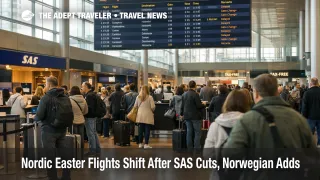
Nordic Easter flights are no longer just getting more expensive, they are being reshuffled. SAS said it would cancel about 1,000 flights in April after already cutting a couple hundred in March, while Norwegian said it would add 120 extra flights between March 25 and April 12 as displaced demand rises. For travelers moving through Scandinavia over the Easter build up, that changes the planning problem from pure fare pressure to seat availability, rebooking speed, and connection reliability. Travelers with short haul feeder legs into long haul itineraries should check bookings now, not at the airport.
Nordic Easter Flights: What Changed
What changed is that the Nordic market now has both a visible capacity cut and a visible backfill window. Reuters reported on March 17 that SAS would cancel 1,000 flights in April because jet fuel prices had surged, after its chief executive said fuel prices had doubled in 10 days. Reuters then reported on March 18 that Norwegian would add 120 flights in the Nordic region between March 25 and April 12. That creates partial relief during the pre Easter rush, but it does not replace all of the flying SAS is removing across the broader April schedule.
The timing matters. Norwegian's added flying is concentrated in the weeks when school holiday and Easter positioning demand typically harden prices and make same day recovery harder. Reuters said the extra flights will mainly run between the Nordic countries and Malaga, Alicante, and Las Palmas, with some additional London flying as well. That means the clearest short term seat relief is on leisure heavy southbound routes and a limited number of city links, not across every Nordic domestic or regional market touched by the SAS cuts.
This also marks a real change from the broader fuel story. In an earlier Adept Traveler article, SAS April Flight Cuts Hit Nordic Easter Plans, the focus was the first published schedule damage. In another recent piece, Europe Fuel Shock Threatens Summer Airfares, the pressure was still framed mainly through fares and thinner capacity. Now one carrier is cutting and another is selectively absorbing demand inside a defined Easter window, which is a more operational booking story.
Which Travelers Face the Most Disruption
The travelers most exposed are not only people flying SAS end to end. The bigger risk sits with passengers using short haul Nordic sectors to complete a longer journey, especially when the first leg feeds an international departure later the same day. A canceled or retimed feeder from Norway, Sweden, or Denmark can turn a manageable airline change into a missed long haul connection, an extra hotel night, or a forced airport change if rebooking options narrow.
Leisure travelers heading from Scandinavia to southern Europe may actually see some near term relief if their dates line up with Norwegian's extra flights to Spain. Even there, the tradeoff is not simple. A route may still operate, but at a different time, on another carrier, or from another airport than originally booked. That can affect baggage rules, seat assignments, ground transfers, and whether a same day onward rail or cruise connection still works.
Business travelers and long haul passengers have less margin for error. SAS said it normally operates about 800 daily flights, which means the April cuts are still a fraction of the total schedule, but the burden will likely fall on frequencies where the airline has alternatives rather than on markets it cannot easily abandon. That usually preserves some service while reducing schedule choice. For travelers, that means the itinerary may survive on paper while becoming less resilient in practice.
What Travelers Should Do Now
Start with the booking itself. Travelers flying between March 25 and April 12 should check whether their specific flight number still exists, whether the operating carrier has changed, and whether the connection time still makes sense after any timetable shift. Anyone flying beyond April 12 should not assume Norwegian's added capacity will still be there, because Reuters only confirmed the extra flights through that date while SAS cancellations extend into April more broadly.
Rebook sooner rather than later if the itinerary includes a long haul connection, a cruise embarkation, a fixed tour departure, or a holiday weekend arrival that would be expensive to miss. Waiting may preserve flexibility if airlines broaden reaccommodation options, but early action is more likely to save the itinerary when seat maps are tightening. Travelers whose trips are point to point, with no onward commitments, can afford to wait a bit longer if their route still has multiple daily alternatives and no hotel or event penalty depends on the original arrival time.
Build more buffer than usual around airport transfers and onward bookings. The first order problem is a changed flight. The second order problem is what that changed flight does to everything attached to it, including rail tickets, rental car pickups, overnight curfews, and long haul check in cutoffs. Travelers should also monitor whether fare increases spread further, because Norwegian said it is not imposing a separate fuel surcharge but uses dynamic pricing, which means tighter supply can still push prices higher on the routes where demand is moving fastest.
Why This Is Happening, and What Comes Next
The mechanism is straightforward, even if the outcome is messy. Higher jet fuel prices pressure airline economics first through margins, then through schedule decisions. SAS told Swedish business daily Dagens Industri that jet fuel prices had doubled in 10 days, which pushed the airline from raising prices into canceling flights. Norwegian, by contrast, had aircraft freed up by canceled Middle East flying, and Reuters said it is redeploying some of that capacity into Nordic and leisure routes where it sees immediate demand.
That matters because airlines do not just sell seats, they sell timing and network reliability. When one carrier removes frequencies and another backfills only selected routes, the total map may still look connected while the practical recovery options become uneven. The main near term question is whether this stays a Nordic Easter distortion or becomes a broader European pattern of selective cuts, fare pressure, and opportunistic redeployment as the fuel shock continues. Adept's broader fuel coverage already shows that airlines across Europe are warning about higher costs, thinner capacity, and fare pressure, so travelers should treat Scandinavia as an early test case, not an isolated market.
What happens next depends on fuel costs, the duration of the shock, and whether more carriers decide that price increases alone are not enough. For now, the practical threshold is simple. If your trip depends on a specific Easter week timing window, a protected long haul connection, or a limited frequency route, act now. If your trip is flexible and stays inside markets with many daily options, watch for timetable updates and fare moves over the next 24 to 72 hours.