

SalamAir Gulf Suspensions Cut Budget Backup Options
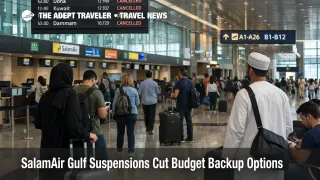
SalamAir Gulf suspensions just became a more useful, and more serious, planning signal for budget travelers. In a March 22 update posted at 4:00 p.m. Muscat time, the Omani low cost carrier said flights to and from Iraq, Lebanon, and Iran are suspended until April 30, 2026, while Kuwait, Sharjah, Doha, and Dammam remain suspended until March 31, 2026. For travelers who rely on SalamAir for short notice repositioning inside the Gulf and nearby markets, that means the cheapest fallback options are now split into two different recovery windows, not one. The practical move is to stop assuming a low fare workaround will appear close to departure, especially for trips that depend on Muscat as a budget bridge.
SalamAir Gulf Suspensions: What Changed
The most important change is not only that SalamAir is still cutting routes. It is that the airline now gives two distinct timelines, and those timelines affect very different kinds of trips. The March 31 bucket covers Kuwait, Sharjah, Doha, and Dammam, markets that many travelers use for short regional hops, VFR travel, labor travel, and same week repositioning. The April 30 bucket covers Iraq, Lebanon, and Iran, which pushes those markets beyond a temporary interruption and into a longer spring planning problem.
SalamAir also says the suspensions are tied to airspace closures in certain destinations because of ongoing regional developments. That matters because airspace driven cuts behave differently from a single airport outage or a fleet issue. Even when one airport is technically open, the route may still remain unusable if surrounding airspace, operating risk, or aircraft rotation logic has not normalized. Reuters has separately reported that airlines across the region and beyond are dealing with wider airspace disruption, rerouting pressure, and sharply higher fuel costs, which helps explain why low cost carriers are not simply snapping back to normal schedules.
Which Travelers Lose the Most Flexibility
The most exposed travelers are not only people booked on SalamAir itself. They are also passengers using Muscat, Oman, or nearby Gulf gateways as cheaper alternatives when legacy carrier fares spike or when larger hubs become harder to use. SalamAir sits in an important niche, it often provides lower fare regional lift that helps travelers rebuild broken itineraries without paying full service prices. When that layer thins out, the first order effect is obvious, fewer cheap seats and fewer simple city pair fixes. The second order effect is more expensive and more annoying, travelers get pushed toward longer routings, overnight stays, ground transfers, and split ticket combinations that are harder to protect if another disruption hits.
The March 31 suspensions hit some of the most practical fallback points in the Gulf. Doha, Sharjah, Kuwait, and Dammam are all useful for onward repositioning, family visits, labor traffic, or bridging to other carriers. Once those points drop out of the low cost map at the same time, price sensitive travelers lose some of the region's cheapest recovery tools. The April 30 suspensions are different. Iraq, Lebanon, and Iran are now in a longer disruption bucket, which makes waiting for a fast late March reset a weak strategy for travelers who still need those markets.
What Travelers Should Do Now
Travelers with SalamAir bookings through March 31, 2026 should treat the affected Gulf routes as suspended, not merely delayed. Check the airline's travel updates page before heading to the airport, and use the carrier's manage booking tools or your travel agent if the ticket was booked indirectly. SalamAir's rebooking page points passengers back to self service management channels and says the airline is monitoring the situation closely, which suggests travelers should expect rolling operational adjustments rather than a one time cleanup.
For trips involving Iraq, Lebanon, or Iran, the better decision threshold is harsher. If your travel is not essential and depends on SalamAir restoring service before the end of April, waiting is a gamble. Those routes now sit in a longer suspension bucket, and broader regional instability has already caused other airlines to extend cuts rather than restore them market by market. In an earlier Adept Traveler article, British Airways Extends Gulf Flight Cuts to May 31 showed how one carrier's late March disruption became a much longer spring problem. In another earlier Adept Traveler article, Middle East Airspace Closures Strand Dubai Travelers explained how airspace disruption spreads beyond the first canceled sector and breaks onward connections, hotel plans, and same day recovery options.
Price sensitive travelers should also look at the workaround SalamAir is signaling, not just the routes it is cutting. The airline's site says additional flights have been added to and from Fujairah, Cairo, and Port Sudan, and separate SalamAir pages show Fujairah inventory in the market now. That does not replace the suspended city pairs, but it does show the carrier is concentrating limited capacity where it still sees viable operating corridors. For some travelers, especially those who only need to get out of the Gulf or reposition to a functioning hub, Fujairah may be more realistic than waiting for Sharjah, Doha, or Kuwait to reopen on schedule.
Why the Budget Gap Matters Next
What happens next depends less on one airline decision and more on whether regional airspace risk actually eases. Reuters reported on March 17 that most Middle East airspace remained closed or disrupted enough to throw global aviation into turmoil, with cancellations, reroutes, and fuel shocks spreading well beyond the region. That broader mechanism matters here. A low cost carrier cannot reliably sell cheap short haul recovery seats when routing flexibility is constrained, operating risk remains elevated, and fuel costs are climbing at the same time.
The next likely phase is uneven restoration, not a clean regional reset. Some shorter Gulf routes may come back around the March 31 line if operating conditions improve, while the April 30 bucket points to a longer separation between near Gulf recovery and deeper conflict exposed markets. Travelers should watch for three signals, whether SalamAir shortens or extends the published dates, whether the airline adds more substitute flying through places like Fujairah, and whether other regional carriers keep moving their own end dates outward. Until those signals improve, SalamAir Gulf suspensions are best understood as a warning that the low fare safety valve in the region is narrower than many travelers assume.