

Middle East Airspace Closures Strand Dubai Travelers
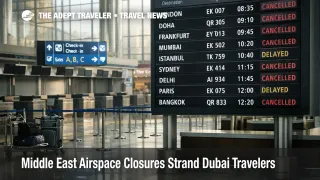
Middle East airspace closures expanded into a full scale passenger disruption on March 1, 2026, after U.S. and Israeli strikes on Iran triggered retaliatory attacks and rolling regional shutdowns. The immediate traveler problem is not only canceled departures, it is that three of the world's most connection heavy hubs, Dubai International Airport (DXB), Zayed International Airport (AUH), and Hamad International Airport (DOH), became unreliable for through travel between Europe, Africa, and Asia. If your itinerary touches these hubs within the next few days, the practical assumption is that schedules can change faster than apps refresh, so you need confirmation from the operating airline and the airport authority before you move.
One detail matters for decision making, airlines can only restart at the pace governments reopen airspace and airports. Qatar Airways has explicitly tied its restart to the Qatar Civil Aviation Authority's decision, and UAE authorities have described airspace measures as temporary and safety driven. That means "scheduled" is not the same as "operating," even when flights reappear in booking systems.
Middle East Airspace Closures: What Changed For Travelers
The closure wave hit travelers in two ways on March 1, 2026. First, direct suspensions at Gulf hubs stranded passengers mid journey, including people transiting on one ticket who expected a short connection that normally works because Gulf hubs run in timed banks. Second, the closure forced long haul reroutes around the region, which cascaded into missed onward connections in Europe and Asia, plus aircraft and crew displacement that can persist after airports reopen.
Reporting on March 1 described jammed airline phone lines, crowded hotels, and uncertainty about reopening timelines, with estimates that large daily connecting volumes normally flow through Dubai, Doha, and Abu Dhabi on carriers such as Emirates, Qatar Airways, and Etihad. Flight tracking data and airline advisories also indicated that cancellations reached well beyond the Gulf, affecting airports such as London Heathrow, Mumbai, Delhi, Bangkok, and Paris as aircraft were held, rerouted, or canceled to avoid closed corridors.
Which Itineraries Are Most At Risk Right Now
The highest exposure group is travelers already in transit who are relying on a same day connection through Dubai, Doha, or Abu Dhabi. When a banked hub pauses, the first order failure is obvious, departures cancel and inbound flights divert. The second order failure is capacity, once a bank is missed, the next viable seat may not be the same day, especially on long haul segments that have fewer frequencies and higher load factors.
Travelers on separate tickets remain the most financially exposed. Even when the first cancellation is not your fault, the onward carrier can still treat you as a no show if you do not proactively rebook, which turns a disruption into walk up fares, extra hotel nights, and lost prepaid reservations. Business travelers with fixed start times, and leisure travelers protecting cruise embarkations or timed tours, should treat this as a protect the itinerary problem, not a wait for the app problem.
There is also a geographic exposure layer. Travelers headed to, from, or over the Gulf and surrounding airspace are affected first, but travelers far away can still get hit when aircraft rotations break. A widebody that was supposed to leave Dubai for Europe tonight is often the same aircraft that feeds a morning departure elsewhere tomorrow. Once those rotations slip, irregular operations spread across networks.
What Travelers Should Do Now
Start with a hard rule, do not go to the airport based solely on your original itinerary time. Check your flight status on the operating carrier's website or app, then cross check the relevant airport authority update. If the airline offers a waiver, use it early, because the best routings that avoid Gulf hubs will disappear first.
Set a decision threshold based on what your trip cannot absorb. Rebook now if you have a hard arrival requirement within 48 to 72 hours, if your itinerary includes a cruise embarkation, or if you are on separate tickets. Waiting can save change fees, but it can cost the itinerary when the rebooking queue grows and inventory collapses.
Plan for lodging and documentation. If you are stranded, keep receipts and screenshots of cancellations, and ask the airline in writing what it will cover under its disruption policy. If your reroute changes where you clear immigration, verify your entry and transit requirements before you accept the new itinerary, because diversions can turn an airside connection into a landside overnight with different document requirements than your original plan.
Why This Disruption Spreads Beyond The Middle East
The mechanism is simple, airspace is the constraint that everything else depends on. When multiple adjacent countries close or restrict airspace, airlines either cancel or detour, and detours add time, consume fuel margins, and push crews toward duty time limits. That is why a regional closure can turn into global delays, even for flights that never intended to land in the affected countries.
Recovery is not instantaneous when airports reopen. Aircraft and crews end up scattered across alternates, maintenance plans slip, and airlines often restart with limited "recovery" flying before they rebuild full banks. Reuters reporting on March 2 described Etihad resuming limited operations while commercial flying remained constrained, which is a typical pattern when safety and airspace availability remain fluid. Expect a phased restart, and expect knock on cancellations to persist until fleets and crews are back in their planned positions.
Sources
- Stranded travelers scramble to make new connections as war shuts much of Middle East to air travel
- Etihad Airways resumes some operations, commercial flights still halted amid Iran conflict
- Update: Temporary Suspension of Qatar Airways Flights due to Qatari Airspace Closure
- Operations update, Qatari Airspace closure
- UAE temporarily, partially closes airspace as exceptional precautionary measure
- UAE airlines extend flight suspensions until Monday amid waves of Iranian missile strikes