

Teruel Aircraft Parking Shows Recovery Still Strained
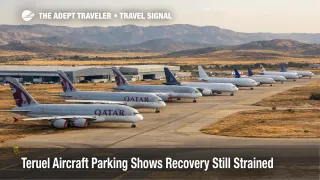
Teruel aircraft parking in Spain has become a useful stress signal for ordinary travelers, because airlines only move jets into storage when the network is too disrupted, too uncertain, or too expensive to use them where they were originally planned. Reuters reported on March 20 that Teruel Airport in eastern Spain was expecting about 20 aircraft, including 17 from Qatar Airways, as airspace disruption and jet fuel risk continued to reshape operations week by week. For travelers, that means the problem has moved beyond frontline cancellations. It is now about weaker schedule recovery, fewer spare aircraft, and less slack when something else goes wrong.
Teruel Aircraft Parking: What Changed
What changed is not just that a remote storage airport is busy again. It is that carriers are still treating part of their fleets as movable reserves rather than normal flying assets. Reuters reported Teruel, a former military base that became one of Europe's largest aircraft storage and maintenance sites, was seeing a fresh influx of widebody aircraft including Airbus A380s, A350s, and a Boeing 787. Airport manager Alejandro Ibrahim said the conflict was forcing operations to be adjusted week to week, which is the opposite of a stable return to normal scheduling.
Qatar Airways has separately said it positioned some aircraft at selected airports outside Qatar as a temporary measure and would return them to service progressively as operations normalize. That language matters. It confirms the parked jets are not routine maintenance traffic, and it also suggests airlines still do not see a clean enough operating picture to put every aircraft back into normal rotation.
In an earlier Adept Traveler article, Spain Parked Aircraft at Teruel Slow Recovery tracked the first visible wave of this shift. The newer fact is that Teruel aircraft parking still fits the broader pattern seen across Europe to Middle East flying, where long dated suspensions and reduced schedules are now stretching well beyond an immediate emergency window. In another earlier Adept Traveler article, Europe Middle East Flight Cuts Stretch to October showed that some carriers are already planning around a much longer disruption arc.
Which Travelers Feel This Most
The most exposed travelers are not only people flying to or from the Gulf. They are also travelers who depend on thin long haul banks, aircraft swaps, or same day reaccommodation through big hubs in Europe and the Middle East. When aircraft are parked instead of circulating, airlines have fewer spare tools to recover after weather, crew issues, air traffic control delays, or another rolling security event. First order, that can mean fewer frequencies or slower schedule rebuilding. Second order, it can mean longer rebooking lines, more forced overnight stays, and higher backup fares even on routes far from the original conflict zone.
This also hits connecting travelers harder than nonstop passengers. A parked widebody is not just one canceled departure. It is one less aircraft available to cover a broken rotation, protect a peak bank, or absorb spill when a different route fails. That is why fleet storage matters operationally even when the airport on your ticket is nowhere near Iran. The visible storage at Teruel points to a network that is still being managed defensively, with capacity held back and redeployed cautiously rather than used normally.
Jet fuel remains part of that same stress picture. In an earlier Adept Traveler signal, Jet Fuel Shortage Risk Spreads Beyond Asia argued that the problem was no longer just about higher prices, but about weaker transport buffers and more protective airline behavior. Parked aircraft in Spain fit that framework. They show carriers are still preserving optionality, not committing fully to normal utilization.
What Travelers Should Do Now
Travelers booking Europe, Gulf, and long haul connection itineraries over the next few weeks should treat schedules as more fragile than they look on the booking screen. The right move is not automatic panic rebooking. It is buying resilience where the trip matters most. For expensive or time sensitive itineraries, that usually means favoring nonstop service, avoiding the last departure of the day, and leaving more buffer before cruises, tours, or separate tickets.
The next decision point is whether your trip depends on an airline or hub that is already operating with reduced Middle East exposure or longer suspension timelines. If it does, waiting for a formal cancellation can save money in some cases, but rebooking earlier can save the itinerary when backup inventory is already thinning. Travelers should also watch for fare jumps on alternate routings, because rising replacement prices are often the first visible sign that spare capacity is getting tighter before another formal schedule cut appears.
A stabilizing signal would look different from what Teruel is showing now. Travelers should watch for aircraft returning from storage, fewer long dated carrier suspensions, and airline language shifting from temporary workarounds to restored normal operations. Until those signs appear, Teruel aircraft parking is not a curiosity. It is evidence that airlines are still protecting fleets, and that recovery margins remain thinner than normal.
Why Parked Aircraft Matter to Recovery
Teruel works as storage because it has space, dry conditions, and an established maintenance role. Reuters reported the airport has capacity for 250 widebody and 400 narrowbody aircraft, which makes it a practical refuge when airlines need safe parking outside the main conflict zone. But a storage surge is not a healthy airline signal. Ibrahim said Teruel's maintenance business works best when planes are flying regularly, not sitting idle. That is the clearest operational clue here. A network returning to normal uses aircraft productively. A network still under strain parks them and revises plans week to week.
What happens next depends on three linked variables, airspace stability, fuel pressure, and airline confidence in rebuilding rotations without having to reverse course days later. If those improve, parked jets can reenter service progressively. If they do not, travelers should expect more cautious scheduling, thinner recovery options, and continued fare pressure on the routes and hubs doing the remaining heavy lifting. For now, Teruel aircraft parking remains one of the clearest signs that Middle East disruption is still a network management problem, not just a front page cancellation story.
Sources
- Remote Spanish airport again becomes parking lot for planes, this time due to Iran war, Reuters
- Qatar Airways positions some aircraft abroad due to regional situation, Doha News
- Qatar Airways Service Update: 05 March 2026, Qatar Airways
- Europe Middle East Flight Cuts Stretch to October, Adept Traveler
- Jet Fuel Shortage Risk Spreads Beyond Asia, Adept Traveler