

Lufthansa Strike Vote Raises Frankfurt, Munich Risk
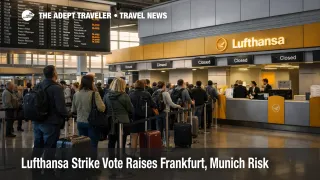
Lufthansa strike risk rose again on March 27 after cabin crew at Lufthansa and Lufthansa CityLine voted overwhelmingly to authorize industrial action, moving the story from labor friction to a formal strike mandate. Travelers connecting through Frankfurt Airport (FRA) and Munich Airport (MUC) now face a higher chance of short notice disruption over the next several days, even though no walkout dates have been announced yet. The immediate problem is uncertainty, not a published shutdown. Travelers with tight same day connections or hard to replace long haul segments should start protecting the weakest parts of the itinerary now.
Lufthansa Strike Risk: What Changed
What changed is not that Lufthansa has posted a strike schedule, it has not. What changed is that UFO, the cabin crew union, now has a clear mandate to escalate after talks broke down. Reuters reported support at 94 percent for Lufthansa cabin crew and 99 percent at Lufthansa CityLine, with no opposition votes cast at CityLine. The union said it will weigh next steps unless management makes what it called meaningful proposals, while Lufthansa said it remains in contact with UFO and hopes to reach positive outcomes through further discussions.
That matters operationally because a strike vote changes the decision window for travelers before any actual strike date is named. Once a union has authorization in hand, the next market moving detail is timing, not legitimacy. In an earlier Adept Traveler article, Lufthansa Strike Risk Rises at Frankfurt and Munich the risk was already elevated. The latest vote hardens that warning by giving the union room to move quickly if talks stay stuck.
Which Travelers Face the Most Disruption
The most exposed travelers are those booked on Lufthansa or Lufthansa CityLine flights touching Germany's hub system, especially itineraries that depend on Frankfurt or Munich for long haul onward travel. Those hubs matter because they concentrate Lufthansa's transfer traffic, alliance feed, and recovery options. If cabin crew action hits, the first order effect is canceled or delayed departures. The second order effect is tighter reaccommodation space across Star Alliance and a faster loss of acceptable same day backup options.
CityLine adds another layer of risk. Reuters reported that part of the dispute centers on management's refusal to negotiate a social plan during a planned wind down affecting about 800 cabin crew. That makes this more than a narrow wage story. It ties labor tension to network restructuring, which can keep negotiations harder and less predictable than a simpler pay fight. Travelers do not need to know every labor law detail to understand the practical consequence, the chance of a quick settlement is harder to model when the dispute also touches job security and fleet transition issues.
Travelers with separate tickets, tight Schengen to non Schengen connections, or prepaid hotel and rail components are in the weakest position. A cabin crew strike at the operating airline can break the core flight segment first, then force expensive fixes across the rest of the trip. Lufthansa's own handling during the March 12 to 13 pilot strike showed the group can run a reduced special timetable, but not a normal operation, and recovery can stretch beyond the official strike window.
What Travelers Should Do Now
The smart move right now is not panic rebooking across the board. It is targeted protection. If your trip depends on a fragile connection through Frankfurt or Munich in the next 24 to 72 hours, look at earlier departures, longer layovers, or routings that reduce dependence on one Lufthansa operated hub wave. If your itinerary is simple, nonstop, or easy to replace, waiting for a formal strike call may still be reasonable.
If Lufthansa later cancels or heavily delays flights, EU passenger rights rules still matter. The European Union says passengers facing cancellation have rights to reimbursement, rerouting, or a return flight, plus assistance such as meals and accommodation when required. The European Commission's passenger rights pages also make clear that airline staff strike cases do not erase the duty of care. In an earlier Adept Traveler article, Europe Airport Strikes: Compensation and Re-Routing Guide we mapped the rerouting logic travelers can use if disruption hardens into an actual walkout.
The next decision point is simple. Watch for three things, a union announcement naming dates, Lufthansa publishing a special timetable or waiver, or a visible slowdown in talks from either side. If none of those appear, risk stays elevated but unconfirmed. If one of them does, especially a timetable change, the window for finding reasonable alternatives usually gets worse fast.
Why This Fight Could Spread Through the Network
Hub airline strikes spread through travel differently than local airport strikes. When the operating carrier's own cabin crew are the pressure point, disruption moves through aircraft rotations, onward connections, and crew legality almost immediately. Frankfurt and Munich are not just local origin airports, they are sorting centers for European and long haul flows. That is why a labor action affecting one airline group can still distort itineraries well beyond Germany, especially for travelers headed to North America, the Gulf, and Asia on connecting tickets.
What happens next depends on whether Lufthansa can produce enough movement in negotiations to stop UFO from naming action. Right now, the verified facts support a higher short notice disruption risk, not a confirmed strike calendar. That distinction matters. Travelers should treat this as a live escalation phase where preparation has value, but should not assume every Lufthansa flight through Germany is about to fail.