

Lufthansa Pilot Strike Hits Germany Through April 14
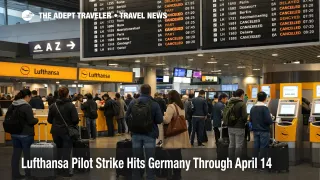
Germany bound and Germany connecting passengers are now in an active two day Lufthansa disruption window after Vereinigung Cockpit called pilots at Lufthansa, Lufthansa Cargo, and Lufthansa CityLine out from 1201 a.m. CET on April 13, 2026, through 1159 p.m. CET on April 14, 2026. Eurowings Germany pilots were also called to strike on April 13 only. Lufthansa says affected passengers should expect cancellations or rebookings, check flight status before going to the airport, and use digital self service tools where possible. For travelers with short connections, fixed tours, cruise departures, or same day rail onward plans, the safer move is to reroute or add buffer now rather than hope the German hub banks recover cleanly.
Lufthansa Pilot Strike Germany: What Changed
What changed is scope, operator mix, and duration. In an earlier Adept Traveler article, Lufthansa Germany Strike Hits April 10 Rebooking, the operational problem was a one day cabin crew action. The current strike is a separate pilot action that runs across two full calendar days for Lufthansa, Lufthansa Cargo, and Lufthansa CityLine, with an added Eurowings Germany strike layer on April 13. Lufthansa's current travel notice confirms the April 13 to 14 strike period and says it is trying to protect as many flights as possible by using other Lufthansa Group airlines and partner carriers.
The carrier has also published a defined waiver window. Passengers with tickets issued on or before April 11, 2026, on Lufthansa operated flights, including Lufthansa CityLine, scheduled for April 13 or April 14 may rebook without a fee onto another Lufthansa Group flight between April 11 and April 21, or request a refund through April 13. Lufthansa also says canceled flights without an air alternative may qualify for Deutsche Bahn rail substitution. That gives travelers options, but it does not remove same day airport risk once cancellations begin stacking.
Which Travelers Face the Most Disruption
The most exposed passengers are those originating in Germany, connecting through Germany, or flying on itineraries that depend on Frankfurt Airport (FRA) or Munich Airport (MUC) to feed a long haul flight. Those hubs matter more than smaller points because missed short haul feeder flights can break an entire ticketed journey even when the long haul sector still operates. Cargo disruption also matters operationally because it competes for aircraft, slots, crews, and recovery bandwidth while the system is already stressed.
Eurowings adds another complication. The airline says only flights operated by Eurowings Germany are affected by the April 13 strike call, while flights operated by Eurowings Europe are not. That means travelers cannot rely on the brand name alone. They need to check the operating carrier on the booking, especially on leisure routes and mixed itineraries that look like one Eurowings trip on the front end but are flown by different operating units underneath.
There is also a Middle East carveout, but travelers should not overread it. Reuters reported that the strike call excludes flights to Azerbaijan, Egypt, Bahrain, Iraq, Israel, Yemen, Jordan, Qatar, Kuwait, Lebanon, Oman, Saudi Arabia, and the United Arab Emirates. In practice, that means those sectors were excluded from the union action, not that every ticket touching Germany is protected. A passenger can still miss an exempt onward flight if the feeder into Frankfurt or Munich is canceled or delayed. That carveout sits on top of an already reduced regional schedule. In an earlier Adept Traveler article, Europe Middle East Flight Cuts Stretch to October, the network was already thinner than normal.
What Travelers Should Do Now
Travelers flying on April 13 or April 14 should check three things before leaving for the airport, flight status, operating carrier, and whether the ticket qualifies under Lufthansa's waiver terms. If the trip depends on a sub two hour connection in Frankfurt or Munich, the threshold for proactive change is low. Waiting may preserve the original itinerary on paper, but it raises the odds of a forced overnight, lost rail connection, or missed cruise embarkation if the feeder leg falls out late.
For passengers whose journey starts in Germany, or whose first European touchpoint is a German Lufthansa hub, rerouting around Germany is the cleaner option when an alternate path exists. For passengers already protected onto another Lufthansa Group service, the next decision point is whether that replacement still leaves enough ground time for immigration, terminal transfer, baggage recheck risk, or onward rail. If the trip purpose is high consequence, a wedding, cruise, conference, or expensive nonrefundable tour, rebooking earlier is usually the safer tradeoff than waiting for airport day recovery.
Travelers booked through agencies or corporate channels should not assume Lufthansa can handle every change directly. The carrier says agency bookings should be worked through the travel agency. That matters because response time can become part of the disruption itself once call centers and airport desks overload. If no usable air option remains, Deutsche Bahn substitution may help on some canceled domestic or short haul sectors, but that is a recovery tool, not a guarantee that a long haul itinerary stays intact.
How the Disruption Spreads Through Travel
The first order effect is straightforward, canceled departures and broken connections during the April 13 to 14 operating window. The second order effect is where the trip gets more expensive and harder to rebuild. Once short haul banks fail at Frankfurt or Munich, long haul passengers get pushed into thinner later departures, hotel demand rises around the hubs, and rail seats become more valuable as substitute transport. Recovery can also continue after the formal strike window ends because aircraft and crews do not reset instantly once operations restart.
What happens next depends on two moving parts, the size of the actual cancellation program, and how much flying Lufthansa can protect through partner and group capacity. Lufthansa says it is trying to operate as many flights as possible with other Lufthansa Group and partner airlines, while Reuters says the labor dispute centers on pensions and follows failed negotiations. That means travelers should watch for rolling schedule changes and reaccommodation notices, not just a single overnight cancelation wave. Over the next 24 to 72 hours, the main risk remains Lufthansa pilot strike Germany disruption spilling beyond the calendar strike window into delayed recovery at the German hubs.