

Lufthansa Strike Extends Germany Flight Risk to April 16
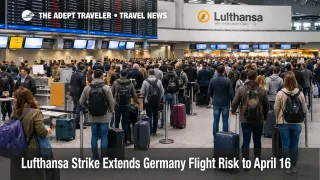
Germany bound and Germany connecting travelers should treat the Lufthansa strike Germany story as a rolling four day hub disruption, not a one day labor shock. Pilots at Lufthansa and Lufthansa CityLine remain out through Tuesday, April 14, 2026, after hundreds of cancellations on Monday, and a separate UFO cabin crew strike is now set for Wednesday, April 15, and Thursday, April 16, covering all Lufthansa departures from Frankfurt Airport (FRA) and Munich Airport (MUC). Lufthansa has widened its current rebooking policy to cover travel through April 16, which is the clearest sign that the carrier itself now expects disruption pressure to extend beyond the pilot action.
At Frankfurt, 570 takeoffs and landings, mostly tied to Lufthansa, were canceled on Monday, with more than 50,000 passengers affected. Munich reported 720 cancellations across two days, mostly involving Lufthansa connections. That scale changes the problem for travelers with long haul departures, cruise joins, fixed tours, or same day rail links out of Germany, because the risk is no longer just whether Tuesday operates, but whether the network is still recoverable by Wednesday morning before the next strike group hits.
Lufthansa Strike Germany: What Changed
What changed since the weekend is that the disruption phase is now verified, quantified, and immediately followed by another labor wave. Reuters reported on April 13 that the pilots' strike at Lufthansa and Eurowings caused hundreds of cancellations on Monday, with Lufthansa mainline and CityLine pilots called out for Monday and Tuesday, while Eurowings pilots were asked to strike on Monday only. Later the same day, Reuters reported that the UFO union called a separate two day cabin crew strike for all Lufthansa departures out of Frankfurt and Munich on Wednesday and Thursday.
Lufthansa's own current travel notice now bundles both labor actions into one operating warning. The carrier says passengers holding tickets from Lufthansa, Austrian, SWISS, Brussels Airlines, or Air Dolomiti, issued on or before April 13, 2026, and booked on Lufthansa operated flights, including Lufthansa CityLine, for April 13 through April 16, may rebook free of charge onto another Lufthansa Group flight before April 23, 2026, or request a refund before the ticketed travel date. Lufthansa also says canceled flights without an air alternative may be exchanged for Deutsche Bahn rail transport through its Good for Train option.
Which Travelers Face the Most Disruption
The most exposed travelers are those using Frankfurt and Munich as connection banks rather than final destinations. A traveler starting in Chicago, Illinois, or New York, New York, and connecting onward to Southern Europe, the Balkans, or the Middle East can lose more than one flight at once when one German hub segment disappears, because later departures may already be full, partner carrier protection can thin out fast, and airport hotels near the hubs tighten when reaccommodation stacks across multiple waves. The same is true for passengers trying to connect from smaller European cities into Lufthansa long haul departures.
Travelers with short haul flights only are not safe just because the ticket value is lower. Short haul flying is often the feed that holds the hub banks together. Once those banks weaken, long haul aircraft and crews can end up mispositioned, baggage transfer timing worsens, and rail substitution demand rises at the same time. In an earlier Adept Traveler article, Lufthansa Pilot Strike Hits Germany Through April 14, the main warning was a two day pilot disruption window. The new problem is that even travelers who miss the pilot strike itself may still walk into a cabin crew departure strike at the same two hubs a day later.
What Travelers Should Do Now
Travelers due to depart on April 14, April 15, or April 16 should stop building plans around tight same day German hub connections. The safer move is to shift to nonstop service, move the transatlantic leg to a non German hub, or add an overnight before any cruise departure, tour start, or separate ticket onward segment. Waiting may still work for travelers with flexible dates and no downstream penalty, but the tradeoff is that rebooking inventory usually gets worse after each cancellation pulse, not better.
Use Lufthansa's digital channels before calling. The carrier says it is experiencing high call volumes and is asking passengers to rely on online status checks, stored contact details, and self service rebooking where possible. That matters operationally because service center queues tend to become the second bottleneck after airport cancellations, especially when multiple strike notices overlap.
For travelers who cannot avoid Frankfurt or Munich, the threshold for changing plans should be low. Rebook early if you have a separate ticket onward, a non refundable hotel at destination, a cruise embarkation, or a visa or immigration deadline that fails if you arrive a day late. It can make sense to wait only if you are on a single protected ticket, have no critical same day connection, and can absorb a later arrival without losing the rest of the trip.
Why the Disruption Spreads Beyond Tuesday
The mechanism is simple, but the consequence is not. Pilots and cabin crew affect different parts of the operation, yet both strikes hit the same core Lufthansa hubs. When pilots stop flights early in the week, aircraft rotations, crew placement, and passenger reaccommodation all start to drift. A cabin crew strike that follows immediately after can then hit the recovery phase itself, not just the published schedule. That is why a Wednesday departure can still be at risk even if Tuesday looks calmer by late afternoon.
What happens next depends on whether Lufthansa and the unions break the current deadlock quickly. Reuters reported that the pilots' dispute centers on pensions, while the cabin crew union cited deadlock in its own collective bargaining dispute. For travelers, the practical signal to monitor is not the labor rhetoric. It is whether Lufthansa keeps its warning narrowed to April 16 or extends waiver flexibility again. For now, Lufthansa strike Germany exposure remains concentrated at Frankfurt and Munich, but the knock on effects can spread across the wider Lufthansa Group network through missed aircraft and crew positioning, crowded replacement flights, and heavier rail fallback demand.
Sources
- Current information, Lufthansa
- Hundreds of flights cancelled as Lufthansa pilots go on strike again, Reuters
- Lufthansa cabin crew union calls for strike on Wednesday and Thursday, Reuters
- Pilots' union calls strikes at Lufthansa on April 13, 14, Reuters
- Lufthansa Pilot Strike Hits Germany Through April 14