

Lufthansa Germany Strike Risk After Arbitration Fails
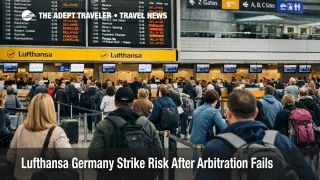
Lufthansa Germany strike risk has shifted from published walkout dates to an open ended settlement failure. On April 15, 2026, Reuters reported that Lufthansa and the Vereinigung Cockpit, or VC, pilots union remain deadlocked over the terms for arbitration after the latest strike wave, with the union saying the airline rejected its proposal and Lufthansa saying it is still open to a broader process. That leaves Germany bound and Germany connecting travelers with an unresolved labor risk even as this week's immediate cancellations begin to clear, especially on itineraries that depend on Frankfurt Airport (FRA), Munich Airport (MUC), and Lufthansa group connections. Travelers with tight onward plans should keep buffers high, avoid assuming recovery is complete, and watch for any new union call, airline waiver, or arbitration breakthrough.
Lufthansa Germany Strike Risk: What Changed
What changed is not just that Lufthansa has already absorbed a damaging strike stretch, but that the off ramp meant to contain the dispute has not been agreed. Reuters reported that VC accused Lufthansa of rejecting its arbitration offer after demanding a much wider process that would revisit not only unresolved issues at Lufthansa and Lufthansa Cargo, but also broader long term contracts. Lufthansa's position, as reported by Reuters, is that any arbitration must cover all major collective bargaining issues, including pay, working conditions, retirement, and transitional benefits. In practical terms, the argument is now about the scope of the deal making process itself, not only about the original pension and labor terms.
That matters because a failed arbitration path keeps future strike risk alive after passengers may have assumed the worst disruption window was already mapped. In an earlier Adept Traveler article, Lufthansa Pilot Strike Hits Germany Through April 14, the operational problem was a defined pilot strike. In a second earlier Adept Traveler article, Lufthansa Strike Extends Germany Flight Risk to April 16, the issue widened into a rolling multi day disruption. The April 15 development keeps the later recovery window unstable, because there is still no accepted framework for settling the dispute.
Which Travelers Face the Most Disruption
The most exposed travelers are the ones using Lufthansa as a hub carrier rather than as a simple point to point airline. That includes passengers connecting through Frankfurt and Munich, long haul travelers relying on short intra Europe feeder flights, and anyone on rebooked tickets whose backup options are still clustered inside Lufthansa group banks. Cargo customers and travelers on CityLine linked itineraries also remain exposed, because the earlier dispute already covered Lufthansa, Lufthansa Cargo, and Lufthansa CityLine, and Reuters says Lufthansa Cargo remains part of the arbitration disagreement.
The risk is lower for travelers on fully nonstop trips with flexible arrival times, or for passengers already moved onto non Lufthansa alternatives. It stays higher for trips where a delay or cancellation would break a cruise embarkation, a long haul same day connection, a rail handoff, or a nonrefundable event. The problem is no longer only the strike day itself. It is the weaker confidence that the operation will normalize cleanly if another walkout threat emerges before aircraft rotations, crew assignments, and reaccommodation loads have fully settled.
What Travelers Should Do Now
Travelers departing within the next 24 to 72 hours should keep checking Lufthansa alerts directly and review whether their itinerary depends on a narrow connection at Frankfurt or Munich. If a missed connection would force an overnight stay, missed cruise, or expensive onward change, the safer move is to rebook earlier onto a lower risk option while alternative seats still exist. Waiting makes more sense when the trip is nonstop, same day arrival is not critical, and multiple backup flights remain visible.
The next decision point is whether the airline and VC show real convergence on arbitration scope. A clear joint statement, a pause in new strike notices, or fresh passenger waivers would point toward stabilization. A new union announcement, especially one that again names Lufthansa, Lufthansa Cargo, or CityLine units, would signal that the disruption risk is moving forward rather than winding down. Travelers booking new Germany connections for late April should price in the possibility that the labor story is not over yet.
Why the Recovery Window Still Looks Fragile
The mechanism here is straightforward. During a normal recovery, airlines clear cancellations, reposition aircraft, restore crews to legal schedules, and work through rebooked passengers over several operating banks. When labor negotiations remain open and the settlement path itself is disputed, confidence in that recovery process weakens. Even if the next strike is not immediate, passengers and corporate travel managers may still shift bookings away, same day backup seats can stay tight, and later bank connections remain more brittle than they would under a clean settlement.
The next phase depends on whether both sides narrow the arbitration scope dispute. Reuters reported that Lufthansa says it is open to comprehensive arbitration, while VC says the airline's conditions go too far because they would reopen agreements the union views as already settled. Until that gap closes, the operational story for travelers is not just past cancellations. It is an unresolved Germany flight risk that can flare again with limited warning.
Sources
- Lufthansa, pilots union deadlocked on arbitration offer
- Pilots' union calls strikes at Lufthansa on April 13, 14
- Hundreds of flights cancelled as Lufthansa pilots go on strike again
- Lufthansa lehnt Schlichtungsangebot der Vereinigung Cockpit ab
- Vereinigung Cockpit kündigt weitere Streiks an und schlägt Schlichtung vor
- Lufthansa Pilot Strike Hits Germany Through April 14
- Lufthansa Strike Extends Germany Flight Risk to April 16