

Jerusalem Holy Week Closures Block Old City Worship
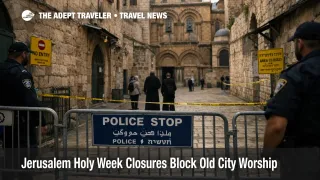
Jerusalem Holy Week closures have turned a regional war story into a site access problem inside the city itself. On March 29, 2026, Israeli police blocked the Latin Patriarch of Jerusalem and the Custos of the Holy Land from reaching the Church of the Holy Sepulchre for Palm Sunday Mass, while church officials said the move prevented their leaders from celebrating there for the first time in centuries. For travelers with Easter week, late Ramadan, or Passover plans centered on the Old City, the practical problem is no longer only whether flights operate. It is whether the religious site, gate, or neighborhood you built the trip around is actually accessible when you arrive.
Jerusalem Holy Week Closures: What Changed
What changed is that the access restriction is now visible at the highest level of Christian observance in Jerusalem, not only in broad security guidance. Reuters reported that Israeli police said all holy sites in the Old City had been closed to worshippers since the war began, that a request to let the church leaders reach the Holy Sepulchre was denied, and that freedom of worship would continue only subject to security restrictions. The Latin Patriarchate and Custody of the Holy Land called the measure disproportionate and said the two church leaders were walking privately, not leading a procession, when they were stopped.
The closure picture is broader than one church. AP reported that the Church of the Holy Sepulchre remained closed under wartime rules that prohibit gatherings above 50 people, that the Western Wall plaza was also closed to worshippers, and that Al Aqsa stood empty through most of Ramadan after the war began. That means Jerusalem's main spring pilgrimage circuit is not operating in anything close to normal form, even where small indoor services may still occur near approved shelters.
Which Travelers Face the Most Disruption
The travelers most exposed are pilgrims whose itineraries depend on timed Holy Week observances, walking processions, Old City hotel stays, and guided faith tours built around access to the Holy Sepulchre, the Western Wall, or Al Aqsa. Independent travelers with flexible plans can still visit Jerusalem more easily than group departures tied to one service, one gate, or one specific day. The risk rises further for same day arrivals from Tel Aviv area hotels or airports, because a trip can remain technically possible while the core religious purpose collapses on arrival.
This also changes the value of staying near the Old City. In an earlier Adept Traveler article, Ben Gurion Flight Cap Forces Israel Exit Choices showed that air access in and out of Israel is already constrained. Now the second layer of risk is inside Jerusalem itself. A traveler can absorb scarce flight inventory, higher hotel rates, and local transfers, then still lose access to the place the trip was meant to serve. That makes the exposure sharper for short stays, organized pilgrimages, and anyone whose schedule leaves no room to wait for a gate or worship rule to ease.
What Travelers Should Do Before Easter Week
Travelers should stop treating a hotel booking in Jerusalem as proof that a religious visit remains workable. Before departure, confirm three separate things, whether your airline or overland arrival still holds, whether your specific service or site is open, and whether the approach route to that site is actually being allowed on the day you plan to go. If even one of those pieces is uncertain, the safer assumption is that the religious part of the itinerary is at risk.
The next decision point is whether your trip is purpose driven or destination driven. If the trip is mainly for Palm Sunday, Holy Week, Easter, Passover, or Ramadan worship inside the Old City, rebooking is easier to justify than waiting for last minute clarification. If the trip is broader and Jerusalem is only one stop, travelers should build extra nights, avoid nonrefundable guided add ons, and be ready to substitute museums, modern city neighborhoods, or trips outside the Old City on short notice. For overland contingency planning, Taba Exit Costs Raise Israel to Egypt Cash Risk and Israel Exit Routes Shift to Aqaba and Taba remain relevant if conditions worsen further.
Travelers still planning to enter Israel should also review broader document and border mechanics in Israel Entry Requirements For Tourists In 2026, because a trip that shifts from straightforward sightseeing to a wait and monitor posture puts more pressure on entry timing, onward proof, and flexibility at the border. The best working threshold now is simple, if your visit depends on one Old City observance on one specific day, Jerusalem Holy Week closures are severe enough to justify delaying the trip unless direct local confirmation says your access path is open.
Why Access Rules May Keep Shifting
The mechanism is wartime crowd control, not only church specific restriction. AP reported that the Holy Sepulchre remains closed under military gathering limits and that some smaller synagogues, mosques, and churches can still open for groups of up to 50 when they are near approved shelter space. Police said the Holy Sepulchre itself lacks adequate emergency access and shelter in the event of a missile attack. In practice, that means access decisions are being shaped by site layout, shelter reach, and crowd concentration risk, not simply by the religious calendar.
What happens next is likely to be uneven rather than cleanly closed or reopened. Some small services may continue in alternate locations, while the highest profile Old City observances remain restricted if missile risk and gathering caps persist. That leaves travelers with a moving threshold problem. The trip may still happen, but the signature religious experience may not. For Easter week travelers especially, Jerusalem Holy Week closures should now be treated as a live operational disruption, not a background security note.