

Ben Gurion Flight Cap Forces Israel Exit Choices
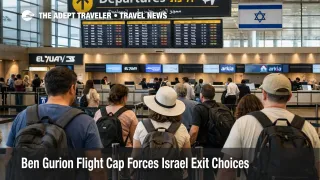
Israel's exit problem is no longer just a shortage of seats, it is a hard operating ceiling. Israel cut Ben Gurion Airport to one incoming and one outgoing flight per hour, and each departing flight is limited to 50 passengers, while El Al said it would operate at only 5 percent of normal capacity under the restrictions. For travelers inside Israel, that sharply reduces the odds of finding a timely direct seat out of Tel Aviv and makes border based plans through Jordan or Egypt far more relevant over the next several days. The immediate consequence is not only fewer flights, but fewer realistic same day recovery options when a booking fails.
Ben Gurion Flight Cap: What Changed
The new ceiling explains why the airport can remain technically open while still failing to function like a normal commercial gateway. Reuters reported that the government mandate allows only one arrival and one departure per hour at Ben Gurion Airport (TLV), with outbound flights capped at 50 passengers. Times of Israel separately reported that arriving flights are not subject to the same passenger limit, which means the system is being managed primarily to control crowding and outbound flow, not to restore normal bidirectional traffic.
That matters because a limited schedule is not the same thing as practical availability. El Al said it would operate at just 5 percent of normal capacity, and Reuters said the carrier would focus on essential flights to major cities including New York, Los Angeles, Miami, London, Paris, Rome, and Athens. Arkia, facing the same constraints, said it would move much of its operation toward Aqaba, Jordan, and Taba, Egypt, though some later reporting shows the airline also trying to preserve selected long haul departures from Israel where possible. The operational picture is clear even if individual flights shift, outbound supply from TLV remains severely constrained.
Which Travelers Should Pivot to Border Exits
The travelers most exposed are those still hoping for a normal outbound booking flow from Tel Aviv, especially families, groups, passengers with tight onward connections, and anyone needing a specific long haul departure window. With only one departure an hour and just 50 outbound passengers allowed on each flight, the Ben Gurion flight cap turns every remaining seat into a scarce exception rather than a routine option. That is why official advisories have shifted from monitoring flights to actively considering land exits.
The U.S. Embassy in Jerusalem said on March 22 and March 23 that Americans seeking to depart Israel should also consider overland routes to Amman, Jordan, or Taba, Egypt, where commercial air options remain available. The U.K. Foreign, Commonwealth and Development Office said on March 24 that Ben Gurion was operating a limited outbound schedule, with operations understood to be approved only for El Al, Israir, Arkia, and Air Haifa. In an earlier Adept Traveler article, Israel Exit Routes Shift to Aqaba and Taba tracked that corridor shift as flights became harder to secure. This new cap strengthens that conclusion, because alternatives are no longer just a backup, they are now part of the main exit map.
What Travelers Should Do Now
Travelers with a confirmed near term seat on one of the still approved Israeli carriers should verify it directly with the airline before going to the airport, because the main pressure point is now execution, not just booking. Canada's travel advisory says Ben Gurion has reopened but availability and destinations remain limited, and travelers should expect delays or cancellations on short notice. If your itinerary depends on a specific same day international connection, the safer assumption is that the Ben Gurion flight cap leaves very little slack for reaccommodation.
Travelers without a confirmed seat, or with a booking that has already slipped once, should stop treating a direct TLV departure as the default plan. The better threshold is practical, not emotional. If you do not have a validated ticket on an operating carrier, or if your departure depends on a waitlist, reaccommodation promise, or unconfirmed reopening, it is time to price and stage border options through Aqaba or Taba. Taba remains open, according to Australia's Smartraveller, though it can close or restrict hours at short notice, and the U.K. warns that border charges there have risen on short notice, with travelers advised to carry cash.
That staging piece matters. Scarce air seats push more people into hybrid exit routes, which means hotel nights near border areas, paid transfers, crossing fees, and onward flights from Egypt or Jordan become part of the real travel cost. Jordan's FCDO entry guidance says land crossings carry a 10 Jordanian dinar departure tax, while U.S. and U.K. advisories both point travelers toward Jordan and Egypt as the practical alternatives. Waiting may still work for travelers with flexibility and no urgent deadline, but it is no longer the low risk option.
Why the Cap Changes the Exit Map
A hard airport cap changes behavior across the whole travel system. First order, it limits departures from Ben Gurion itself. Second order, it shifts demand to border crossings, shuttle buses, hotels near Eilat and Taba, transfer providers, and alternate airports in Jordan and Egypt. That also raises the risk of a different kind of disruption, longer border processing, tighter ground transport availability, and more expensive last minute onward flights once travelers finally clear Israel.
What happens next depends on whether the cap loosens, whether Ramon Airport near Eilat is opened as a wider alternative, and whether the security environment allows Israel to expand departures beyond the current ceiling. For now, the Ben Gurion flight cap is the clearest decision marker travelers have. If you hold a real seat, protect it. If you do not, build an exit plan around Aqaba or Taba before those corridors absorb even more displaced demand.
Sources
- Israel's El Al Airlines to operate at 5% of capacity after government limits traffic
- Israel travel advice
- Security Alert: U.S. Embassy Jerusalem, March 22, 2026 update
- Security Alert: U.S. Embassy Jerusalem, March 23, 2026
- Travel advice and advisories for Israel and Palestine
- Israel, Smartraveller advice
- Entry requirements, Egypt travel advice
- Entry requirements, Jordan travel advice