

Jerusalem Holy Week Access Still Fragile After Reversal
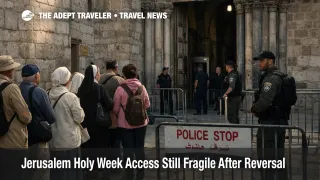
Jerusalem Holy Week access is still too unstable to treat the Palm Sunday reversal as a clean reopening. Israeli police blocked Cardinal Pierbattista Pizzaballa and another senior Catholic cleric from the Church of the Holy Sepulchre on March 29, 2026, before Prime Minister Benjamin Netanyahu reversed the restriction for the rest of Holy Week. That fixes the immediate diplomatic flashpoint, but not the deeper travel problem, because Reuters reported that Old City holy sites had been closed to worshippers under wartime security rules, and the U.S. Embassy in Jerusalem still directs many departure plans toward Taba and warns travelers they must arrange and pay for their own onward transport from Egypt. For pilgrims whose trip depends on one service, one shrine, or one narrow exit path, the margin for error remains thin.
Jerusalem Holy Week Access: What Changed
What changed since Sunday is not that Jerusalem has become reliably accessible again. It is that the most visible restriction, the blocking of top Catholic leaders at the Church of the Holy Sepulchre, was reversed after international pressure. Reuters reported that Netanyahu ordered authorities to grant access after the police action sparked outcry, but the same reporting also said police had closed Old City holy sites to worshippers since the start of the war and tied the restrictions to emergency access limits and the lack of bomb shelters in parts of the Old City. That means the reversal removed one highly symbolic ban, but it did not eliminate the enforcement logic behind sudden closures.
For travelers, that distinction matters more than the politics. A pilgrimage can still fail operationally even if a church is not formally shut all week. Access can narrow at the gate, at the neighborhood level, or at the point where crowd controls, gathering caps, and shelter rules collide. Reuters and AP both described a picture of uneven, conditional enforcement rather than a stable open status, which leaves Holy Week plans vulnerable to abrupt changes on the day of worship.
Which Pilgrims Face the Highest Risk
The most exposed travelers are those on short, purpose built Holy Week itineraries, especially pilgrims arriving for Palm Sunday, Holy Thursday, Good Friday, Easter, or a single timed service at the Holy Sepulchre. Group tours, day trips from outside Jerusalem, and travelers with nonrefundable guides or fixed transfer chains have less room to absorb a same day access change. A broader leisure trip can survive if the Old City becomes partly inaccessible. A worship centered trip often cannot.
The second pressure point is departure planning. The U.S. Embassy in Jerusalem said on March 30 that travelers using Taba must arrange and pay for travel to and from the crossing and for onward flights from Egyptian airports, while the March 18 State Department sourced OSAC update said Taba remains open, commercial flights remain an option, and Allenby Bridge to Jordan is still a departure route. That leaves travelers with exits, but not with a friction free fallback. In practice, a pilgrim can lose site access in Jerusalem, decide to leave, and then face a self managed overland and onward air problem rather than a simple airport handoff.
This is where the story becomes more brittle than a normal security advisory. The religious access issue and the exit issue stack on top of each other. In an earlier Adept Traveler article, Jerusalem Holy Week Closures Block Old City Worship laid out the site access risk inside the city. In an earlier Adept Traveler article, Ben Gurion Flight Cap Forces Israel Exit Choices showed how limited air capacity was already narrowing departure flexibility. Together, those pressures make Holy Week trips more vulnerable to a single bad turn.
What Travelers Should Do Before Plans Break
Travelers should judge Jerusalem plans by brittleness, not by hope. If the trip depends on one ceremony, one access gate, or one same day transfer chain, the safer threshold is to postpone or rework the itinerary unless you have direct, current confirmation from your church operator, hotel, and transport provider. A trip becomes too brittle when one closure or one road restriction wipes out the whole purpose of travel.
If you are already committed to travel, build slack into every layer. Hold flexible hotel nights where possible, avoid tightly timed ground transfers, and keep cash and document buffers for overland contingencies. Travelers considering Taba as a fallback should read Taba Cash Warning Raises Israel Exit Route Risk before assuming Egypt is a simple onward bridge, and travelers still entering Israel should review Israel Entry Requirements For Tourists In 2026 before departure. The right decision is no longer only about whether you can get in. It is whether the purpose of the trip survives once you arrive.
The next practical signal to watch is not rhetoric from either side. It is whether churches and local operators can give specific, same day access confirmation for Holy Week services and whether exit guidance remains stable for Taba, Allenby, and limited commercial flights. If confirmations stay vague, or if worship is shifted again to alternate venues or private formats, Jerusalem Holy Week access should still be treated as a live disruption rather than a normalized reopening.
Why The Reversal Did Not Restore Normal Access
The mechanism here is wartime crowd control in a dense, hard to evacuate religious district. Reuters reported that police cited the Old City's narrow lanes, limited emergency vehicle access, and shelter constraints when defending the Palm Sunday restriction. AP reported that gathering limits and proximity to shelter space were shaping what could still operate. Those are structural conditions, not a one day misunderstanding, which is why a political reversal did not automatically restore predictable access for pilgrims.
What happens next is likely to be uneven. Some services may proceed, some may be relocated or limited, and access decisions may continue to change faster than long haul travelers can safely rework flights, hotels, and onward exits. That keeps the operational risk elevated through the rest of Holy Week. Jerusalem Holy Week access is still open enough to tempt travelers, but not stable enough to trust without real time confirmation.
Sources
- Israel blocks cardinal from Jerusalem's Holy Sepulchre on Palm Sunday, sparking outcry
- Israeli police prevent Catholic leaders from celebrating Palm Sunday Mass at Jerusalem church
- Security Alert: U.S. Embassy Jerusalem, March 30, 2026
- Security Alert: Egypt, Update on Taba Border Crossing, March 18, 2026