

Taba Cash Warning Raises Israel Exit Route Risk
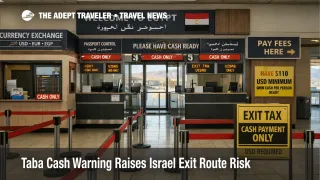
Travelers treating Taba as a backup exit from Israel now need to plan it like a cash first border operation, not a simple overland substitute for Ben Gurion Airport (TLV). The U.K. government now advises anyone crossing from Israel into Egypt at Taba to carry at least $110.00 (USD) in cash per person, plus extra cash for additional expenses, and says border charges there have been rising at short notice since early March 2026. The problem is no longer just whether Taba is open, it is whether travelers arrive funded for the exact route they intend to take. That changes the decision window before departure from Israel, especially for anyone trying to reach Sharm el Sheikh, Cairo, or a same day onward flight.
Taba Cash Warning: What Changed
What changed is the level of official specificity. GOV.UK says travelers crossing at Taba should bring at least $110.00 (USD) in cash per person, with extra cash on hand because charges have been increasing at short notice since early March 2026. It also says ATMs at the crossing are unreliable and frequently run out of cash, which means travelers should obtain U.S. dollars before travel, or in Eilat, rather than assuming they can solve a shortfall on arrival.
The current fee stack depends on how far the traveler is going once inside Egypt. Travelers staying only in Taba are told to expect a $10.00 (USD) border tax for an entry permission stamp valid up to 15 days. Travelers continuing farther into Sinai, including Sharm el Sheikh, face a $60.00 (USD) border tax. Travelers going beyond Sinai, including those planning to fly onward from Cairo or Hurghada, face a $60.00 (USD) border tax, a $30.00 (USD) standard entry visa, and at Taba, a letter of guarantee that costs about $20.00 (USD).
Which Travelers Face the Highest Taba Risk
The travelers most exposed are those leaving Israel without a firm cash plan, those relying on same day transfers to Sharm el Sheikh International Airport (SSH) or mainland Egypt flights, and those assuming Taba works like a normal airport handoff. In an earlier Adept Traveler article, Israel Exit Routes Shift to Aqaba and Taba explained why Taba had become more central as flight options narrowed. The new friction is at the border counter itself. Fee volatility, cash only payment requirements, and route dependent charges can turn a workable exit into a missed transfer or forced overnight stay.
This risk rises further for travelers heading beyond South Sinai. The Taba route can still work, but the cash threshold climbs quickly once a mainland Egypt flight is involved. That means the border decision is not just about getting out of Israel. It is also about whether the traveler has the right paperwork, enough physical cash, and enough buffer to absorb slow processing, fee changes, or a last minute change in onward plans. In an earlier Adept Traveler guide, Egypt Tourist Entry Requirements For 2026 explains the wider visa logic travelers need to match to that onward plan.
What Travelers Should Do Before Leaving for Taba
Travelers should fund the whole corridor before departing Israel. For many people, that means carrying more than the minimum $110.00 (USD), not less, because the official advice already assumes extra cash may be necessary. Anyone continuing to Sharm el Sheikh should plan around the $60.00 (USD) Sinai border tax, while travelers heading to Cairo, Hurghada, or elsewhere in mainland Egypt should budget for the border tax, visa, and letter of guarantee together, then add buffer cash for transport, food, and delay related costs.
The decision threshold is straightforward. Taba works best when the traveler already has U.S. cash, understands whether the trip ends in Taba, South Sinai, or mainland Egypt, and has enough schedule slack for a slower than expected crossing. It becomes a poor choice for travelers who are underfunded, do not know their onward visa requirements, or are trying to make a tightly timed flight without room for a missed connection. If you are driving, the budget should be higher still, because GOV.UK says car travelers may also be required to pay $50.00 (USD), with added parking charges.
What to monitor next is simple but operationally important. Watch for any fresh government updates on Taba charges, keep onward transport flexible where possible, and do not assume a published route is the same thing as a friction free route. At Taba, the failure point is increasingly not finding the crossing. It is arriving without enough cash and margin to get through it cleanly.
Why Taba Works Best as a Pre Funded Exit Route
Taba remains useful because it is still listed by GOV.UK as open 24 hours, and because it gives stranded travelers a live overland path into Egypt when air capacity out of Israel remains constrained. But the mechanism has changed. This is no longer just an alternate border. It is a variable cost transfer point where the route beyond the crossing determines the true price and paperwork burden.
That creates a second order travel problem beyond the border booth. When travelers arrive short on cash, they are not just delayed at immigration. They can miss airport transfers, lose hotel nights, or watch a controlled exit plan turn into an improvised overnight in Taba or Eilat. The practical lesson is that Taba still works, but mostly for travelers who treat it as a funded corridor with paperwork and timing built in, not as a cheap or casual escape valve.