

Colombia Protest Risks Return to Airport Access
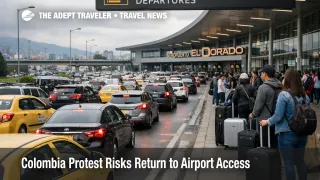
Colombia protest travel disruption is back in the decision frame after the U.S. State Department reissued its Colombia advisory at Level 3, Reconsider Travel, on March 31, 2026. The practical risk is not only security in the abstract. The advisory says demonstrations can shut roads and highways without notice, reduce access to public transportation, and interrupt travel within and between cities, which turns routine airport transfers and domestic travel days into weaker links in an itinerary. Travelers with fixed flight times, long road transfers, or same day city to airport moves should plan more conservatively than they would on a normal Colombia trip.
Colombia Protest Travel Disruption: What Changed
The headline change is not a new protest order or a single national strike date. It is that the State Department refreshed the advisory on March 31, 2026 and kept Colombia at Level 3 while repeating unusually operational language about demonstrations. The advisory says political demonstrations are common throughout Colombia and can close roads and highways without notice, cut access to public transportation, and interrupt travel within and between cities. It also warns that airports and transportation centers can be potential targets in Colombia's wider security environment.
For travelers, that changes how to read a normal looking schedule. A flight can remain on time while the weak point shifts to the road between a hotel and the terminal, or between one city and the next. A missed flight in that situation is not caused by an airline cancellation, it is caused by access failure, which usually leaves fewer protections and fewer recovery options.
This refresh also adds recency to a pattern Adept Traveler has already been tracking. In an earlier Adept Traveler article, Bogotá Protest Marches Block Key Roads, Airport Runs documented how Bogotá demonstrations were already disrupting central corridors and airport runs. In another earlier Adept Traveler article, Colombia Election Border Closure Disrupts Travel the same no notice protest and road risk intersected with wider movement controls.
Which Travelers Face the Most Exposure
The most exposed travelers are those relying on road timing they cannot easily recover from. That includes same day departures from Bogotá El Dorado International Airport (BOG), travelers staying in central Bogotá, travelers connecting from domestic flights to international departures, and anyone using a long private transfer or bus leg before a flight. Bogotá stands out because recent U.S. Embassy alerts there have explicitly warned that protests can cause traffic disruption around protest locations, and prior city level disruption has affected major transit corridors.
The risk is broader than Bogotá, though. The March 31 advisory says demonstrations are common throughout Colombia, not just in one city. That makes Medellín, Cali, Cartagena, and other urban itineraries vulnerable in a different way, especially when the plan depends on highways, bus terminals, or a tightly sequenced transfer chain. Once a closure blocks a major road, the second order effect is usually not just delay. It is route compression, rideshare scarcity, slower public transport, and fewer fallback options for reaching airports, hotels, tours, or onward ground transport.
There is also a geographic ceiling travelers should not ignore. The State Department continues to mark several departments and the Colombia Venezuela border region at Level 4, Do Not Travel, even while the country overall remains Level 3. That does not mean tourist trips to Bogotá or Cartagena are automatically unworkable. It does mean travelers should stop thinking of the advisory as background noise and start treating domestic movement assumptions more carefully.
What Travelers Should Do Now
The cleanest adjustment is to reduce same day dependencies. If a departure from Bogotá, Medellín, or another major city is important enough that a missed flight would break the trip, the stronger move is to sleep near the airport the night before or move the long transfer to an earlier day. No official agency has published a universal "add this many minutes" rule for Colombia. That is exactly the point. When closures can happen without notice, rigid buffer math is weaker than changing the structure of the day.
For ordinary travel days, travelers should also treat intercity road segments and airport transfers as separate risk events, not one smooth chain. A domestic flight after a morning city tour, or a long bus ride feeding an evening international departure, is a fragile setup under this advisory. When the trip purpose is high stakes, rebooking to a later flight or moving the transfer earlier usually protects the itinerary better than hoping traffic holds.
The next decision point is local monitoring. Watch airline apps, local traffic conditions, hotel transport desks, and U.S. Embassy alerts in the 24 hours before movement, not just the night before a flight. Protest related friction in Colombia often hurts travelers first at the curb, on the highway, or in the transfer queue, not on the departures board. That is the real Colombia protest travel disruption problem now, airport access and intercity timing can fail before the aircraft does.
Why the Risk Hits Airport and Intercity Plans First
Demonstrations become a travel problem in Colombia because they interfere with the network layer that connects everything else. The March 31 advisory does not say flights across Colombia are broadly shut down. It says roads and highways can close without notice, access to public transportation can be reduced, and travel within and between cities can be interrupted. In operational terms, that means the first break often appears before check in, at the road junction, bus corridor, or transfer leg that feeds the terminal.
That mechanism is why the disruption can feel bigger than the visible protest footprint. One blocked corridor can push taxis and private cars onto fewer usable routes, lengthen airport approach times, and make ETAs unreliable even for travelers far from the demonstration itself. If public transportation is also affected, more passengers shift into road based options at the same time, which compounds congestion. Embassy protest alerts in Bogotá have repeatedly warned of traffic disruption around protest locations, which supports a conservative planning posture for city to airport timing.
What happens next depends on whether the advisory is followed by additional embassy alerts, city traffic advisories, or a new wave of protest calls. For now, the serious part is not a nationwide shutdown claim. It is that the U.S. government has freshly restated a no notice road closure risk that directly affects airport access, public transport reliability, and intercity movement planning in Colombia.