

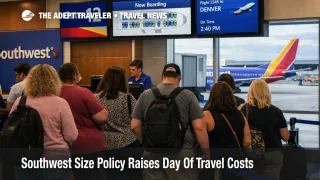
Southwest Size Policy Raises Day Of Travel Costs
April 2 flight delays are shaping up as a Chicago first problem with a wider national risk map behind it. The Federal Aviation Administration's command center said weather lingering over Chicago triggered an active ground stop at Chicago O'Hare International Airport (ORD) this morning, while additional programs were possible later for Minneapolis St. Paul International Airport (MSP), Ronald Reagan Washington National Airport (DCA), Newark Liberty International Airport (EWR), Boston Logan International Airport (BOS), John F. Kennedy International Airport (JFK), and other hubs. At the same time, San Francisco International Airport (SFO) was already posting average destination delays of 47 minutes because of low ceilings. Travelers with short connections, late day turns, or same day onward plans should protect margin early.
April 2 Flight Delays: What Changed
What changed on April 2, 2026 is that the FAA's system picture moved from broad forecast risk into at least one live choke point. The agency's current operations plan listed an active ground stop at ORD until 12:45 Zulu, with rain and low ceilings affecting Boston, New York approach sectors, Seattle, and Chicago, thunderstorms affecting Central Florida, Austin, Dallas Fort Worth, and Houston flows, and freezing rain creating additional concern in Minneapolis. The same FAA plan also showed that later ground stops or delay programs were possible for MSP, DCA, ORD and Chicago Midway International Airport (MDW), SFO, EWR, BOS, JFK, Westchester County Airport (HPN), Orlando International Airport (MCO), and Tampa International Airport (TPA).
The live airport pages show the stress is not evenly distributed yet. ORD was under a traffic management program for thunderstorms, with departing traffic bound for O'Hare held until at or after 8:30 a.m. CDT and general departure delays running 46 minutes to 1 hour and increasing. By contrast, MSP, BOS, EWR, JFK, and MDW were still posting only minor delays when checked, which means today's risk is less about a nationwide collapse and more about how fast one constrained hub begins to infect aircraft rotations and connection banks elsewhere.
Which Airports Carry the Most Risk Today
The most exposed travelers are people connecting through Chicago, passengers departing on aircraft that first need to arrive from Chicago, and anyone whose itinerary depends on a short same day handoff in San Francisco. Chicago matters because thunderstorm programs do not only slow one departure bank. They can hold departures at origin airports, compress arrival flows, and then push late inbound aircraft into later turns across the network. That is why an ORD problem often shows up first as a gate hold at the departure airport, then later as missed connections and reduced same day recovery.
San Francisco is the other clear watchpoint. The FAA airport status page said flights destined for SFO were already seeing average delays of 47 minutes because of low ceilings, and the FAA operations plan separately showed SFO runway and taxiway construction continuing through November 15, 2026. In an earlier Adept Traveler article, SFO Landing Restrictions Cut Arrivals Through October 2, the longer running issue was a lower margin arrival system at SFO. Today adds weather on top of that reduced flexibility.
The secondary risk zones are more conditional, but still worth watching. The FAA plan flagged possible later programs for Washington, the New York area, Boston, Central Florida, and Tampa, plus route controls tied to storms over Texas and the Southeast and heavy snowbird traffic in the national system. That combination is where an ordinary looking noon departure board can become a weaker evening operation, especially for Florida bound flights and for travelers trying to connect eastbound after a Midwest delay.
What Travelers Should Do Before Leaving for the Airport
Travelers flying through ORD or into SFO today should act as if the schedule has less slack than usual. Check the inbound status of your aircraft, not only your own flight number, because that is often the earliest signal that your departure is about to slip. If your trip includes a short layover, prepaid ground transfer, cruise embarkation, or timed meeting, build extra buffer now rather than waiting for an airline app to formalize a delay. ORD is already in active weather management, and SFO already has a measurable destination delay.
The next decision point is whether to rebook early or hold your current itinerary. Waiting is usually reasonable for nonstop passengers with flexible arrival times and several later backup options. It is a weaker choice for travelers connecting through Chicago, for families, for international passengers with one protected onward leg, and for anyone heading into SFO where low ceilings are already slowing arriving traffic. If your carrier offers a same day change onto an earlier departure or a routing that avoids ORD, that can be worth more than a small fare difference when the rest of the day depends on arriving on time.
Over the next 24 hours, monitor whether the FAA's planned programs in Washington, New York, Boston, and Florida actually turn active. Also watch for ORD delays spilling into aircraft availability later in the day, and for SFO delay averages rising beyond the current published level. Travelers who want broader system context can read U.S. Air Traffic Control Privatization: Reality Check.
Why Delay Pressure Can Spread Beyond the First Airport
Most flight delay days are not defined by how many airports look bad at once. They are defined by how quickly the system runs out of recovery room after one or two key hubs slow down. The FAA plan for April 2 shows exactly that structure, active pressure in Chicago, active destination delay at SFO, weather constraints scattered from the Northeast to Texas and Florida, plus route controls that can slow how efficiently aircraft move through the national network. When that happens, the first order effect is a late departure or a longer hold. The second order effect is fewer clean connections, later aircraft turns, tighter crew timing, and more brittle same day rebooking.
That is also why today's seriousness is meaningful disruption, not yet a full national breakdown. Several major airports were still showing only minor delays when checked, which means the system retains recovery capacity if the Chicago and San Francisco pressure points stabilize. But if weather holds longer than expected in Chicago, or if more of the FAA's planned programs switch on this afternoon and evening, the problem can widen fast without every airport ever posting headline length delays at the same time. For travelers, the practical read is simple, protect tight connections first, protect fixed same day plans second, and treat normal looking airport boards outside Chicago with some skepticism until the network absorbs the morning shock.
Sources
aSouthwest size policy changed on January 27, 2026, when Southwest Airlines shifted to assigned seating across U.S. airports and tied extra-seat handling more tightly to prebooked adjacent seats. For larger-bodied travelers, the practical problem is no longer just comfort onboard. It is the airport risk that a second seat may need to be bought at the day-of-travel fare, or that the traveler may be rebooked if adjacent space is gone on a full flight. Southwest still offers refunds for some extra-seat purchases, but only if the trip meets its conditions, including an open seat at departure.
That makes this a cost and reliability story, not only a culture-war story. Under the carrier's current guidance, customers who may need extra space are told to buy the additional seat before travel to ensure it is available. If they arrive without that seat reserved and airport staff determine another seat is needed, Southwest says the extra seat and any applicable seat fee must be bought at the airport, and if adjacent seats are unavailable the traveler will be moved to a later flight.
Southwest Size Policy: What Changed
The operational change is straightforward. Southwest's assigned-seating system, now bookable for flights departing January 27, 2026, and later, replaced the carrier's long-running open seating model with seat maps, seat types, and boarding groups linked to assigned locations. In that system, a second seat has to exist as an actual adjacent inventory item, not as the old open-seating workaround where space might be improvised at the airport on a lightly booked flight.
Southwest's current help pages still preserve a refund path, but it is narrower than many travelers may remember. The airline says an extra seat purchased for a Customer of Size can be refunded if the request is made within 90 days, both seats are in the same fare class, and the flight departs with at least one open seat. If the flight is full, that condition is not met, which shifts the traveler consequence from a temporary outlay to a possible permanent extra cost or a forced rebooking.
Which Southwest Travelers Face the Most Risk
The travelers most exposed are larger-bodied passengers flying peak periods, last-minute itineraries, or routes where same-day alternatives are thin. The financial hit rises when the second seat has to be bought close to departure, because Southwest's own process says that airport purchase happens at the fare available on the day of travel. The schedule hit rises on sold-out departures, because the carrier says travelers can be moved to a later flight if no adjacent seat remains.
This also creates a consistency problem at the gate. Recent coverage from People, SFGATE, Fox News Digital, and TravelPulse shows the backlash is being driven less by the existence of an extra-seat rule than by how subjective and uneven travelers believe the airport decision can feel. Southwest has responded that the policy was communicated in advance, is posted online, and is aligned with industry practice, but the dispute is landing in the gap between a written rule and day-of-travel enforcement.
What Travelers Should Do Before Departure
The practical move is to treat this as a booking-stage issue, not an airport-stage issue. If there is a real chance you will need extra space, Southwest's own guidance points toward reserving the second seat before travel rather than hoping an agent can solve it at the gate. That reduces the risk of paying a higher same-day fare, and it reduces the chance that a full flight turns a seating issue into a missed trip.
There is also a clear decision threshold. If your trip is date-critical, tied to a cruise, event, wedding, or nonrefundable hotel stay, the safer move is to lock in the extra seat early because the downside of waiting is not just price. It is the possibility of losing the whole itinerary if Southwest has to rebook you. If your trip is flexible and your flight is on an off-peak day with multiple later departures, waiting may feel less risky, but that is still a gamble against inventory.
Travelers should also document the rule before departure. Save the current Customer of Size and refund-policy pages, keep both tickets in the same fare class if booking an extra seat, and submit any refund request quickly after travel. In an earlier Adept Traveler article, Southwest Assigned Seating Changes Boarding January 2026 explained how the January 27 assigned-seating launch changed the day-of-travel flow for all Southwest passengers.
Why Assigned Seating Changed the Tradeoff
Open seating gave Southwest more informal flexibility because unused space could sometimes be absorbed at the airport without protecting a specific adjacent seat in advance. Assigned seating changes that mechanism. Every seat is now part of a planned map, and Southwest's broader product redesign also sorts passengers by seat type, fare bundle, and boarding group. That makes the system more legible for many travelers, but it also makes last-minute exceptions harder to accommodate cleanly when a cabin is already sold or partially fragmented.
The second-order effect is that this is no longer only about onboard comfort. It is about cash flow, rebooking exposure, and how much discretion airport staff exercise in a high-pressure boarding environment. In an earlier Adept Traveler article, Southwest Assigned Seating Tweaks Target Bin Space showed Southwest was already refining boarding after early friction from the assigned-seating rollout. The extra-seat dispute suggests the airline may face similar pressure to clarify how Customer of Size decisions are made before more travelers reach the podium without certainty about cost, seating, or whether they will board at all.
Sources
Customers of Size Boarding & Airport Experience, Southwest Airlines
Southwest's Controversial New Plus-Size Customer Policy Begins Today - Here's What to Know, People
Southwest Airlines Facing Backlash Over New 'Customer of Size' Policy, TravelPulse
Southwest is charging plus-size passengers a 'fat tax' at the airport, SFGATE
Chicago O'Hare International Airport (ORD) Real-time Status, FAA
San Francisco International Airport (SFO) Real-time Status, FAA
Minneapolis-St Paul International Airport (MSP) Real-time Status, FAA
General Edward Lawrence Logan International Airport (BOS) Real-time Status, FAA
John F Kennedy International Airport (JFK) Real-time Status, FAA