

New York Low Visibility Delays Break April 5 Flight Timing
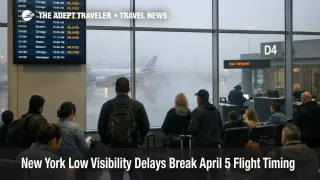
New York low visibility delays are no longer just a morning watch item. By early Sunday, April 5, 2026, the Federal Aviation Administration said the LaGuardia Airport (LGA) ground stop had been extended to first tier airports and Canada because of low runway visual range and the number of diversions, while diversion recovery was issued for LaGuardia, Newark Liberty International Airport (EWR), and nearby satellite airports. For travelers, that turns the New York metro system into a live same day timing problem, especially for short layovers, late morning departures, and onward domestic legs that depend on aircraft or crews rotating through New York before noon. Travelers with same day connections or fixed arrival commitments should move early if their itinerary already looks tight.
New York Low Visibility Delays: What Changed
What changed on April 5 is that the FAA moved beyond a forecast warning and into active flow control. The current operations plan says the LaGuardia ground stop was extended to first tiers and Canada because of low RVRs, shorthand for runway visual range, and because diversions were already building. The same advisory also shows diversion recovery in force for LaGuardia, Newark, and Newark area satellite airports through 1700Z, or 1:00 p.m. EDT, which is a sign that the system is dealing not only with delayed arrivals, but with the secondary work of getting diverted aircraft, gate space, and schedules back into sequence.
The FAA plan also shows the wider weather and traffic picture around the Northeast is not isolated to one runway at LaGuardia. Terminal constraints were listed for the New York, Philadelphia, and Potomac areas because of low ceilings, visibility, thunderstorms, and rain, with possible additional ground stop or delay programs later on April 5 for Philadelphia, the Washington airports, and again for JFK and LaGuardia after 1700Z. That means the immediate New York problem can widen later even if the first low visibility window starts to improve.
In an earlier Adept Traveler article, Flight Delays and Airport Impacts: April 3 described a lower intensity day where New York was still more warning than breakdown. April 5 is different because the FAA is now dealing with an active LaGuardia stop, a broader catchment area for affected departures, and recovery pressure already spreading beyond one airport.
Which Travelers Face the Most Disruption
The most exposed travelers are people departing from or connecting through LaGuardia, Newark, and nearby Northeast spokes feeding those airports. A ground stop extended to first tier airports and Canada means delays do not stay confined to one metro area, because inbound departures from many origin airports are held on the ground before they can even begin the trip to New York. Travelers on shuttle style business routes, short haul East Coast flights, and same aircraft turns later in the day are especially vulnerable.
Newark adds a separate layer of fragility because it is still operating under an FAA rate-limiting framework that extends through October 24, 2026. The FAA said in September 2025 that the Newark order extends the limit on arrivals and departures through that date, raising the hourly cap to 72 operations, and earlier agency statements tied Newark delays to staffing and technology issues at the Philadelphia TRACON that handles Newark traffic. That does not mean April 5 is a Newark-specific technology event, but it does mean Newark has less spare room to absorb weather and diversion shocks than a fully unconstrained airport would. Travelers touching Newark on a tight schedule should treat it as a recovery-sensitive airport, not a neutral backup.
The second order risk is broader than New York. When low visibility cuts safe arrival throughput, the FAA meters departures, holds aircraft at origin, reroutes flows, and then has to unwind diversions. Aircraft arrive late somewhere else, crews miss their next rotation, and the afternoon bank loses flexibility. That is why a morning New York weather problem can turn into missed connections, thinner same day rebooking inventory, and forced overnight stays far from the original weather zone. Travelers who want broader structural context can read U.S. Air Traffic Control Privatization: Reality Check.
What Travelers Should Do Now
Travelers with a same day onward leg should use a low threshold for action on April 5. If the New York segment feeds an international departure, a cruise embarkation, a timed event, or the last practical arrival of the day, rebooking earlier can protect the itinerary better than waiting for a formal cancellation. If your connection at LaGuardia or Newark is already under about 90 minutes, or if your onward leg is the last one with a workable backup, the safer move is to search alternatives now rather than rely on midday recovery.
Travelers who are not yet disrupted should watch the inbound aircraft, not only their own departure time. A flight can remain technically on schedule while the aircraft operating it is still delayed, diverted, or waiting for recovery sequencing elsewhere. If the inbound aircraft is late, and your itinerary depends on a tight connection after New York, the odds of cascading failure rise quickly. For travelers with flexibility, shifting to a nonstop, moving to an earlier departure, or avoiding a same day New York connection can preserve the rest of the trip better than waiting for airport conditions to normalize.
The next signals to watch are simple. Watch whether the planned JFK and LaGuardia ground stop or delay programs after 1700Z actually turn active, whether Washington or Philadelphia programs switch from possible to active, and whether your carrier opens broader self-service changes as recovery drags into the afternoon. If those signals worsen, this stops being a localized LaGuardia issue and becomes a larger Northeast rotation problem for the rest of Sunday.
How the Disruption Spreads Through Travel Next
Runway visual range is the distance a pilot can see down the runway environment, and when it drops too low, safe arrival rates fall because aircraft spacing and operating procedures tighten. That is the mechanism behind the April 5 disruption. Low visibility reduces how many flights can land efficiently, diversions climb when aircraft cannot fit into the arrival stream, and the system then has to recover both the delayed flights and the diverted ones.
What happens next depends on how quickly New York regains arrival capacity, and on whether the surrounding Northeast weather corridor worsens. The FAA plan already shows possible later programs for Philadelphia, Washington, JFK, and LaGuardia, plus en route routing restrictions and capping options in the broader region. That means even improving conditions at one airport may not produce a clean recovery if the regional flow picture stays constrained. The practical takeaway is blunt, New York travelers should think in terms of preserving the day's itinerary, not just salvaging one flight number.