

Flight Delays and Airport Impacts: April 7
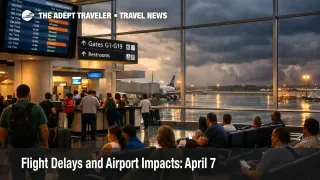
April 7 flight delays are shaping up as a Boston, New York, and Florida problem first, with a separate low ceiling watch stretching from Seattle to Southern California. The Federal Aviation Administration says low clouds and light snow may slow flights at Boston Logan International Airport (BOS), gusty winds may delay traffic in the New York area and at Philadelphia International Airport (PHL), and thunderstorms could slow flights in Florida, especially around Miami International Airport (MIA), Fort Lauderdale Hollywood International Airport (FLL), Orlando International Airport (MCO), and Tampa International Airport (TPA). For travelers, this is still more of a protect-the-itinerary day than a systemwide collapse, but the FAA's planning window shows the late afternoon and evening are where schedules could get harder.
April 7 Flight Delays: What Changed
The FAA's morning public outlook is broader than a one airport issue. Boston is dealing with low clouds, visibility limits, and light snow, while the New York and Philadelphia corridor is under wind pressure. Florida is the sharper operational watchpoint because the command center says South Florida arrival and departure gates are already under thunderstorm pressure, and traffic managers are evaluating flow programs to meter demand into that airspace. The same operations plan says ground stop or delay programs were possible after 500 p.m. for Boston, John F. Kennedy International Airport (JFK), and LaGuardia Airport (LGA), after 600 p.m. for Orlando and Tampa, and until midnight for Miami, Fort Lauderdale, and Palm Beach International Airport (PBI).
That matters even though most major airports named in the plan were still posting only routine gate hold, taxi, or airborne delays of 15 minutes or less when checked. Boston, JFK, Miami, Orlando, San Francisco International Airport (SFO), Fort Lauderdale, and Los Angeles International Airport (LAX) were all still showing no destination specific delays on their FAA status pages. That gap between a clean early board and a riskier later plan is the key operational fact for April 7. It means travelers still have room to protect connections and reposition plans before the network gets tighter.
Which Travelers Face the Most Disruption
The most exposed travelers are the ones moving through short connection banks in Boston, the New York metro airports, Philadelphia, and Florida this afternoon and evening. That includes passengers on Northeast to Florida routes, same day business trips that depend on a precise return, and long haul itineraries that use JFK, Newark Liberty International Airport (EWR), or Miami as an onward hub. The FAA plan specifically notes a Northeast to Florida routing program and says South Florida managers are using wider spacing between aircraft to handle arrival and departure gate limits under thunderstorm pressure.
A second exposed group sits on the West Coast. The FAA daily report flags low clouds at Seattle Tacoma International Airport (SEA), San Francisco, Los Angeles, and San Diego International Airport (SAN). In practice, that kind of marine layer setup does not always produce dramatic cancellation counts, but it can reduce arrival rates, slow gate turns, and narrow the margin for later aircraft rotations. That is especially relevant at San Francisco, where runway and taxiway construction remains in the background through November 15, 2026, limiting slack when ceilings fall.
What Travelers Should Do Now
Travelers flying before midafternoon still have a better chance to absorb small delays without blowing up the full trip. Travelers booked into Boston, JFK, LaGuardia, Orlando, Tampa, Miami, Fort Lauderdale, or Palm Beach later in the day should check whether an earlier departure, a longer layover, or a same airline rebooking option is available before airport programs formally activate. Once a ground delay program or ground stop is in place, the remaining seats on cleaner options usually disappear faster.
For Florida itineraries, the main threshold is whether your trip depends on a late afternoon arrival or a final flight of the day. Thunderstorm programs in South Florida can create a first order delay on the inbound leg, then a second order problem when that aircraft misses its next turn, crew duty time tightens, or onward hotel and cruise transfers lose buffer. Travelers headed to a cruise, a timed event, or a nonrefundable same night hotel in South Florida should be more aggressive about protecting the arrival window than a traveler on a flexible leisure trip.
For the Northeast, the threshold is connection length. Gusty wind restrictions in the New York and Philadelphia airspace can spread more gradually than a hard thunderstorm ground stop, but they still reduce capacity across one of the country's most interconnected air traffic zones. A short connection that looks acceptable on paper can turn into a misconnect once inbound holding, taxi time, and gate congestion start stacking. Travelers with less than about 90 minutes at JFK, LaGuardia, Newark, or Philadelphia later today should watch for same airline alternates while options are still open. This is the same pattern Adept tracked in Flight Delays and Airport Impacts: April 6, where a manageable early picture still carried a harder late day risk window.
Why the Pressure Could Build Later
The FAA daily air traffic report is the public facing summary. The command center operations plan is where the operational mechanics become clearer. On April 7, those mechanics point to multiple separate friction zones hitting the network at once, low ceilings in Boston and on the West Coast, wind in the New York and Philadelphia corridor, and thunderstorms over Florida and the Southeast routing structure. The system does not need every airport to fail at once for travelers to feel it. It only needs enough capacity cuts at major hubs to force metering, reroutes, and slower turns.
Two background constraints add to that sensitivity. The FAA plan notes Masters tournament traffic management measures in the Southeast through April 14, and it also lists ongoing infrastructure or operating constraints at several hubs, including a JFK runway closure through April 9, reduced arrival rate conditions at Washington Dulles International Airport (IAD), a Seattle runway closure through May 13, and San Francisco construction through November 15. None of those issues automatically creates a disruption day on its own, but each one reduces spare capacity when weather pressure rises. Travelers who want the bigger structural context can also read U.S. Air Traffic Control Privatization: Reality Check. The next decision point on April 7 is simple, watch whether the FAA turns the planned Boston, New York, and Florida programs into active traffic management initiatives by late afternoon.
Sources
- FAA Daily Air Traffic Report
- Current Operations Plan Advisory, ATCSCC ADVZY 021, April 7, 2026
- General Edward Lawrence Logan International Airport (BOS) Real-time Status, FAA
- John F Kennedy International Airport (JFK) Real-time Status, FAA
- Miami International Airport (MIA) Real-time Status, FAA
- Orlando International Airport (MCO) Real-time Status, FAA
- San Francisco International Airport (SFO) Real-time Status, FAA
- Fort Lauderdale/Hollywood International Airport (FLL) Real-time Status, FAA
- Los Angeles International Airport (LAX) Real-time Status, FAA