

Middle East Flight Recovery Stays Split by Carrier
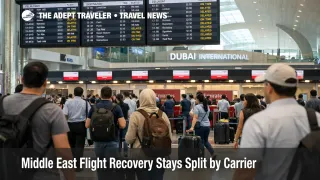
Middle East flight recovery is no longer a simple reopen or remain shut story. As of April 14, 2026, the operating map is splitting in two, with Gulf airlines rebuilding schedules in controlled stages while many foreign carriers still keep long suspension windows in place. That leaves travelers with more options than they had in March, but not a return to normal hub reliability. For passengers booking or rebooking now, the practical move is to judge the itinerary by carrier type, not by broad assumptions that the region is either fully stable again or still uniformly closed.
The recovery inside the Gulf is measurable, but still partial. Emirates says it is operating a reduced flight schedule after the partial reopening of regional airspace. Etihad says it is running a commercial schedule between Abu Dhabi and around 80 destinations. Qatar Airways says it is gradually rebuilding flights to more than 120 destinations by mid May, using dedicated corridors coordinated with Qatar's civil aviation authority. Cirium says the three major Gulf carriers have still removed more than 5.4 million seats and more than 18,000 flights from April schedules compared with pre conflict plans, which means the region has moved from acute shutdown toward constrained recovery, not full restoration.
That contrast matters because foreign airline behavior is still pointing to a longer risk window. Reuters reported on April 14 that Air France has suspended Tel Aviv, Beirut, Dubai, and Riyadh until May 3, KLM has suspended Riyadh, Dammam, and Dubai until May 17, Cathay Pacific has canceled Dubai and Riyadh through June 30, and Lufthansa Group has suspended Dubai and Tel Aviv until May 31 while keeping several other Middle East destinations off its schedule through October 24.
Which Travelers Still Face the Most Risk
The most exposed travelers are not necessarily the people flying into the Gulf on Gulf carriers. They are the travelers whose trip depends on mixed carrier chains, short same day connections, or a foreign airline that still treats the region as operationally unsafe or commercially weak. A Dubai or Doha stop may look workable again on one booking engine, while the long haul carrier a traveler actually needs is still absent for weeks or months. That gap is where missed connections, forced overnight stays, and more expensive last minute reroutes can still pile up.
U.S. travelers also still face a more conservative map than the Gulf carriers are offering. Reuters says Delta has canceled New York to Tel Aviv and pushed the restart of Atlanta to Tel Aviv to September 5, 2026, while American continues to publish waiver coverage for Tel Aviv and Doha travel through July 3, 2026. United is still listing a Middle East unrest flexibility alert affecting at least Dubai and Tel Aviv in its travel alerts search results. That means travelers starting in the United States may still have schedule flexibility on paper, but not broad nonstop recovery in practice.
A second exposed group is summer travelers who are not headed to the Gulf at all, but who still rely on the region's old hub logic. Foreign airlines are redeploying aircraft away from the Middle East and toward Europe, Africa, and Asia, which changes where replacement capacity shows up. British Airways, for example, is trimming future Middle East service while adding India and Africa capacity. Cathay Pacific is suspending Dubai and Riyadh through June 30 while adding extra April passenger flights to London, Paris, and Zurich. First order, that weakens direct Middle East options. Second order, it can distort fares and backup inventory on entirely different long haul corridors.
What Travelers Should Do Now
Travelers booked on Emirates, Etihad, or Qatar Airways should treat a confirmed ticket as more usable than it was in March, but not self proving. Check the flight number directly with the carrier, confirm the route is operating on the revised schedule, and protect any short onward connection with extra buffer. A published flight is no longer rare. A resilient full itinerary still is.
Rebook sooner if your trip depends on a non Gulf carrier that has already published a long suspension window, especially Lufthansa Group, Cathay Pacific, KLM, or an Air France itinerary touching one of the still suspended city pairs. Wait only if you are sitting on a waiver, the trip is not time critical, and you can absorb another schedule revision without breaking a hotel, cruise, rail, or visa plan. The tradeoff is straightforward, waiting may preserve fare flexibility, but rebooking early may preserve the itinerary itself.
Over the next 24 to 72 hours, watch for three signals. The first is whether Gulf carriers keep adding frequencies without another round of pullbacks. The second is whether foreign carriers shorten suspension windows instead of extending them. The third is whether the fuel and corridor story worsens again, because even a stable ceasefire does not erase airspace, insurance, and supply chain stress overnight. In an earlier Adept Traveler article, Iran Port Blockade Raises Gulf Travel Risk, the pressure point was maritime escalation. In another, Europe Jet Fuel Shortage Threatens Summer Flights, the risk was fuel availability spilling into wider flight reliability. Those pressures still sit behind the current recovery.
Why the Recovery Still Looks Uneven
The mechanism is not complicated, but it is easy to misread. Gulf carriers have a stronger incentive and often a better local position to restore selective operations quickly once corridors reopen, because their business depends on rebuilding connecting flows through Dubai International Airport (DXB), Zayed International Airport (AUH), and Hamad International Airport (DOH). Foreign carriers are making a different calculation. They can redeploy aircraft elsewhere, avoid fragile corridors, and wait for a wider safety and commercial reset before reentering the market at scale.
That is why Middle East flight recovery now looks better in schedules than it does in network resilience. Travelers can once again move through key Gulf hubs on some carriers, but the backup layers remain thin. When one leg fails, the pool of same airline alternatives is still smaller than usual, interline rescue is less certain, and foreign carrier capacity has not returned in enough volume to make recovery easy. In an earlier Adept Traveler article, Qatar Doha Flights Expand, but Connections Stay Fragile, the warning was that wider schedules did not automatically restore dependable connections. That remains the right frame across the region.
What happens next depends less on one headline about peace and more on whether carriers begin converging toward the same map. If Gulf schedule rebuilding continues and foreign airlines start pulling suspension dates forward, the region moves toward genuine stabilization. If Gulf carriers keep growing while foreign airlines stay out through summer or into autumn, travelers should keep planning around a split market where some hubs are usable, but the old network depth is still missing.
Sources
- Airlines cancel flights amid Middle East conflict, Reuters
- The Immediate and Current Impacts to Middle East Hub Airports & Airlines, Cirium
- Travel Updates | Help | Emirates
- Etihad Airways operates a comprehensive flight schedule this April
- Qatar Airways Further Rebuilds Flight Schedules
- Travel alerts - Travel information - American Airlines
- Receive disruption updates during your journey, KLM
- Cathay Pacific temporarily suspends Dubai services
- Cathay Pacific temporarily suspends Riyadh services
- TWP2603/TWP2604/TWP2606: Lufthansa Group airlines adjust the flight offer to and from the Middle East