

Australia Flags U.S. Airport Delays From Shutdown
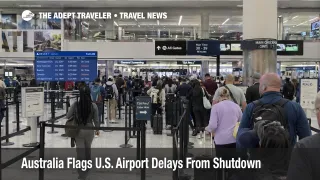
Australia has turned a domestic U.S. staffing problem into an international traveler planning signal. On April 16, 2026, Smartraveller updated its United States advisory to say the partial U.S. government shutdown has affected some federal services, including at airports, and may cause flight delays, longer airport lines, and slower connection times. For inbound visitors, that is a warning to stop treating airport friction as isolated headline noise and start planning extra slack into arrivals, onward flights, and any same day fixed time commitments. The operational risk is meaningful for tight itineraries, but it is not the same as a nationwide airport breakdown.
U.S. Shutdown Airport Delays: What Changed
The new development is not that the shutdown exists. It is that a foreign government has now updated official travel advice to tell its citizens that U.S. airport disruption can affect real trips. Smartraveller's page, updated on April 16, 2026, says the shutdown began on February 1 and has affected airport related federal services enough to produce possible delays, longer lines, and weaker connection times. That moves the issue from industry and domestic policy reporting into traveler facing state advice.
The underlying mechanism is still staffing strain inside the Department of Homeland Security, especially around airport screening. Reuters reported on April 10 that the shutdown was still ongoing, nearly two months in, even as furloughed DHS staff were told to return to work and their paychecks were being processed. That recall matters, but it does not erase the damage already done to day to day airport flow.
Earlier in the standoff, Reuters reported that 460 TSA officers had quit, national absences had moved above 10 percent, and some airports had seen waits of up to 4.5 hours. Conditions improved after pay restarted at the end of March, but recovery has remained uneven by airport rather than uniform across the system. In an earlier Adept Traveler article, TSA Pay Restart Eases Airport Security Lines, the national picture improved before every local airport fully recovered.
Which Trips Are Most Exposed
The highest exposure is on travelers whose first U.S. airport is only one step in a longer chain. That includes visitors arriving on long haul international flights and then re clearing security for a domestic onward segment, cruise passengers flying in on embarkation day, travelers with prepaid car services or hotel check in windows, and anyone landing before a conference, wedding, tour, or other fixed time event. Smartraveller's wording around longer connection times is especially important for these travelers, because the problem does not need to be an outright cancellation to break the itinerary.
The first order effect is extra time at the airport. The second order effect is brittle downstream timing. A slower security queue, a delayed bag handoff, or a thinner staffing day at one checkpoint can turn into a missed domestic leg, a lost cruise boarding window, a forced overnight, or more expensive same day reaccommodation. That is why this advisory matters more for connection dependent visitors than for travelers whose U.S. arrival airport is also their final destination.
This is also a bigger issue at large hubs and peak banks than on every trip equally. Reuters and earlier Adept reporting showed some of the sharpest strain at airports such as Hartsfield Jackson Atlanta International Airport (ATL), George Bush Intercontinental Airport (IAH), Baltimore, New Orleans, New York area airports, and Philadelphia, even after pay restarted. In an earlier Adept Traveler article, ICE Leaves Some U.S. Airports, TSA Recovery Uneven, the key takeaway was that visible emergency support could fade before checkpoint reliability fully normalized.
What Travelers Should Do Now
International visitors should build larger time cushions into U.S. itineraries immediately. For arrivals that feed into another flight, rail trip, cruise, or event, the safer approach is to assume connection times may be less reliable than normal and to avoid the shortest legal connection unless the consequences of missing it are low. If you are booking now, a same day connection that looked efficient a month ago may no longer be the best value if it leaves no room for slower airport processing.
The main decision threshold is trip consequence. If missing the onward segment would jeopardize a cruise embarkation, a guided tour start, a major meeting, or a nonrefundable overnight plan, pay for more slack now. If the onward segment is flexible, the traveler can tolerate more risk. That tradeoff matters more than the headline alone, because the shutdown is producing uneven friction, not a constant nationwide stop.
Travelers already ticketed should watch for three signals over the next 24 to 72 hours, airport specific advisories, airline flexibility waivers, and evidence that screening conditions are worsening again at major hubs. For broader context on why the staffing risk may outlast any single political headline, see Airport Security Delays Could Outlast the Shutdown.
Why The Warning Matters Beyond One Advisory
Smartraveller's update does not prove a new nationwide airport collapse. What it does show is that the shutdown has lasted long enough, and remained visible enough, for an allied government to warn its citizens in plain language about airport consequences. That is a meaningful escalation in traveler relevance, because official advisories can shape booking behavior, route choices, and how much buffer travelers build into U.S. trips.
What happens next depends less on whether workers were recalled and more on whether airport operations regain enough slack to absorb normal peaks. Reuters has already reported both the staffing losses that built up during the standoff and the later attempt to restore staffing through recall and resumed pay. That means the next phase is a reliability question, not just a payroll question. If absenteeism stays lower and hubs stabilize, U.S. shutdown airport delays should keep easing. If staffing remains thin at peak banks, international visitors will keep feeling the problem through longer queues and weaker connection margins even without dramatic new shutdown headlines.