

TSA Pay Restart Eases Airport Security Lines
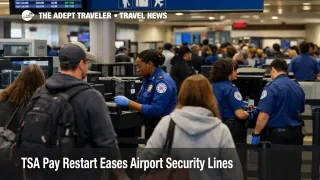
TSA pay restart began easing airport security pressure across the United States on March 31, 2026, after unpaid screeners started receiving retroactive pay during the ongoing Department of Homeland Security shutdown. The national TSA absence rate dropped to 8.6% on Monday from 12.4% on Friday, according to Reuters, and several major airports reported shorter lines after the first paychecks hit. That is a real operational improvement for spring travelers, but it is not a full recovery. Travelers flying through large hubs should still leave extra buffer because some airports remained far above the national average, and the broader DHS funding fight is still unresolved.
TSA Pay Restart: What Changed
The immediate change was payroll, not a full shutdown resolution. President Donald Trump signed a memorandum on March 27, 2026 directing the Department of Homeland Security and the Office of Management and Budget to use funds tied to TSA operations to provide compensation and benefits that would have accrued during the lapse in funding. That action allowed TSA employees to begin seeing retroactive pay on March 31, 2026, which quickly reduced callouts and started to stabilize checkpoint staffing.
Reuters reported that the absence rate improvement was visible at the system level, and that shorter lines were reported at several hard hit airports. But the same report also showed how uneven the recovery remained. Atlanta still had a 29% absence rate on Monday, and airports in Houston, Baltimore, New Orleans, New York, and Philadelphia were still near 20%. That means the checkpoint picture improved nationally before it fully improved locally. Travelers should treat the headline improvement as a sign of easing pressure, not as proof that every hub is back to normal.
Which Travelers Still Face The Most Risk
The travelers most exposed now are those flying through major connecting hubs, those traveling at the morning bank or late afternoon peak, and those building trips around tight connections or timed ground transfers. When checkpoint staffing drops, the first order effect is longer security waits. The second order effect is missed flights, compressed rebooking options, missed hotel check in windows, and extra pressure on rides, rail links, and airport hotel inventory around disrupted hubs.
This matters more right now because the spring travel system is already full. Airlines for America said on February 24, 2026 that U.S. airlines expected 171 million passengers from March 1 through April 30, about 2.8 million passengers per day, with carriers adding flights and seats to handle demand. A busy system has less slack. Even after pay resumed, Reuters reported that more than 500 TSA officers had already left their jobs since mid February, which means payroll relief helps, but does not instantly restore staffing depth.
The broader exposure is not limited to TSA workers either. AFGE said 47,000 TSA officers it represents would finally be paid, while warning that thousands of other DHS employees still faced uncertainty. For travelers, that keeps the operating environment fragile because the wider department funding fight can still affect border, customs, and security related workflows beyond the checkpoint itself.
What Travelers Should Do Now
Travelers flying in the next 24 to 72 hours should still build extra airport buffer, especially at large hubs that were among the worst affected during the unpaid period. The safer play is to arrive early enough to absorb checkpoint volatility rather than assuming March 31 improvements will hold evenly across every terminal and time bank.
The next decision point is connection planning. Travelers with tight domestic connections, or with onward rail, cruise, or prepaid transfer commitments, should be more conservative than usual until local staffing patterns stabilize. Waiting may be fine for point to point flyers with flexible plans. It is a weaker bet for families, international travelers, or anyone whose day depends on making one specific flight.
The other thing to watch is airport specific performance, not just national averages. National improvement can hide local stress. If your hub was one of the airports still showing elevated absence rates, monitor your airline app, airport alerts, and any local media reports before leaving for the terminal. The recovery signal is real, but the system is still operating with thinner margins than normal.
How The Disruption Spreads Through Travel
A TSA absence rate is not just a labor statistic. It is a queue capacity problem. When fewer officers are available, fewer screening lanes can run at full throughput, and each minute of delay at the checkpoint pushes pressure into the rest of the travel day. That is why airport security staffing problems can ripple into gate crowding, missed boarding windows, later aircraft turns, and fewer same day recovery options even when flights themselves are still scheduled normally.
What happens next depends on whether the temporary pay fix turns into a durable staffing recovery and whether Congress resolves DHS funding. The White House memorandum addressed TSA compensation during the emergency, but it did not end the larger political standoff by itself. The likely near term path is gradual operational improvement with uneven checkpoints until staffing normalizes and the shutdown dispute is resolved. For travelers, the practical reading is simple. The worst checkpoint pressure has started to ease, but airport security lines can still swing sharply at major hubs while the system works through the damage already done.
Sources
- Absences fall sharply after US airport security workers finally get paid
- DHS orders payment of 50,000 US airport workers in emergency action
- Paying Our Great Transportation Security Administration Officers and Employees
- U.S. Airlines Prepare for Record Number of Passengers this Spring Amid Government Shutdown
- AFGE President Kelley Statement Following Trump's Order to Pay TSA Officers