

Syria Exit Planning Now Means Airport and Border Failure Risk
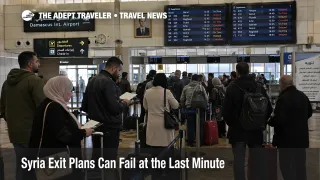
Travelers still in Syria, or anyone considering movement into or out of the country, should treat Syria exit plans as provisional even after a ticket is issued or a driver is booked. Australia's Smartraveller advisory says only limited commercial air service remains, airports and airlines could stop operating at any time, and roads plus border crossings may close without warning. That shifts the problem from a generic no travel label to a live transport failure story, where the weak point may be the road to the airport, the airport itself, or the crossing you intended to use, and any of them can fail on the same day.
Syria Exit Plans: What Changed
The core update is not that Syria is dangerous, that has been true for years. The sharper operational message is that the remaining exit network is too thin to trust in a straight line. Smartraveller now says a limited number of commercial airlines still fly to Syria, but commercial air services and airports could be attacked or stop operating at any time, while roads and border crossings may close without warning. It also says civilian airports in Damascus and Aleppo could come under attack at any time.
That matters because confirmed travel does not equal workable travel in this environment. The advisory spells out the failure chain directly, transport options to airports and seats on flights may be limited, roads may close or be blocked without warning, major highways may be blocked, and border crossings can close with little or no warning. In practice, that means the real risk is not only flight cancellation. It is losing access to the airport or to the border after you have already committed money, time, and personal security to the move.
Which Exit Options Are Most Fragile
Air exits are fragile because they depend on both a functioning airport and a functioning surface route to reach it. Smartraveller specifically flags Damascus and Aleppo as airports that could come under attack, and it separately warns that civil aviation risk remains elevated in Syrian airspace. For travelers, that means a same day airport run carries unusually high failure risk because the plan depends on multiple variables holding at once, airline operations, airport status, road access, communications, and the local security picture.
Land exits are not automatically safer. Smartraveller says access to international border crossings may be limited by roadblocks, road closures, and fighting, and highlights major corridors including Damascus to Jordan and Damascus to Beirut as roads that may already be blocked or may become blocked.
The neighboring fallback options also come with their own warning labels. Australia's Jordan advisory says the Syrian and Iraqi border regions are unstable, crossings could close without notice, and there is frequent military activity near Jordan's borders with Syria and Iraq. Its Lebanon advisory says Syria to Lebanon crossings have seen clashes and airstrikes, and may close at short notice. On the Türkiye side, U.S. State Department information says the Turkey Syria border is closed except for urgent medical treatment or immediate danger cases defined by the Turkish government. That does not make every overland exit impossible, but it does mean travelers should stop treating neighboring countries as simple backup valves.
What Travelers Should Do Now
For anyone already in Syria, the practical move is to stop relying on a single departure chain. A workable Syria exit plan now means confirming the flight or crossing, confirming the route to reach it, and having a second route or second country option mapped before movement starts. If you only have one airport, one driver, one highway, or one border in the plan, the plan is too brittle for current conditions.
Travelers should also avoid same day timing assumptions. In an earlier Adept Traveler article, Jordan Amman Exit Plans Need More Buffer Now, the same regional pattern was already visible, a live departures board did not mean a low friction transfer day. That logic is even harsher in Syria, where communications problems, checkpoint delays, and route closures can erase the margin before departure. If an onward international ticket depends on reaching the airport at the last minute, or on clearing one specific border crossing in one narrow time window, the risk is too high.
The next decision point is simple. If you are outside Syria, do not build plans that require entering the country and exiting on a fixed schedule. If you are inside Syria, monitor route status and neighboring country rules continuously, carry passport and travel documents at all times, and be ready to move earlier than planned if a usable window opens. Travelers looking at the wider regional pattern may also find context in Iraq Airspace Closure Leaves Only Overland Exits and the broader Middle East - Travel News and Guides from The Adept Traveler, because the main mechanism is the same, thin transport networks fail fastest when conflict pushes airports, roads, and borders at the same time.
Why Same Day Exit Logic Breaks Down
The reason same day exit logic fails in Syria is that the transport system is not failing at one point. It is failing as a chain. Smartraveller says telecommunications and travel restrictions may limit exit options, seats may be limited, roads may close, major highways may be blocked, and conflict can limit access to all border crossings. Once that happens, a traveler can lose both the primary plan and the backup at nearly the same time.
That creates second order effects quickly. A missed airport run can turn into an unplanned hotel night in a city where onward transport may be harder to secure the next day. A closed crossing can unravel onward flight tickets from Amman, Beirut, or elsewhere. A route that is technically open can still become unusable if military activity, checkpoints, or traffic bunching destroy the timing margin. Australia's broader Middle East conflict guidance now tells travelers that flights can change or stop suddenly, borders can close, and people in the region who want to leave should do so while commercial options remain available. Syria is the sharpest version of that warning because even the surviving air and land exits are described as unstable at the last stage.