

Jordan Amman Exit Plans Need More Buffer Now
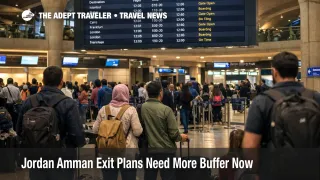
Amman exit plans still work, but Jordan is no longer a clean fallback story. As of March 8, 2026, the U.K. Foreign, Commonwealth & Development Office still advises against all but essential travel to all of Jordan outside the Syria border zone, warns that regional escalation poses significant security risks, and tells travelers to follow local shelter guidance when sirens sound. Queen Alia International Airport (AMM) is still showing live departures, which keeps Amman in play as one of the more usable air exits in the region. The traveler decision is narrower now. Use Jordan as a staged departure platform with buffer, not as a last minute same day sprint.
The meaningful change since earlier cleaner exit coverage is not that Jordan closed, because it did not. The change is that the advisory environment around the airport hardened on March 7, and that matters more than a simple open or closed check. Travelers who can still depart from Amman should protect extra time, confirm airport runs before moving, and stop assuming that a functioning departure board means a low friction transfer day.
Amman Exit Plans: What Changed for Travelers
The current FCDO page, still marked current on March 8 and updated on March 7, says the U.K. advises against all travel within 3 kilometers of the Syria border and against all but essential travel to all other areas of Jordan. It also tells British nationals to follow local authorities, keep departure plans under review, stay away from security, military, and U.S. government facilities, and move indoors or to the nearest safe building or designated shelter when sirens sound. That is the hardening that changes how travelers should use Amman.
At the same time, Queen Alia remains operational enough to matter. The airport's departures platform continues to show outbound flights and active statuses such as gate opened, boarding, and final boarding, which confirms that Amman is still functioning as a commercial exit point rather than a purely theoretical option. That keeps Jordan in the regional exit map, but only in a risk managed way.
The main traveler consequence is simple. Amman is useful for leaving, not for pretending conditions are normal. Travelers should think in terms of controlled staging, one extra hotel night, confirmed airline communication, and a transfer plan that can absorb alerts, traffic friction, or a late operational change without collapsing the whole departure.
Which Travelers Can Still Use Amman Best
The best fit is the traveler who already has a confirmed seat, valid documents, enough budget flexibility to absorb an overnight delay, and a ground plan that is not built on tight assumptions. That includes people already in Jordan, or travelers repositioning into Amman early enough to break the trip into stages instead of chaining border crossing, city transfer, and departure into one fragile move. The logic here is not certainty. It is reducing the number of things that can fail at once.
The weaker fit is the traveler using Jordan as an improvisation. That is especially true for anyone trying to cross from Israel late in the day, then reach Queen Alia International Airport (AMM) for a same evening flight. Israel Airports Authority says the Jordan River passenger terminal is on reduced Ramadan hours through March 18, 2026, with last passenger acceptance at 330 p.m. Sunday through Thursday, 230 p.m. on Friday, and no Saturday passenger service. That makes late afternoon salvage plans materially easier to miss.
Ground movement risk also matters more than many travelers will expect. Canada's travel advice says demonstrations occur regularly in Jordan, often on Friday afternoons, and major gathering points have included locations in Amman. U.S. Embassy alerts have also told Americans to avoid protests and demonstrations. That does not make Amman unusable, but it does make tight road timing less trustworthy, especially on Thursdays and Fridays or on routes that depend on predictable city traffic.
What Travelers Should Do Before Moving Toward Queen Alia
The practical move is to stage earlier than feels necessary. If you are entering Jordan overland, do not treat Amman as a same day rescue chain unless every step is confirmed, early, and under your control. A protected overnight in Amman is usually stronger than a border run that arrives late, depends on separate tickets, or assumes normal airport access. This is one of those cases where paying for slack can save the itinerary.
Rebook or delay the airport move if your plan depends on narrow timing. That includes late border arrival, uncertain transport, a separate ticket onward, or an evening departure with no cushion. Hold the plan only if your flight is still confirmed directly by the airline, your road transfer is arranged, and you can still absorb a missed same day departure without losing the trip entirely. Under the current advisory posture, "operating flight" is not the same as "low risk transfer."
Over the next 24 to 72 hours, monitor three things before you move: official airline status, airport departures at Queen Alia, and new government or embassy alerts. For border based plans, keep reduced Jordan River hours in the calculation through March 18. For document prep, Jordan Entry Requirements For Tourists In 2026 is still useful background, while Jordan River Crossing Hours Tighten Through March 18 and Jordan Travel Advice Hardens Around Amman Exit Runs remain the most relevant internal reads before committing to an Amman exit.
Why Jordan Still Works as an Exit, but Less Cleanly
The mechanism is straightforward. Jordan still matters because Queen Alia keeps a commercial departure function while several nearby hubs remain more disrupted, more restricted, or more conditional. That gives travelers a real outbound platform. But the advisory hardening changes the environment around that platform. Once official guidance emphasizes sirens, shelter behavior, sensitive facilities, and significant security risk, the usable asset is not "Jordan" in a broad sense. It is a narrower corridor made up of a working airport, a viable transfer window, and enough buffer to survive friction on the ground.
That is why the first order effect is not immediate airport closure. It is tighter movement discipline, higher insurance sensitivity, and more fragile transfer planning. The second order effects are the ones travelers actually feel, extra hotel nights in Amman, more cautious corporate approvals, weaker same day border to airport chains, and more pressure on confirmed seats when people abandon riskier regional exits for Jordan. In other words, Amman remains one of the better exit platforms in the region, but it now works best for travelers who treat it as a staged departure system, not a spontaneous reset button.
Sources
- Jordan Travel Advice, GOV.UK
- Arrivals & Departures, Queen Alia International Airport
- Travel Advice and Advisories for Jordan, Government of Canada
- Security Alert: U.S. Embassy Amman, Jordan, March 7, 2026
- Jordan River Crossing Hours Tighten Through March 18
- Jordan Travel Advice Hardens Around Amman Exit Runs