

New Zealand Cabin Crew Strike To Hit Flights December 8
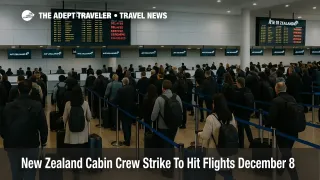
Air New Zealand cabin crew represented by unions E tū and the Flight Attendants Association of New Zealand have called a 24 hour strike for December 8, 2025, a move that could hit everything from short regional hops to long haul services into and out of New Zealand. The action would apply across the airline's regional, domestic, and international fleets, and union estimates suggest about 1250 crew are covered, making it one of the largest coordinated cabin crew strikes in the airline's history. The airline has warned that if talks fail, thousands of passengers may face cancellations, rerouting, or overnight delays, so anyone planning early December trips needs to treat December 8 as a high risk travel day, add buffer time at hubs, and consider moving critical legs off the strike date where possible.
In practical terms, the Air New Zealand strike December 8 turns that single Monday into a potential choke point for domestic and Pacific travel, especially through Auckland, Wellington, and Christchurch, and it means travelers should build fallback plans now rather than waiting for day of notifications.
What Is Planned For December 8
The strike notice covers a full calendar day of action. E tū has told members to stop work for 24 hours on Monday, 8 December 2025, under three coordinated notices that together span the regional turboprop fleet, the domestic jet network, and the long haul widebody operation. The union says this reflects months of stalled bargaining over pay, rosters, and fatigue, and describes the walkout as a historic action that touches all three fleets rather than a narrow, symbolic stoppage.
Air New Zealand's own travel alert confirms that industrial action is planned for December 8 and that flight disruptions are likely, though the airline stresses that negotiations are continuing and that it will contact customers directly if their flights change. The carrier is encouraging passengers to keep profiles up to date so that text and email alerts reach the right devices, and it is already advising some travelers to consider flexible rebooking.
Public comments from Air New Zealand's chief executive indicate that the company is preparing contingency schedules that could see between 10000 and 15000 customers affected if the strike goes ahead, with some flights canceled and others retimed or consolidated. At the same time, both the airline and unions say they remain available for talks, and union officials have signalled that no industrial action will take place in the seven days immediately before Christmas, which gives families a slightly clearer window for late December trips even as the early month picture stays unsettled.
We first covered the initial strike notices and timing in New Zealand Cabin Crew Strike Cuts Flights December 8, which sets out the basic time bands and fleet coverage. This update focuses on how the situation has evolved now that travel insurers, consumer advocates, and the airline itself have provided more detailed guidance on likely disruptions and passenger remedies.
Which Routes And Airports Are Most Exposed
Auckland Airport (AKL) is the beating heart of Air New Zealand's network, so any cabin crew strike will first and foremost squeeze its domestic trunk lines and long haul banks. If the December 8 action proceeds, travelers should expect the highest concentration of cancellations and rebookings on flights linking Auckland with Wellington International Airport (WLG), Christchurch Airport (CHC), and Queenstown Airport (ZQN), as well as Pacific destinations such as Rarotonga International Airport (RAR) and key trans Tasman routes into Sydney, Melbourne, and Brisbane.
Because Air New Zealand is the dominant carrier on many of those city pairs, there are relatively few spare seats on competing airlines that can absorb disrupted passengers at short notice. Jetstar and Qantas operate selected domestic and trans Tasman services, but they do not match Air New Zealand's frequency on core New Zealand routes, and late season holiday demand means many of their flights are already heavily booked.
Internationally, the biggest pain points will be itineraries that rely on seamless connections through Auckland to long haul flights for North America, Asia, or the Pacific. For example, a same day connection from a regional New Zealand city into an Auckland to Los Angeles, Vancouver, or Tokyo sector could collapse if the feeder leg is canceled or if crew shortages force a retiming that eats into connection buffers. Similar risks apply for travelers heading from New Zealand to cruise departures in Australia or the South Pacific, where missing an embarkation day can be very expensive to fix.
Travelers who can route some journeys on non Air New Zealand metal, especially for trans Tasman or intra Pacific sectors, may find it easier to protect tight plans. Our broader look at seasonal pressure in Australia And New Zealand Summer Flight Delays gives additional context on why spare capacity is limited and why even a one day strike can echo across several days of schedules.
What Air New Zealand Says It Will Do For Passengers
Air New Zealand's disruption and refund pages say that when the airline cancels or significantly changes a flight, it will offer affected customers a choice between rebooking and credit or refund, and that for some domestic disruptions within the airline's control, passengers may be entitled to damages under New Zealand's Civil Aviation Act.
In the specific case of the December 8 strike, the airline has told local media that it will work to keep as many essential services running as possible, prioritising routes where there are no practical alternatives. At the same time, it has acknowledged that if the walkout goes ahead, a significant number of flights will be canceled and that affected customers will be rebooked or refunded.
For international routes, Air New Zealand's customer service and tarmac delay plan outlines notification timelines and care obligations, and for flights that touch Canada it sets out specific compensation tiers in Canadian dollars when delays exceed certain thresholds. Those rules sit alongside more general contract of carriage commitments, but they still leave considerable room for the airline to frame a strike as outside its control for compensation purposes, even though it will almost certainly offer refunds, rebookings, or credits to keep customers whole.
Crucially, the airline's disruption guidance reminds passengers that they must keep contact details current, because email and SMS notifications are the primary way Air New Zealand will flag cancellations or revised itineraries. In a fast moving strike situation, that can make the difference between rebooking from home and discovering a cancellation at the check in counter.
How New Zealand Passenger Rights Work In A Strike
New Zealand does not have an exact equivalent of Europe's EU 261 regime, which mandates fixed cash compensation for many delays and cancellations. Instead, passenger rights are split between the airline's own conditions of carriage and local law, primarily the Civil Aviation Act and the Consumer Guarantees Act.
Consumer NZ and other advocates note that for domestic flights, if a cancellation is within an airline's control, such as staffing or scheduling issues, the Civil Aviation Act can allow passengers to claim proven losses up to 10 times the price of the ticket, including reasonable additional costs like accommodation and meals. Air New Zealand's own domestic rights page echoes that framework, although the exact remedy depends on individual circumstances and travelers may need to document their losses carefully.
For events considered outside the airline's control, such as severe weather or air traffic restrictions, there is generally no legal right to compensation beyond a refund or credit, and the law is less explicit on where industrial action by airline staff itself fits. In practice, that means passengers should expect Air New Zealand to provide rebooking and refunds as baseline remedies for the December 8 strike, but not to offer automatic cash compensation for delays or knock on costs unless clearly required by domestic law on a particular route.
Travel insurance can fill some gaps, but only for those who bought cover early. Australian insurer Travel Insurance Direct, for example, has issued an alert stating that travelers who purchased policies before the event date of 22 November 2025 may have cover for strike related disruption, while policies purchased after that date will not cover losses arising from the known strike risk. The alert also stresses that travelers must first work with airlines or agents to minimise losses and keep receipts for any additional expenses.
World Nomads and other global insurers follow similar patterns, generally excluding claims that arise from strikes or industrial action once that action has been announced and widely reported. The practical takeaway is that many people booking New Zealand trips now will not be able to rely on new insurance policies to cover December 8 strike disruptions, so they need to treat airline remedies and itinerary design as their main risk management tools.
For a step by step approach to building redundancy into strike season itineraries, readers can also draw on our Europe focused evergreen Europe Airport Strikes: Compensation and Re Routing Guide, which, while written for another region, lays out transferable tactics for tracking waivers, stacking buffer days, and protecting key connections.
Practical Strategies For Travelers Between Now And December 8
With just over a week between publication and the planned cabin crew strike, the priority for most travelers is to simplify critical journeys and reduce exposure to same day risk. The most conservative move is to pull any non negotiable events, such as weddings, tours, or cruise embarkations, off December 8 entirely, by arriving in New Zealand at least a day earlier or shifting onward flights to December 7 or 9.
If your dates are fixed, start by mapping out every segment that touches Air New Zealand on or around the strike day. Pay particular attention to itineraries that rely on tight domestic connections in Auckland, Wellington, or Christchurch before or after long haul legs. Wherever possible, extend those connections to at least three hours on December 8, and avoid separate tickets that split domestic and international segments across different booking records, because those are much harder to protect if one leg is canceled.
Next, sketch backup routings that use other carriers on key sectors. For example, if you must be in Sydney on December 9, see whether a Qantas or Jetstar flight from Auckland or Christchurch could serve as a fallback if your planned Air New Zealand sector is canceled, even if that means buying a cancellable backup that you can drop once your main flight is confirmed. Similarly, travelers heading to Pacific islands might look at whether direct services from Australia or Fiji on other carriers could rescue a trip if the Air New Zealand network is heavily cut for a day.
Finally, do the basics. Log in to your Air New Zealand account, verify that your mobile number and email are correct for every passenger, and enable app notifications. Bookmark the airline's travel alerts and disruption help pages, and keep your booking reference handy so you can move quickly if rebooking opens for December 8 flights. If you hold an older travel insurance policy that predates the strike announcement, pull up its terms now and make sure you understand any requirements to contact the insurer promptly or to minimise losses.
If Air New Zealand and the unions reach a settlement before December 8, the strike may never occur, and some passengers may feel they added buffer for nothing. In the current environment of tight capacity and growing passenger rights enforcement, though, planning around the Air New Zealand strike December 8 is a rational hedge, and most of the safeguards you put in place now will also reduce risk from other disruptions later in the season.
Sources
- Air New Zealand cabin crew to stage full day strike on 8 December
- E tū industrial action update for Air New Zealand cabin crew
- Air NZ strike could disrupt flights for up to 15000 travellers ahead of Christmas
- Air New Zealand strike December 2025 travel insurance alert
- Air New Zealand flight disruption, credit, and refund information
- Domestic passenger rights under the Civil Aviation Act
- Your rights when travelling, flights and accommodation
- Flight disruptions, Australia and New Zealand overview
- New Zealand Cabin Crew Strike Cuts Flights December 8
- Europe Airport Strikes, Compensation and Re Routing Guide