

Greek Farmer Roadblocks Hit Highways Nov 30 To Dec 5
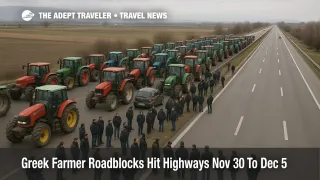
Greece farmer roadblocks highways from November 30 to December 5 are set to test the country's main north to south road corridors, particularly the Athens to Thessaloniki route and roads feeding key ports, creating real delay risks for bus passengers, self drive travelers, and cross border trips. Farmer unions say they will bring tractors onto national highways, customs posts, and port approaches in a rolling series of actions that could escalate through early December. Travelers with tight overland connections should start planning detours, longer buffers, or alternate transport such as rail and domestic flights where available.
The Greece farmer roadblocks highways plan will roll out in phases from November 30 to December 5, with tractors and farm vehicles positioned at strategic points that may temporarily sever key routes between southern and northern Greece.
How The Protests Are Being Organized
Greek media report that the latest escalation was agreed at large assemblies of farmer unions in Larissa and Nikaia, in the central region of Thessaly, where the Panhellenic Coordinating Committee of Roadblocks brought together delegations from across the country. Farmers approved a coordinated plan to begin nationwide roadblocks on November 30, then expand them steadily until December 5, using tractors and other machinery to choke key junctions and customs approaches.
Statements from organizers describe a strategy built around a unified blockade on the Athens to Thessaloniki national highway, supported by additional choke points on roads such as the E65 motorway near Karditsa and the Malgara tolls north of Thessaloniki. These are among the main corridors used by tour buses, KTEL intercity coaches, and self drive itineraries linking central and northern Greece.
One prominent farmer leader cited by Greek outlets warned that unions are prepared to "cut Greece in two" if the government does not respond with more robust guarantees on minimum farm gate prices, compensation for livestock lost to disease, and faster insurance and subsidy payments.
Why Farmers Are Mobilizing Now
The current mobilization builds on months of protests over high production costs, weak producer prices, and delays in European Union subsidy payments that followed an EU fine and an investigation into fraudulent land claims. Farmer groups say they face a funding gap of hundreds of millions of euros after audits slowed payments and after fines related to the misuse of EU agricultural funds.
Livestock breeders are joining the roadblocks to highlight the impact of a long running sheep pox crisis, which has already led to the culling of more than 400,000 animals nationwide, with Thessaly among the hardest hit regions. They argue that existing compensation and veterinary measures are inadequate and that herd losses compound already tight cash flows for rural communities.
Farmer unions also accuse the state farm insurance body of slow reimbursement for weather related losses and disease outbreaks, while pointing to a widening gap between what supermarkets charge consumers and what producers receive at the farm gate. Recent partial payments of overdue subsidies to about 82,000 producers, worth roughly €42.00 million (EUR), have been described by unions as a short term patch rather than a structural fix.
Where Travel Is Most At Risk
For travelers, the most critical axis is the Athens to Thessaloniki corridor, which carries a large share of long distance bus traffic, rental cars, and tour coaches linking Athens with Thessaloniki, Meteora, Halkidiki, and the northern borders. A unified tractor blockade near Nikaia or at the Malgara tolls could effectively split north and south traffic, forcing lengthy diversions on smaller regional roads that may not be designed for heavy coach traffic.
Additional risk points include stretches of the E65 motorway and local roads around Larissa and Karditsa, where unions are considering parallel blockades. These areas matter both for domestic road trips and for itineraries that connect Athens and central Greece with western ports such as Patras and Igoumenitsa, which handle many ferry departures toward the Ionian islands and Italy.
Organizers have also signaled that some tractors may target roads serving ports and customs offices, which could slow access to major passenger gateways along the Aegean and Adriatic coasts. That could mean delays on approach roads to large ferry hubs and regional ports used by island hoppers and cruise excursions, even if the ports themselves remain open.
While the protests are primarily focused on roads, some union leaders have mentioned possible actions at airports, which would most likely take the form of slow moving convoys on approach roads rather than disruption inside terminals. That could create pockets of heavy traffic on routes to Athens International Airport Eleftherios Venizelos (ATH) or regional airports on peak protest days, particularly for travelers relying on highway transfers from city centers.
How Fixed Are The Plans
A complicating factor for trip planning is that many of the most disruptive details will be decided at regional level, often only a day or two in advance. The nationwide assemblies have set the broad window from November 30 to December 5, and they highlight flagship locations such as Nikaia and Malgara, but local federations still have latitude to choose exact junctions, toll plazas, and village squares where tractors will gather.
Travel risk will also vary by day. Early reports suggest that the first tractors may appear at scattered points on November 30, with numbers and locations building through the week and culminating in larger simultaneous blockades on or around December 5 if talks with the government do not progress. That pattern would raise the odds of severe disruption in the second half of the protest window.
Background: How Greek Roadblocks Affect Travel
Greek farmer roadblocks are a recurring protest tactic, especially in Thessaly, where tractors line up across national highways and occupy toll plazas to force negotiations with Athens. In practice, this can reduce multilane motorways to a single controlled lane or shut them entirely for hours, depending on how police and organizers coordinate traffic management. Surrounding local roads then absorb diverted vehicles, leading to congestion far from the actual blockade.
In earlier protest waves, police often allowed limited passage for emergency vehicles, local residents, and sometimes buses, but they did not guarantee through movement for long distance traffic. That pattern is likely to repeat here, which means travelers should not count on being waved through simply because they hold a ferry ticket or a same day hotel reservation. Tour operators may need to adjust itineraries, adding extra nights or rerouting groups via alternative corridors.
Practical Guidance For Travelers
For road trips between Athens and northern destinations such as Thessaloniki or Meteora during the November 30 to December 5 window, it is safest to assume that normal drive times could double if tractors occupy main highway segments. Avoid planning back to back legs that depend on making a specific ferry or evening flight shortly after a long highway run.
Whenever possible, look at alternative modes. Rail links between Athens and Thessaloniki may provide a more predictable backbone for long distance travel during this period, even if trains are crowded or sell out earlier than usual. On some routes, a short domestic flight between Athens and a northern city might be more reliable than driving through a potential blockade zone, even after accounting for airport transfers and security time.
If you have a rental car, build flexibility into your booking so you can shift pick up or drop off locations if road closures make your original plan impractical. Keep the fuel tank comfortably above half full to allow for detours on smaller regional roads, and be prepared for slower speeds behind tractor convoys where diversions route traffic through rural areas.
For ferry passengers, plan to arrive earlier than usual at ports that depend on highway access, particularly if you are driving your own vehicle onboard. Aiming for an earlier sailing in the day, or adding an overnight near the port, can reduce the stress of navigating around potential roadblocks on departure day. If you are using a tour operated coach transfer, confirm pickup times and contingency plans as protests ramp up.
Finally, keep local information sources close at hand. Greek language news outlets, official police and civil protection social channels, and navigation apps that report road closures and slow traffic can all help you fine tune your route on the day. Travelers already familiar with Adept Traveler's coverage of recent European strike waves, including major labor actions in Italy and Belgium, will recognize the same pattern here, where proactive rebooking and extra time are better than hoping disruptions will miss your particular route.
Sources
- Farmers decide to blockade roads, ports
- Farmers Across Greece Plan Roadblocks and Port Actions Starting 30 November
- Farmers Poised to Shut Athens-Thessaloniki Route on December 5
- Roadblocks on National Highways from November 30 and closure of ports and customs offices is what the farmers decided
- Farmers Vow to 'Cut Greece in Two' with Highway Blockades Starting Nov. 30
- Nationwide farmers' protests scheduled in Greece from Monday (30 November) to Friday (5 December)
- Greek farmers say they face massive funding hole after land scandal