

Portugal General Strike To Hit Flights December 11, 2025
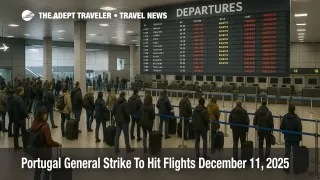
Portugal general strike flights December 11 are about to turn Portugal's main gateways into one of the highest risk travel chokepoints of the winter, especially for trips routed through Lisbon, Porto, and Faro. Unions have called a nationwide general strike for December 11, 2025 in protest at sweeping labor law reforms, and aviation, rail, and public sector unions have lined up to join the action, with cabin crew already committed and pilots considering whether to follow. For travelers, that means planning as if most flights, trains, and many public services will be unavailable on the day, then building itineraries that either avoid the date entirely or include generous buffers.
In plain language, the Portugal general strike flights December 11 alert means that Humberto Delgado Airport (LIS), Francisco Sa Carneiro Airport (OPO), and Faro Gago Coutinho International Airport (FAO) are all likely to run on skeleton operations, while trains, metros, and buses shift to minimum service patterns that leave long gaps in the timetable. Anyone who treats December 11 as a normal Thursday, particularly on multi stop itineraries that mix flights and trains across Iberia, risks finding themselves stranded in a hub or missing a cruise or tour departure.
Why This Strike Is Different
This is not a narrow workplace dispute. Portugal's two main union confederations, CGTP and UGT, have jointly called the December 11 general strike to oppose a labor code overhaul that would make dismissals easier and expand flexible scheduling, a move union leaders say undermines worker protections. It will be the first nationwide walkout of this scale since 2013, and follows mass demonstrations in Lisbon earlier in November against the reform plans.
On the transport side, Portugal's cabin crew union SNPVAC has already voted by a large majority to join the general strike, and its president has warned that it will be "very difficult" to operate flights on December 11, with most services expected to be grounded apart from legally mandated minimum operations. Portuguese media report that 2,305 out of 2,802 voting members backed participation, and that the decision covers cabin crew across TAP Air Portugal and other carriers based in the country. The civil aviation pilots union SPAC has called an extraordinary general assembly for December 5 to decide whether pilots will formally join, which could deepen disruption if they vote yes.
Beyond aviation, CGTP lists worker committees from ANA Aeroportos de Portugal, CP Comboios de Portugal, EasyJet, Portway, SPdH ground handling, Lisbon Metro, and multiple bus and logistics operators among those mobilizing for December 11, indicating that both airports and the wider transport network are inside the strike perimeter.
Airports, Flights, And Minimum Services
At Humberto Delgado Airport (LIS), Lisbon's main international gateway, travelers should prepare for a day where most departures simply do not operate. Union and advisory services alike expect the vast majority of flights to be canceled, with only a small number of minimum service rotations preserved for essential links. As in other European general strikes, these minimum services are likely to cluster in specific morning and evening bands, although the government has not yet published a definitive schedule.
Porto's Francisco Sa Carneiro Airport (OPO) and Faro Gago Coutinho International Airport (FAO) face the same basic pattern, with local reporting and strike trackers warning of widespread cancellations affecting TAP Air Portugal, Azores Airlines, and low cost carriers such as Ryanair and easyJet. Even where airlines want to operate, they may not have enough cabin crew, ground handlers, or security staff to run a normal program, and some crew will be unavailable if pilots decide to join the action after the December 5 assembly.
Adept Traveler has already mapped December 11 as a peak risk date in its earlier overview of December strikes across Europe and New Zealand, which groups Portugal's general strike with actions in France, Italy, and New Zealand. This Portugal focused update is meant to drill down on what that means specifically for flights and trains touching Lisbon, Porto, and Faro. For a deeper structural explainer on how European strikes affect flights and trains, readers can also refer to our evergreen guide to strikes, which unpacks minimum service rules, notice periods, and passenger rights across key markets.
Rail, Metros, And Airport Access
General strikes in Portugal do not just thin flight schedules, they also weaken the backup options that travelers might normally use when a flight is canceled. Worker committees and sector federations in rail, metro, and bus networks have issued their own pre notices aligning with December 11, including at CP Comboios de Portugal, Lisbon Metro, and Infraestruturas de Portugal, the infrastructure manager that underpins many passenger services.
The government says it will try to minimize the impact of the general strike on essential services such as airports, CP, and metro systems by defining minimum service bands and, if necessary, using civil requisition powers to compel some staff to work. That should keep a skeleton timetable in place on key commuter and airport access routes, but it will not restore normal frequency. Travelers should anticipate long intervals between trains, more crowded carriages on services that do run, and limited late evening options, especially between airports and city centers.
For example, if your flight is one of the few that operates into Lisbon on December 11, you may land to find that the metro is only running at restricted intervals and that suburban services to towns on the Tagus or along the main north south axis are missing several usual departures. The same logic applies at Porto and Faro, where regional trains and intercity services are likely to be thinned and some bus routes suspended.
How This Affects Iberian And Long Haul Itineraries
Lisbon, Porto, and Faro function as gateways, not just endpoints. On a typical winter Thursday, long haul flights from North America and Brazil connect through Lisbon and Porto into secondary European and domestic markets, while regional flights from Spain, France, the UK, Germany, and the islands feed in and out. When a general strike knocks out most of the short haul spokes and shrinks long haul frequencies, those carefully timed banks of flights no longer align.
If you hold a through ticket from a city such as New York, Boston, Miami, Toronto, or Sao Paulo into Europe via Lisbon, any cancellation of the intra European leg can invalidate the whole itinerary, even if the long haul sector still flies. Airlines will have to choose which parts of their network to preserve inside the minimum services framework, and many will sacrifice regional feeders to protect strategic long haul rotations or vice versa.
For Iberian trips that combine Portugal with Spain, rail and coach links are also vulnerable. Services on routes such as Lisbon to Madrid, Porto to Vigo, and regional cross border buses will be affected both by the Portuguese strike and by the knock on effect on rolling stock and crews. That makes same day plane to train or train to plane connections through Portuguese hubs an especially bad idea on December 11.
Cruise and tour itineraries that depend on smooth transfers through Lisbon or flights onward to Madeira and the Azores face similar risks. Operators may reschedule embarkation times, reposition ships, or bus guests from Spanish ports if Portuguese airports and ports cannot move people efficiently on the strike date.
What EU 261 Likely Means Here
Under Regulation EC 261, passengers whose flights are canceled or heavily delayed retain a right to care, which includes meals, refreshments, and accommodation where necessary, and a choice between rerouting and a refund when a flight does not operate. In practice, that means your airline should either get you to your destination on another date or route, or return your money if the trip no longer makes sense, and should provide food and a hotel if you are stuck overnight.
Cash compensation is a different question. Advisory services analyzing the December 11 Portugal strike already flag it as an "extraordinary circumstance" in EU 261 terms, which points toward no automatic compensation for cancellations or long delays, although individual cases can vary. Because this action is a nationwide general strike tied to government labor reform, rather than a narrow dispute between one airline and its staff, regulators are likely to treat it as outside airlines' direct control.
Passengers on flights operated by EU carriers such as TAP Air Portugal still benefit from EC 261 protections on duty of care and rerouting, and those on non EU airlines are protected on any departure from an EU airport. However, travelers should be realistic about cash compensation expectations and focus on securing alternative transport and documenting out of pocket expenses that may be reimbursable.
Practical Strategies For December 11 And Surrounding Dates
For most leisure travelers, the simplest strategy is to avoid December 11 altogether. If you are still flexible, move departures and arrivals to December 10 or December 12, and consider routing via Madrid or Barcelona rather than through Portuguese hubs, especially if your itinerary includes multiple segments or cruise connections. Airlines and travel agencies are already issuing alerts about the strike, and some carriers are likely to publish change fee waivers that allow one free date or routing change for tickets touching Portugal on December 11.
If business commitments or family events make travel on or near December 11 unavoidable, build in extra nights. For a morning meeting in Lisbon on the 12th, aim to arrive on the 10th instead of trying to thread the needle on the strike day. For journeys elsewhere in Europe that happen to connect through Lisbon, Porto, or Faro for convenience, reroute via alternative hubs, even if that means a slightly longer flight or a higher fare. The cost of rebooking now is likely to be less than scrambling for last minute seats after a cancellation.
Multi stop Iberian itineraries deserve special attention. Avoid booking separate tickets where one PNR covers a flight into Portugal and another covers a low cost leg onward to Spain on December 11 or the morning of December 12, because protection between tickets is limited. Where possible, consolidate segments on a single through ticket, or adjust the plan so that high risk movements happen on protected days with spare time built in.
Travelers already in Portugal on December 11 should treat the date as a soft stay put day. Keep movements local, book restaurant and museum visits within walking or short taxi distance, and allow generous time margins for any essential transfers. Keep airline, rail, and metro apps installed and notifications turned on, and monitor alerts from your carrier, hotel, cruise line, or tour operator.
Finally, anyone combining this trip with other strike affected countries should cross check plans against broader December actions, including the France wide strike on December 2 and Italy's general strike on December 12, both of which can complicate rerouting options.
Sources
- Portugal expected to see flight cancellations on December 11
- General strike in Portugal on 11 December, what to know
- Portugal Set for Major Flight Disruptions Due to December 11 General Strike
- Travel Alert, General strike to cause major flight disruptions on December 11, Portugal
- Cresce a adesao a Greve Geral no Sector dos Transportes e Comunicacoes
- Greve geral, Governo vai tentar minimizar efeitos em varios setores
- Tripulantes de cabine aprovam adesao a greve geral de 11 de Dezembro
- Portugal General Strike To Ground Flights December 11
- December Strikes Hit Europe, New Zealand Flights, Trains