

Portugal General Strike To Ground Most Flights December 11
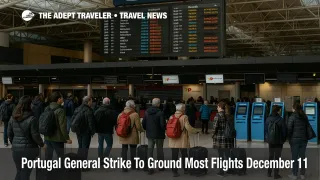
Portugal general strike flights December 11 are now shaping up as one of the most disruptive single day events of the European winter, with unions expecting most operations at Humberto Delgado Airport (LIS), Francisco de Sa Carneiro Airport (OPO), and Faro Gago Coutinho International Airport (FAO) to be grounded as part of a nationwide walkout over labor law reforms. Cabin crew union SNPVAC, which represents around five thousand staff at TAP Air Portugal and other carriers, says it will be very difficult to operate flights and expects most services at Portuguese airports to be canceled, with only legally required minimum operations in place. Travelers booked to, from, or through Portugal that day should assume schedules are fragile, build generous buffers, and consider shifting travel to dates outside the worst of the strike pattern.
At a practical level, the Portugal general strike means flights on 11 December will run only as minimum services agreed between TAP and unions, while the airline has blocked many new bookings for that date, turning a busy winter Thursday into a day when many travelers simply will not be able to fly.
What Is Planned For December 11 In Portugal
Portugal's two main union confederations, CGTP and UGT, have called the country's first joint general strike in more than a decade for 11 December, in protest at a draft labor reform that would make dismissals easier, expand outsourcing, and increase employer flexibility over working hours. The action is intended to shut or slow a broad swath of public services, including transport, schools, health care, ports, and municipal offices.
In aviation, SNPVAC's emergency assembly saw around eighty two percent of cabin crew vote to join the strike, covering staff at TAP, Azores Airlines, Ryanair, and easyJet among others. Union leaders have warned that most flights at Portuguese airports will be grounded, with only a narrow band of minimum services running to comply with legal requirements.
How TAP's Minimum Service Plan And Sales Freeze Work
TAP has confirmed that it plans to operate on 11 December strictly according to the minimum services agreed with unions and the government, rather than a normal schedule. While the detailed flight list has not been published in full, these plans usually prioritize a handful of essential domestic links, the Azores and Madeira, and limited international trunk routes from Lisbon, Porto, and Faro that are considered socially or economically critical. Everything else is at high risk of cancellation or significant retiming.
To avoid compounding the problem, TAP has blocked new ticket sales for many flights on 11 December, with Portuguese financial daily Jornal de Negócios and local media reporting that it is impossible to buy some itineraries to or from Portugal on the airline's own channels for that date. The move is designed to keep seats free for rebookings and to prevent additional travelers from being caught in what the carrier expects to be a heavily disrupted day.
Other airlines are not blocking sales as aggressively, but several have issued travel alerts advising customers to check flight status often, register for alerts, and consider moving nonessential trips. For travelers, that means a TAP ticket on 11 December is likely to be subject to tight capacity but reasonably structured rebooking, while tickets on foreign carriers may remain available but come with similar operational risk and potentially less tailored local support.
Which Airports And Routes Are Most Exposed
The heaviest impact will likely fall on flights into and out of Lisbon's Humberto Delgado Airport, where TAP concentrates much of its short haul and long haul network, including connections to Brazil, southern Africa, the Azores, and Madeira. Francisco de Sa Carneiro Airport in Porto and Faro Gago Coutinho International Airport in the Algarve are also expected to see most operations canceled, with only a skeleton service left in place.
Secondary airports are not immune. Ponta Delgada João Paulo II Airport (PDL) in the Azores and Madeira's Funchal Airport are likely to see reduced services, with some routes consolidated or moved around the strike day instead of operating on it. Travelers using Portugal as a hub for onward connections to West Africa, Brazil, or secondary European cities should plan for missed connections, last minute rerouting, or involuntary overnight stays.
Long haul flights that cannot be covered by minimum services are particularly vulnerable, since airlines may need to reposition crews and aircraft and may lack spare capacity in the days immediately before and after the strike. If your itinerary involves an overnight bank at Lisbon or Porto, it is safest to assume that the connection will not be viable on 11 December unless your airline explicitly confirms operation.
How EU261 And Airline Policies Protect Travelers
Under EU air passenger rules, airlines must provide assistance and rebooking options when flights are canceled or heavily delayed, including meal vouchers, hotel accommodation when necessary, and the choice between a refund and rerouting at the earliest opportunity. Cash compensation for cancellations under Regulation EC 261 2004 can apply when disruptions are considered within the airline's control, but large scale general strikes and wider political actions are often treated as extraordinary circumstances.
In practice, travelers should not assume an automatic payout for Portugal's general strike. Instead, the key protections to focus on are:
- The right to choose between a refund and rerouting when your flight is canceled or delayed by more than five hours, or when a missed connection makes the trip pointless.
- The right to care, which includes food and drink during long waits, two phone calls or emails, and hotel and local transport when an overnight stay becomes necessary.
- The right to be informed, meaning airlines must clearly set out your rights and explain what they are offering, at the airport and in writing.
Most major carriers will also publish strike specific flexibility policies, such as allowing free date changes to flights on 10, 11, or 12 December, or letting passengers reroute via alternative hubs without extra fare. It is usually easier to take advantage of these waivers before the wave of same day cancellations hits.
Portugal In The Wider December Strike Pattern
Portugal's 11 December action sits inside a crowded European strike calendar. France is already experiencing a general strike on 2 December, with RATP staff in the Paris region and some SNCF workers cutting frequencies on metro, RER, tram, and certain regional rail lines. In Italy, the CGIL union has called a nationwide general strike for 12 December, with particular emphasis on rail operations and public services, while separate protests have already triggered flight and train cancellations in late November.
For travelers planning multi country itineraries, that means three choke points in quick succession. Portugal's general strike will hit 11 December, Italy's action is set for the 12th, and French networks are already absorbing intermittent disruptions. Anyone planning a chain of flights such as New York to Lisbon to Rome or London to Paris to Lisbon to Madeira should treat the period from 10 to 13 December as a high risk window and, where possible, break journeys with overnight stops, longer buffers, or alternative routings.
Good internal references for deeper planning include recent coverage of France's 2 December strike impacts and the wider December Italian general strike, which break down rail, metro, and airport effects in more detail for those legs of a European trip. Evergreen guidance on how European transport strikes and minimum service rules work can also help travelers understand what governments will and will not guarantee on the day.
Practical Rerouting And Rescheduling Strategies
If you are booked on 11 December and have flexibility, the cleanest solution is simply to move your trip. Slides to 10, 12, or even 9 or 13 December are likely to face normal winter congestion but far less structural risk than the strike day itself.
Where travel cannot move, consider these tactics:
- Push at least one leg of any multi stop journey outside 11 December so that you are not dependent on minimum services in both directions.
- When connecting to island services in the Azores or Madeira, allow a full day buffer in Lisbon or Porto if your inbound leg touches 11 December.
- For itineraries that combine Portugal with Italy around 12 December, err on the side of direct flights rather than rail segments during the Italian strikes, or break the route through a hub that is not affected by industrial action.
- Assume that public transport links to airports will be thinned out, so arrange private transfers, shared shuttles, or extra time with taxis where they are still running.
If your airline has not yet canceled your flight but clearly warns of major disruption, it is often wise to accept any free change or voucher offer rather than waiting for a scramble at the airport. Keep copies of all communications and boarding passes, since they will be useful if you need to argue about refunds, care, or compensation later.
Background: Why This Strike Matters
Portugal's government argues that its labor reform package will boost productivity and help small and medium enterprises adapt staffing to fluctuating demand, in line with recommendations from the National Productivity Council. Unions counter that the changes dismantle long standing protections against unfair dismissal, expand precarious outsourcing, and weaken leave entitlement, especially for women and vulnerable workers.
The result is a rare joint strike by CGTP and UGT, meant to demonstrate that discontent runs across political and sectoral lines, not just within a single militant federation. For travelers, the political context matters less than the operational reality, which is that Portuguese airports are being deliberately targeted as high visibility pressure points. That makes 11 December a day when the safest assumption is that your plane will not leave as scheduled, and your job is to plan around that risk rather than hope for a last minute reprieve.
Sources
- Portugal expected to see flight cancellations on December 11
- TAP to guarantee minimum services during strike
- General strike in Portugal on 11 December: flight cancellations expected
- General strike to cause major flight disruptions on December 11
- Portugal set for major flight disruptions due to December 11 general strike
- Italy general strike on 12 December 2025 and key travel disruptions
- Air passenger rights, your Europe
- Humberto Delgado Airport