

Flight Delays and Airport Impacts: December 17, 2025
The Federal Aviation Administration's planning outlook for today points to a familiar winter recipe for uneven reliability, low ceilings in North Texas, low clouds on the Southern California and Northern California coasts, mountain snow showers, and thunderstorms that can force reroutes across Texas and Gulf corridors. The highest leverage hubs in that mix are Dallas Fort Worth International Airport (DFW), San Diego International Airport (SAN), and San Francisco International Airport (SFO), because even small arrival rate cuts there can ripple into missed connections later in the day.
Dallas Love Field Airport (DAL) sits in the same low ceiling risk bucket as Dallas Fort Worth, which matters because airlines often rely on short, frequent rotations in and out of both airports. In the mountain West, Jackson Hole Airport (JAC) and Friedman Memorial Airport (SUN) are flagged for snow showers, while Denver International Airport (DEN) shows a wind driven capacity risk. In Texas, Austin Bergstrom International Airport (AUS) and San Antonio International Airport (SAT) are in the thunderstorm planning area, and the FAA also highlights George Bush Intercontinental Airport (IAH) and William P. Hobby Airport (HOU) for storm impacts that can slow the Houston flow and constrain Gulf routings.
The operations planning view adds a second layer, where the FAA is explicitly signaling that traffic management initiatives could be needed during peak local windows at Boston Logan International Airport (BOS), Newark Liberty International Airport (EWR), and Teterboro Airport (TEB), alongside the coastal California airports and the mountain airports. Separate from weather, runway construction and airfield constraints at LaGuardia Airport (LGA), Chicago Midway International Airport (MDW), Palm Beach International Airport (PBI), San Diego, and Charlotte Douglas International Airport (CLT) can make recovery harder because they reduce flexibility when banks get compressed.
Who Is Affected
Travelers are most exposed if their itinerary depends on a tight connection through the hubs the FAA is actively watching, especially Dallas Fort Worth, San Diego, San Francisco, Boston, Newark, and Denver. The practical risk is not just a single delay, it is the network effect, where one late inbound aircraft triggers a cascade of late departures, then crews time out, and later flights cancel to reset tomorrow's schedule.
Long haul passengers can feel this even when their flight is not at the original weather airport. West Coast low clouds that slow San Francisco and San Diego during the late morning and afternoon can push transcontinental arrivals late into the Northeast evening bank, which raises misconnect risk for Europe departures and for last flights to smaller cities. Dallas constraints can propagate across multiple domestic spokes because so many aircraft and crews cycle through North Texas during a single duty day.
Travelers with same day cruise positioning, rail connections, tours, or fixed check in times should treat the flagged hubs as higher risk nodes today. Even modest flow constraints often translate into late arrivals that collide with hotel front desk cutoffs, rental car counter hours, and prepaid ground transfers. If you are still recovering from earlier week Northeast disruption, it is also worth scanning whether your airline is running thin on spare aircraft and crews, because that can turn a manageable delay day into a reaccommodation bottleneck when something slips.
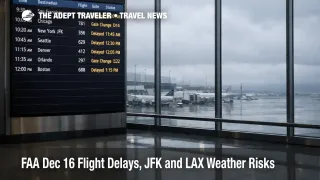
For context on how FAA flow programs and hub congestion showed up in real itineraries earlier this week, see FAA Dec 16 Flight Delays, JFK and LAX Weather Risks and Northeast Storm Flight Delays Linger December 15, 2025.
What Travelers Should Do
Start by stress testing your itinerary against today's risk hubs. If your trip routes through Dallas Fort Worth, San Diego, San Francisco, Boston, Newark, or Denver, prioritize earlier departures, pad connections, and avoid separate ticket self transfers. If you have flexibility, moving a late afternoon departure earlier often reduces exposure because airlines can still swap aircraft and crews before the day's delays compound.
Use a simple decision threshold for rebooking versus waiting. If your plan depends on a connection under 90 minutes at a flagged hub, or you must arrive by a fixed event and your flight is later in the day, it is usually smarter to rebook once you see the first sustained delays at that airport. The reason is inventory, once a flow program or storm reroute wave is active, same day alternatives disappear quickly, and you can lose the best nonstop options while you are still hoping the original flight recovers.
Over the next 24 to 72 hours, monitor three things that tend to predict whether disruption stays localized or spreads. First, watch whether low clouds at San Diego and San Francisco persist into the later banks, because that is when the national ripple grows. Second, watch Texas and Gulf thunderstorm routing, since reroutes can stack delays far from the storms themselves. Third, keep an eye on runway construction constrained airports, because when demand is high, those constraints can turn a small delay into a gate and taxi congestion problem.
How It Works
Most days like today do not fail because one airport is closed. They fail because capacity dips at the exact moment the schedule is densest, and the FAA has to meter demand to keep arrivals and departures safe and orderly. Low ceilings and low clouds reduce the arrival rate because controllers need more spacing between aircraft, which can trigger a ground delay program that holds departures at origin airports rather than letting planes circle in holding patterns near the destination.
Once a hub's arrival stream slows, the downstream effects show up in layers. The first order impact is at the source airport, departure queues grow, gates stay occupied longer, and inbound aircraft arrive late. The second order ripple hits connections and crew flow, because the same aircraft and crews are scheduled across multiple legs, and one late leg can break the rest of the day's rotation. A third layer hits hotels, transfers, rail links, and tours, because late arrivals compress check in windows and make fixed time ground movements, like pre booked shuttles, more fragile.
Runway construction and airfield constraints magnify this because they reduce the airport's ability to flex, even when the weather is only moderately bad. When capacity is already constrained by construction, the system has less slack to absorb a weather driven arrival rate cut, and recovery tends to take longer.