

Barcelona FGC Strike Called Off for MWC Week
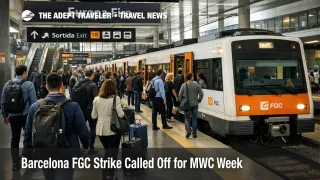
Barcelona FGC strike called off is a real operational change for Mobile World Congress week, because it removes the biggest "last mile" threat that would have pushed thousands of arrivals onto taxis and already saturated roads. The drivers union SEMAF has withdrawn the planned March 2, 3, and 4, 2026 action at Ferrocarrils de la Generalitat de Catalunya (FGC), and FGC says service will run normally on the Barcelona Vallès line, with reinforced service on the Llobregat Anoia line to handle MWC demand. MWC Barcelona runs March 2 to March 5, 2026, at Fira Gran Via, Barcelona, Spain, so this reversal lands just before peak arrivals and the first conference mornings.
This is new versus the prior planning posture because it flips the week from contingency mode back to normal scheduling assumptions. That changes what travelers should optimize for, not minimum service decrees and cascading gaps, but predictable peak crowding, station circulation time, and road congestion at the venue corridor.
Barcelona FGC Strike Called Off, What Changed for Travelers
For March 2 to March 4, the core change is simple, you can treat FGC as a usable backbone again for venue access instead of an unreliable variable. FGC's own notice frames it as normal service on Barcelona Vallès, and reinforced service on Llobregat Anoia, which is the corridor many visitors use to reach Europa Fira station for Fira Gran Via access.
Practically, that reduces the risk of the classic MWC failure chain, a disrupted rail plan forces taxis, taxis become scarce and expensive, pickup times drift, road congestion thickens, and a short transfer becomes a missed keynote, a missed exhibitor setup slot, or a lost meeting block. With the strike off, travelers should expect crowding, but not a mode collapse.
Who Benefits Most From Normal FGC Service During MWC
Conference travelers staying outside the immediate venue area benefit the most, especially anyone commuting in at fixed start times. When transit is stable, you can build repeatable morning and evening patterns, which is how busy event weeks stay intact.
Early morning airport runs are the other high value segment. Even though this was an FGC action rather than an airport shutdown story, ground access fragility is what makes people miss flights on event weeks. With the strike called off, fewer travelers are forced into the same taxi and rideshare funnel at the same time, which usually means fewer extreme waits and fewer price spikes.
Travelers who were about to pre book expensive transfers "just in case" also get their optionality back. You can keep a backup plan without paying for it by default, which is the right posture for a city hosting a massive conference, where normal congestion still punishes tight margins.
How To Plan Transfers Now That the Strike Is Off
Plan around normal peak conditions, not industrial action. That means building buffer for station entry, platforms, escalators, and venue corridor congestion, especially in the first two mornings of the show. If your schedule has a hard start, treat arriving at the venue area early as the cost of reliability, not as wasted time.
Use a simple decision threshold for airport departures. If missing the flight would be expensive, or if you are checking bags on a tight timeline, keep a backup mode ready, but do not default to it unless conditions force it. A pre booked taxi or hotel arranged car can still be rational for very early departures, heavy luggage, or groups, because the failure mode in those cases is not rail service, it is time lost to complexity.
If you want a template for how "last mile" problems behave during European transit disruptions and event load, see how Berlin travelers were advised to rebuild plans around rail spines and reduce interchanges during a live city shutdown in Berlin BVG Strike Halts Transit Feb 27 to Mar 1. For the broader pattern of how a nationwide transit action breaks airport and station access even when flights run, see Germany Transit Strike Starts Feb 27, Buses, Trams Halt.
Why This Reversal Still Matters Operationally
A called off strike does more than restore trains, it relaxes the substitution pressure that breaks trips. First order, travelers stop pivoting into taxis and private cars purely out of fear, and they stop padding schedules with expensive, fragile road moves. Second order, that reduces overload on alternate commuter systems and reduces the likelihood of road gridlock spikes at exactly the wrong times, like morning arrivals to the venue area and evening dispersal back to hotels.
FGC also signals a service posture aligned to the event rather than to minimum service constraints, with normal operations on Barcelona Vallès and reinforcement on Llobregat Anoia to absorb the MWC volume. That is the difference between a system that can flex under load, and a system that is already capped by labor action rules.
The remaining risk is not an FGC strike, it is normal event week friction, crowding at predictable hours, slower movement through stations, and road congestion near Fira Gran Via. Travelers who treat this as "problem solved" and cut buffers to the bone can still get burned, but the week is no longer defined by a major, known mobility constraint.