

Barcelona FGC Rail Strike Disrupts Trains Feb 24-25
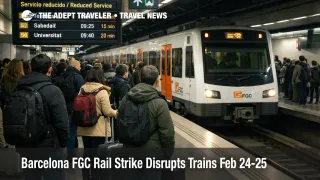
A five day train drivers strike is set to disrupt Ferrocarrils de la Generalitat de Catalunya (FGC) services in and around Barcelona, Spain, on February 24 and February 25, 2026, with additional strike days on March 2, March 3, and March 4. Travelers are most affected if they rely on FGC for commuter style moves between central Barcelona and suburbs, or for day trips that start with an FGC platform. The practical move now is to plan each strike day like a reduced capacity system, confirm the minimum service plan for your line, and keep a road based backup for any timed deadline.
The Barcelona FGC rail strike will run under minimum service levels set by Catalonia's labor authority, which means some trains will run, but frequency and reliability will be meaningfully worse than a normal weekday.
Who Is Affected
Visitors staying outside the city center who use FGC as their primary way to reach central Barcelona are the highest exposure group. When frequency drops, the failure mode is not a simple delay, it is a missed window, one canceled train can turn into a 30 to 60 minute slip once you add platform waits, crowding, and longer boarding times. This matters most for hotel changes, timed entry attractions, and meet up based tours where the organizer will not wait.
Day trip travelers are the second high risk group, because many popular itineraries begin on FGC corridors and require predictable departure timing to work. Even when minimum services exist, they are usually distributed to satisfy a system percentage, not to preserve your preferred departure minute. That creates uneven gaps that can be hard to see until you are standing on the platform watching headways stretch.
Business travelers and conference attendees face a sharper version of the same problem on March 2, March 3, and March 4, when Mobile World Congress timing overlaps the strike window and minimum services are set higher in peak periods to protect baseline mobility. A higher percentage does not mean smooth operations, it means more trains than the earlier strike days, and the rest of the system, taxis, rideshares, and roads, will still absorb spillover demand.
What Travelers Should Do
If you have a hard deadline, a flight departure, a cruise check in, or a timed ticket you cannot miss, build a plan that survives one failed FGC departure. Leave earlier than you normally would, and decide in advance what you will do if the first train is canceled or too crowded to board, for example switching to metro, a pre booked taxi, or a car service from your hotel rather than improvising at the last minute.
Use a clear decision threshold for rebooking versus waiting. If missing your arrival window would trigger a cascading loss, such as a missed flight on separate tickets, a cruise day excursion meeting time, or a timed attraction you cannot move, shift the rail dependent segment to a different time of day, or move it to a non strike day if you can. If the consequence is only a later arrival and you have slack plus multiple alternatives, it can be rational to monitor FGC updates and attempt the trip, but only with extra buffer.
Over the next 24 to 72 hours, monitor the signals that change outcomes. Watch FGC's official strike notices for each day's operating plan, and watch for any updates to minimum service instructions and peak windows. Also track secondary indicators, rising taxi demand near major stations, heavier road congestion around central Barcelona, and longer queues at customer service points, because those are the practical signs that the reduced rail plan is pushing travelers into the same small set of alternatives.
How It Works
FGC has confirmed that the strike action called by SEMAF covers February 24, February 25, and March 2, March 3, and March 4, and that trains will operate according to service levels established by the Departament d'Empresa i Treball. In practice, minimum services are a floor for essential mobility, not a guarantee that your specific train will run, or that headways will stay consistent all day.
Reporting in Catalonia indicates minimum service levels of 50% during peak hours on February 24 and February 25, rising to 66% during peak hours on March 2 to March 4, with peak windows described as 600 a.m. to 900 a.m. and 400 p.m. to 600 p.m. local time. Outside those windows, the same reporting describes a thinner pattern, roughly one in four trains on the February days, and one in three trains during the March days.
The first order effect is straightforward capacity loss. Fewer staffed departures means longer gaps, heavier loads on the trains that do run, and slower station flow because platforms and carriages fill at once instead of distributing demand across frequent headways. The second order ripple is where travelers get surprised, demand shifts onto metro lines, taxis, rideshares, and road corridors at the same time, which makes curbside travel time less predictable and increases the chance of missed timed entries and tour meetups.
This is also why airport and cruise planning can get hit even when neither the airport nor the port is the root cause. If your plan uses rail for the first or last mile into a fixed deadline, reduced frequency creates a misconnect risk that then forces a more expensive and less available road substitute. For broader context on how Barcelona area rail volatility can behave around strike windows, see Barcelona Rodalies Rail Disruption Before Feb 11 Strike and Spain Rail Strike Feb 9 to 11 Hits Trains Nationwide.
Sources
- Avís, Anunci de vaga els dies 24 i 25 de febrer i els dies 2, 3 i 4 de març de 2026 (FGC)
- Informació de vagues amb serveis mínims (e-Tauler) (Generalitat de Catalunya, Treball)
- El sindicat SEMAF porta les vagues de maquinistes als Ferrocarrils (Nació Digital)
- Serveis mínims del 50% per la vaga d'FGC aquest dimarts i del 66% durant el Mobile World Congress (ElNacional.cat)
- Semaf calls five-day strike in FGC for safety reasons (Trenvista)