

Paris Tractor Protest Blocks Roads, Airport Transfers
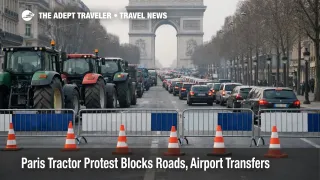
Farmers drove tractors into central Paris and blocked key roads around major landmarks and at least one highway approach, triggering severe congestion and police controls across the city. Visitors relying on taxis, rideshares, private drivers, and road based shuttles are the most exposed, especially for runs to Paris Charles de Gaulle Airport (CDG), Paris Orly Airport (ORY), and rail terminals such as Gare du Nord. Assume road times are unreliable, shift to rail based airport access where you can, and build decision time so you can reroute before your departure window collapses.
The core change is that Paris tractor protest road access has become a city scale mobility disruption, not a single march you can drive around. Reuters reported tractors moving along the Champs Élysées and blocking the road around the Arc de Triomphe before gathering near the National Assembly, with authorities trying to contain access through checkpoints and controls. Associated Press reporting added that convoys bypassed restrictions and that tractors were positioned in the city center, including at the Arc de Triomphe area and near the Eiffel Tower, which widens the risk footprint across both banks and multiple ring road feeders.
Who Is Affected
Travelers with same day departures are the first group at risk, because a normal thirty to sixty minute cross city drive can turn into a multi hour crawl once a corridor is blocked and adjacent streets backfill. That includes anyone staying west or central and trying to reach CDG by road, and anyone transiting between neighborhoods, rail stations, and airports with a tight schedule. If you are connecting from a long haul arrival to a separate ticket rail departure, the risk is compounded because neither operator will treat the other leg as protected.
Rail travelers are also exposed because the disruption is not only about road travel, it is about access to the stations and the metro nodes that feed them. Le Parisien reported that access to the Charles de Gaulle Etoile station was closed by order, with Metro and RER trains passing without stopping, which matters because that hub sits on the western axis many visitors use to reposition between hotels, landmarks, and onward connections. Even when Eurostar and TGV trains are operating normally, arriving late to the concourse can be enough to miss a departure, especially when you must clear ticket gates, security screening, or platform controls at peak times. For context on how quickly rail recovery options can vanish when disruption hits the Paris corridor, see Eurostar Snow Cancellations London Paris Jan 7.
Airport travelers have a second layer of exposure this week because Paris has already been operating in a fragile winter pattern. If road access delays cause you to miss check in, you can end up pushed onto later flights that may already be tight due to earlier cancellations and aircraft rotation disruption. If your itinerary involves a connection via other hubs that are also strained, a single missed Paris departure can cascade into an overnight. The broader network context is covered in Storm Goretti Cuts Schiphol Flights, Paris Caps Departures.
What Travelers Should Do
If you have a flight or an international rail departure on Thursday, January 8, 2026, treat road travel as a last resort and add real buffer. For CDG, prioritize the RER B, and build extra time for station access, crowding, and slower onward movement once you arrive at the airport campus. For ORY, prioritize Metro line 14 or an RER B plus OrlyVal plan, because the Orlybus direct service has been out of service since March 3, 2025, and road coaches are more likely to be trapped by diversions.
Use a simple rebooking threshold tied to how you will physically reach the terminal or platform. If your plan requires a taxi or car transfer across the western or central city, and you are inside a four hour window to wheels up or train departure, switching to rail based access, or shifting to a later departure, is usually safer than gambling on road recovery. If you are already in the airport or at a station, avoid leaving the controlled area unless you have confirmed a new departure time, because returning through checkpoints can take longer than expected and taxis may be scarce.
Over the next twenty four to seventy two hours, monitor police traffic controls, RATP service alerts, and your operator status, then recheck right before you move. Watch for station access closures around major hubs, and for rolling tractor repositioning that can reopen one corridor while locking another. If you must be in Paris for timed entries, tours, or meetings, build a local buffer too, because the same gridlock that breaks airport runs also breaks cross city repositioning.
How It Works
A tractor convoy protest disrupts a city differently than a single route march because it can create hard blocks at chokepoints, then trigger spillover congestion that overwhelms parallel streets. When tractors occupy a landmark circle or a bridge approach, the immediate effect is that police close ramps, meter traffic, or redirect flows, which quickly saturates the next available arteries. The second order effect is that taxis and rideshares cannot circulate efficiently, so availability drops and prices rise, which pushes more travelers toward the same metro nodes, station entrances, and limited shuttle options.
The travel system ripple shows up in at least two layers beyond the first road closure. First, rail terminals take the hit through missed departures, because late arrivals to Gare du Nord or other stations are not recoverable once the last same day departure sells out. Second, airports take the hit through missed check in windows and broken connections, because a delayed road transfer does not just miss one flight, it can also break the aircraft rotation plan that feeds later departures. The tertiary layer is hotels, because once missed connections accumulate, rooms near CDG, ORY, and major stations compress quickly, and that forces travelers into longer, more expensive recovery moves. Visitors trying to improvise should lean on the basics in Paris Travel Guide: The Ultimate 7-10 Day First-Timer's Itinerary, but should assume that normal "getting around" advice is overridden by enforcement zones during a disruption like this.
Sources
- French farmers block Paris streets in protest against Mercosur trade deal | Reuters
- Farmers drive tractors through Paris and block highways in Greece to protest free trade deal | AP News
- EN DIRECT, colère des agriculteurs : les dernières informations - Le Monde
- DIRECT. Colère des agriculteurs : après sa rencontre avec Yaël Braun-Pivet, la FNSEA réclame "des annonces rapides" - Le Parisien
- Shuttles, Buses, and RER from Ile-de-France to Charles de Gaulle Airport - Paris Aéroport
- To/From Paris-Orly by public transport
- Info trafic bulletin général | RATP