

France Farmer Protests Block Motorways, Port Access
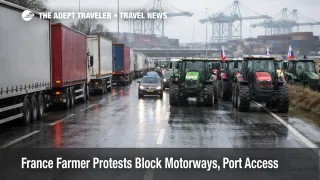
France farmer protest roadblocks returned on key motorways and at Port of Le Havre in early January 2026, creating localized but high impact disruptions for drivers and transfer routes. Travelers most exposed are those on self drive itineraries, airport transfers, and port linked connections where a single blocked junction can erase schedule cushion. The practical move is to add buffer time, avoid known choke points during peak action windows, and keep a re route plan ready before you get on the road.
The renewed actions have leaned on two tactics that matter for travel planning. First, roadblocks and slow rolling convoys on high volume corridors, including the A1 north of Paris, can create long queues and force detours that are not obvious until you are already committed to a direction. Second, filtering inspections at logistics nodes, including reported checks of trucks carrying imported goods at Le Havre, can slow access roads around port gates even when the action stops short of a full closure. That combination tends to produce sharp, time bound disruption that can reappear with little notice when groups relocate to a different interchange or toll area.
This ground transport story is separate from the airside capacity pressure already tracked in France ATC Delays Raise CDG, Orly Connection Risk. The risk here is getting to the airport reliably, not only what happens once you are inside the aviation system.
Who Is Affected
Independent travelers driving between Paris, Normandy, and Hauts de France are the most exposed, particularly when routes depend on the A1, A13, A16, and their feeder roads. The same applies to travelers using hired cars, private transfers, or taxis for cross town and airport runs because pricing may surge and drivers may refuse certain approaches when traffic is gridlocked.
Paris departures become more fragile when approach roads seize up. On first mention, that includes Paris Charles de Gaulle Airport (CDG) and Paris Orly Airport (ORY), where a late arrival can turn into a missed check in cut off, a missed bag drop window, or a misconnect on separate tickets. If your itinerary relies on a morning bank departure, or on the last flight of the day, you have less recovery room when highways clog.
Port adjacent travelers are also in the blast radius, even if they are not moving cargo. Le Havre is both a major freight gateway and a passenger facing embarkation and excursion node for some itineraries, so congestion near port access points can delay shuttles, private drivers, and day trips that start or end near the waterfront. When port actions expand to other sites, such as fuel terminals and grain handling facilities reported in this protest cycle, the knock on effect can include localized service strain and longer waits for road services in affected regions.
Finally, travelers who pivot away from roads can be caught by the second order ripple. When enough people abandon a drive, rail and coach demand compresses into fewer seats, and last minute inventory can tighten quickly. If you are already traveling in a period where labor actions are stacking across Europe, the combined effect can reduce your same day backup options, which is why it helps to keep the wider calendar in view via Europe Transport Strike Dates 2026 for Flights and Trains.
What Travelers Should Do
Start with buffers that actually change outcomes. If you are driving to an airport, a port, or a timed reservation, treat the trip like winter weather, leave earlier than normal, and build a margin that can absorb an unexpected motorway shutdown. For Paris stays, use Paris Travel Guide: The Ultimate 7-10 Day First-Timer's Itinerary to sanity check transfer assumptions across neighborhoods and gateways, then add extra time on any day you must cross the city or reach the ring road.
Use a decision threshold for rebooking versus waiting. If your plan depends on the last practical flight, a non refundable tour start, or a same day connection, do not gamble on a protest clearing "soon." Your trigger can be simple, if your live traffic view shows growing queues on your intended corridor, or if a prefecture or motorway operator signals an active disruption, switch to a safer departure time, reroute, or move the high stakes segment to the next day while inventory still exists.
Over the next 24 to 72 hours, monitor three channels in parallel. Watch local prefecture notices in the departments you will cross, watch motorway operator traffic tools on the corridors you plan to use, and watch credible national reporting for where the next actions are concentrating, especially around ports and high volume toll points. Do not rely on a single social post, because protest locations can shift quickly, and the most important signal for travelers is whether your specific approach road is being filtered or blocked right now.
How It Works
Farmer protest road disruption propagates through the travel system in two waves. The first order effect is direct road capacity loss where tractors, straw bales, or filtering checkpoints reduce lane throughput at a single interchange, toll plaza, or port gate. Even when emergency vehicles are allowed through, normal traffic flow can collapse because merging behavior changes, detours overload secondary roads, and navigation apps reroute too many drivers onto the same alternates.
The second order ripple shows up when logistics and traveler behavior collide. If a port access road slows, truck queues can spill back onto arterials, which makes local mobility worse for everyone, including shuttles and private drivers. When motorways seize, travelers and commuters shift modes, pushing demand onto intercity trains, regional rail, and coaches, which can sell out or run crowded at short notice. Airports feel this indirectly, not because runways are closed, but because passengers arrive late, staff commutes become less reliable, and missed connections increase rebooking pressure at the exact time winter schedules already run with tighter slack.
For planning purposes, treat these actions as short fuse events with a predictable targeting logic. Protest groups tend to choose places where a small number of vehicles can slow a large amount of movement, including the busiest motorways, key toll points, and strategic logistics nodes such as ports and fuel terminals. That is why the same geography can be quiet for hours, then abruptly become a multi hour delay, and why a conservative transfer strategy is a reliability hedge, not just extra caution.
Sources
- French farmers target food imports as Mercosur protests continue
- French farmers block roads and ports as EU prepares to sign Mercosur deal
- Protesting French farmers bring tractors to Paris
- Manifestation des agriculteurs en cours sur l'A16
- Bison Futé : Prévisions nationales de circulation du vendredi 2 janvier au dimanche 4 janvier 2026
- Information trafic des autoroutes en temps réel