

Le Havre Port Farmer Checks Slow A1 and A13 Traffic
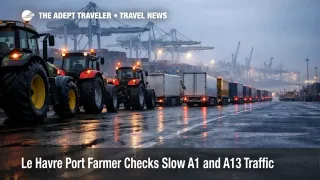
Farmers in northern France widened their tactics from headline city protests to freight choke points, using tractors and "filtering" inspections to slow lorries moving through the Port of Le Havre on January 12, 2026. The travelers most exposed are drivers, tour groups, and anyone with a timed transfer who relies on motorway reliability between Normandy, Lille, and the Paris region. Plan to add buffer time, favor rail where it fits, and build a same day backup for airport access and onward connections if queues build.
The shift matters because Le Havre port farmer checks turn a political protest into a logistics bottleneck, which can ripple into ordinary traveler trips long before a road is fully blocked.
Who Is Affected
Travelers driving between Normandy and Paris are the first group at risk because even a short "filtering" action can become a long queue when traffic volumes stack. The A13 corridor is a core route for Normandy road trips, day tours, and airport drives that begin west of Paris, and it has already been targeted in the wider protest wave.
Travelers approaching Paris from the north, including those coming from Lille, Belgium, or the Channel corridor by car or coach, are also exposed. A filtering action around an A1 toll plaza can function like a metering point, and that is exactly the kind of delay that breaks fixed check in times for flights, tours, and hotel arrivals.
Travel advisors and tour operators should treat this as an operations problem, not just a headline. When tractors slow a port gate and a motorway toll point in the same 24 hour window, vehicles and drivers end up out of position. That shows up as missed pickup windows, late coach swaps, delayed luggage transfers, and itinerary day compression that forces unplanned hotel nights.
What Travelers Should Do
If you have a same day airport departure or a timed activity, treat any drive that touches the A1, the A13, or Le Havre port access as high variance. Leave earlier than normal, keep a parallel rail option ready, and carry proof of reservations and airline or tour contacts so you can re sequence plans quickly if a queue forms.
If conditions worsen, switch sooner rather than later. If your live navigation shows stop and go speeds sustained for 30 minutes or more, or a queue that is not shrinking, assume the delay will compound and move to a rail plan, an alternate departure time, or a protected overnight. For tours, the decision point is whether losing two hours breaks your first fixed booking, if it does, rebook the day rather than trying to "make up time" on motorways.
Over the next 24 to 72 hours, monitor three things in parallel: official road traffic updates for the corridor you will use, union statements signaling new targets, and port or prefecture notices that indicate a shift from filtering to forced clearance. Also watch for signs of fuel distribution stress in your region, because prolonged depot actions can turn a routing issue into a refueling and availability issue.
Background
The current actions are part of a broader French farmer protest campaign tied to multiple grievances, with a major focus on the EU Mercosur trade deal and claims of unfair competition from imported products. After EU member states authorized the signature of the EU Mercosur agreement on January 9, 2026, French unions signaled continued pressure aimed at influencing the European Parliament stage that still must follow.
What makes the northern France escalation more disruptive for travelers is the choice of assets. A "filtering" blockade at a container port slows the release of trucks into the regional road network, which then backs up on approach roads and motorway feeders. When a second action hits an A1 toll point, it creates a separate metering effect on a route that carries heavy daily volumes, which can push traffic onto secondary roads that are not designed for diversion surges. Those first order road impacts become second order travel disruptions when airport transfers, intercity bus timetables, and touring schedules rely on motorway predictability, and when mis timed arrivals force late hotel check ins or extra nights.
The French government has also moved on import control measures in parallel with the protest climate. An order dated January 5, 2026, and published in the official journal on January 7, 2026, provides for suspending the import, introduction, and placing on the market of certain foods from non EU countries when they contain quantifiable residues of specified prohibited active substances. While that policy is not a real time traffic tool, it helps explain why "import checks" have become a visible protest tactic at ports and freight corridors.
Sources
- French farmers target food imports as Mercosur protests continue (Reuters)
- Macron says France will vote against Mercosur after farmers protest in Paris (Reuters)
- Colère des agriculteurs : plusieurs ports visés, un barrage filtrant sur l'A1 (TF1 Info)
- Le port du Havre bloqué par des agriculteurs qui filtrent les " produits qui entrent et sortent " (HuffPost)
- EU Mercosur: Council greenlights signature of the comprehensive partnership and trade agreement (Consilium)
- Arrêté du 5 janvier 2026 portant suspension d'importation, d'introduction et de mise sur le marché... (Légifrance)