

Bilbao Airport Cleaning Strike Hits Terminals Jan 14-15
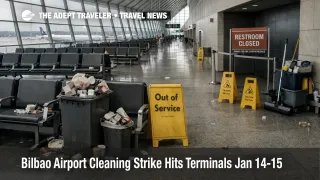
A scheduled cleaning strike in Bizkaia, Spain, is affecting cleaning services at Bilbao Airport (BIO) across January 14 and January 15, 2026, with work stoppages covering the full working day. Travelers are most likely to notice the impact as uneven terminal cleanliness, slower trash removal, and restrooms that cycle between acceptable and strained conditions during peak waves. For passengers, the practical move is to build more buffer into airport arrival times, plan for longer dwell periods in crowded areas, and carry basic hygiene supplies in case facilities are temporarily overloaded.
The Spanish Ministry of Transport has set minimum service requirements aimed at keeping critical hygiene and safety areas functioning. The resolution specifies 50% minimum staffing for terminal restrooms, for cleaning and asepsis in technical and operational areas tied to airport operations and air traffic control facilities, and for airside exterior cleaning around the terminal. It also sets 25% minimum staffing for the remaining interior public areas and for landside exterior areas including access zones, with at least one person per shift as a floor.
Who Is Affected
This disruption mostly changes the passenger experience rather than the published flight schedule, but it can still create real knock on effects for travelers on tight timelines. Departing passengers who arrive close to check in or security cutoffs are more exposed because any added friction, such as longer restroom lines, denser gate area crowding, or slower spill cleanup, reduces the margin to absorb a delay. Arriving passengers can feel the effect most during long baggage claim waits, when restrooms and seating areas get stressed at the same time.
Airline operations can also feel indirect pressure. The same Ministry resolution treats aircraft cleaning and related turn services as essential for protected categories of flights, and it applies route based protection percentages that are higher for certain domestic links and defined services. For January 2026 conditions in the document, Bilbao's protected service levels are shown as 77% for domestic routes to or from non peninsular territories, and 53% for routes where the public transport alternative is at least five hours, or for international routes. That helps keep a baseline of turn capability, but it does not guarantee on time performance for every rotation, especially when the day is already strained by winter weather, air traffic flow restrictions, or late inbound aircraft.
The labor context is broader than the airport itself. Local reporting describes the strike days as part of a sector wide dispute in Bizkaia's building and premises cleaning industry, called by unions ELA and LAB, following an earlier strike on December 17. That matters to travelers because the same labor action can touch multiple public facing facilities in the region, increasing the chance that crowding and service gaps compound when people are already stressed and moving between venues.
What Travelers Should Do
For departures on January 15, 2026, travelers should plan for a longer pre security timeline than usual, even if the flight itself is not delayed. The strike is not a screening shutdown, but degraded terminal flow, crowded waiting areas, and uneven restroom availability can slow routines that people normally do quickly, including last minute repacking, meals, and gate moves. A small kit, wipes, sanitizer, a refillable water bottle, and spare snacks, reduces dependency on facilities that may be stretched.
If conditions start stacking, travelers need a clear decision threshold. When the first flight of the day is already late, or when a short turn inbound pushes boarding close to departure, it is usually smarter to protect the itinerary by moving to a later same day flight or a next morning option rather than gambling on a tight connection. For separate tickets, the safest play is to treat the airport as a slow moving environment and increase the connection buffer materially, because a small delay can become a missed onward segment when gate areas are crowded and rebooking lines form.
Over the next 24 to 72 hours, travelers should monitor three things: whether the strike extends beyond January 15, 2026, whether any weather or air traffic constraints are layered onto the same window, and whether airlines begin padding schedules or consolidating turns to protect the operation. Even when minimum services keep critical areas functioning, backlogs can accumulate across a day and spill into the next morning, so early flights the day after a disruption can still inherit late aircraft and crews.
Background
Airport cleaning is not cosmetic in operational terms, it is part of the system that keeps passenger processing and aircraft turns moving. When cleaning coverage drops, the first order effect is predictable: restrooms and high traffic areas need more time to recover between peaks, and small issues, spills, overflow bins, and blocked fixtures, linger longer. The second order effect is about flow, not cleanliness: crowded gate areas raise dwell times, dwell times push people to move in tighter waves, and that can amplify friction at boarding doors and concessions. On the airside, aircraft cabin servicing is one of the dependencies for on time departures, and when the workforce is tight, short turns become less resilient, which can cascade into later departures, missed connections, and unexpected overnight stays.